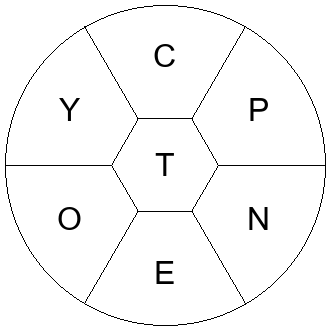
Monday, May 19, 2025

Answers to yesterday's Bee

Jump to answers for


The official answers for today's puzzle are:

Click on the arrow to show the definition.
Click outside the pop-up to close it.


Number of Pangrams: 1

Maximum Puzzle Score: 204

Number of Answers: 47

Points Needed for Genius: 143

Genius requires between 22 and 40 words. You need at least a 7-letter word to reach genius. If you don't get the pangram, you need 75% of the total points to reach genius. If you get the pangram, you only need 68% of the remaining points to reach genius.

Other days with this pangram:

The button below will reveal a chart with the number of words by each letter. Red bars indicate that there is a pangram(s) starting with that letter.


How does this puzzle compare to other puzzles?

Today's score of 204 was in the 67th percentile of all puzzles.
The last time there was a score this high was on May 18, 2025.
The highest score ever was 537 on January 22, 2021.
The lowest score ever was 47 on March 27, 2023.

This puzzle's 47 possible answers rank it in the 70th percentile of all puzzles.
The last time there were more answers than this was on May 18, 2025.
The highest number of answers was 81 on June 8, 2019.
The lowest number of answers was 16 on March 27, 2023.

It takes a 7-letter word for genius.
The last time this happened was on May 17, 2025.

Today's puzzle has an average word length of 5.3.
For all Bees, the average word length has been 5.3.


Haven't I seen these letters before?

Hover over a letter to see its first and most recent appearance in the Bee!


Haven't I seen these words before?

The most common words in the Bee are:

  • noon 199
  • loll 194
  • toot 187
  • naan 171
  • nana 171
  • lilt 139
  • till 139
  • tilt 139
  • tint 136
  • nene 131
  • mama 130
  • mamma 130
  • acacia 123
  • acai 123
  • onto 123
  • toon 123
  • onion 119
  • anal 116
  • olio 114
  • anon 112
  • boob 112
  • booboo 112
  • baba 108
  • tact 108
  • dodo 107
  • papa 107
  • poop 106
  • lull 105
  • lulu 105
  • call 104
  • calla 104
  • ratatat 104
  • tart 104
  • tartar 104
  • attar 103
  • mitt 103
  • mono 103
  • moon 103
  • tatty 102
  • tattoo 101
  • allay 100
  • ally 100
  • ammo 100
  • momma 100
  • tutu 100
  • cocci 99
  • epee 99
  • peep 99
  • loon 97
  • loot 95


How long are words in the Bee?

There have been 101,392 answers ever accepted in the Bee - with 10,589 unique words.
Below are the distributions of the lengths of these words.


Valid dictionary words not in today's official answers

You may be wondering why these words aren't here*:

  • cenote
  • cento
  • cete
  • cocotte
  • coenocyte
  • concent
  • conte
  • conto
  • cotype
  • cyton
  • ecotype
  • ectype
  • neoteny
  • neotype
  • netop
  • nett
  • nocent
  • octette
  • oncet
  • oocyte
  • otto
  • pecten
  • pentene
  • peptone
  • petto
  • ponent
  • ponton
  • poteen
  • potence
  • potteen
  • potto
  • ptooey
  • tenne
  • tenno
  • tenny
  • tenpence
  • tenpenny
  • tenty
  • tepoy
  • toco
  • tonette
  • toney
  • topee
  • topo
  • topotype
  • totty
  • toyo
  • toyon
  • tyee
  • tyne
  • typey
  • typp
  • typy
  • yett

*Because the New York Times considers them obscure or offensive.

cent

noun
  1. (money) A subunit of currency equal to one-hundredth of the main unit of currency in many countries. Symbol: ¢.
  2. A small sum of money.
  3. (money) A subunit of currency equal to one-hundredth of the euro.
  4. (money) A coin having face value of one cent (in either of the above senses).
  5. A hundredth of a semitone or half step.
noun
  1. The point in the interior of a circle that is equidistant from all points on the circumference.
  2. The point in the interior of a sphere that is equidistant from all points on the circumference.
  3. The middle portion of something; the part well away from the edges.
  4. The point on a line that is midway between the ends.
  5. The point in the interior of any figure of any number of dimensions that has as its coordinates the arithmetic mean of the coordinates of all points on the perimeter of the figure (or of all points in the interior for a center of volume).
  6. The subgroup (respectively, subring), denoted Z(G), of those elements of a given group (respectively, ring) G that commute with every element of G.
  7. A place where the greater part of some function or activity occurs.
  8. A topic that is particularly important in a given context.
  9. A player in the middle of the playing area
  10. A player who can go all over the court, except the shooting circles.
  11. A pass played into the centre of the pitch.
  12. One of the backs operating in a central area of the pitch, either the inside centre or outside centre.
  13. A temporary structure upon which the materials of a vault or arch are supported in position until the work becomes self-supporting.
  14. One of the two conical steel pins in a lathe, etc., upon which the work is held, and about which it revolves.
  15. A conical recess or indentation in the end of a shaft or other work, to receive the point of a center, on which the work can turn, as in a lathe.
  16. The ensemble of moderate or centrist political parties.
noun
  1. A centigrade temperature scale having the freezing point of water defined as 0° and its boiling point defined as 100° at standard atmospheric pressure. Known as the Celsius scale since 1948.
  2. A single degree on this scale.
  3. A unit of angle equal to the hundredth part of a quadrant. Its symbol is gon.
noun
  1. (Sanskrit and other Indian philology) satakam, set of one hundred verses connected by the same metre or topic
  2. Perfect score on a board exam
noun
  1. A period of 100 consecutive years; often specifically a numbered period with conventional start and end dates, e.g., the twentieth century, which stretches from (strictly) 1901 through 2000, or (informally) 1900 through 1999. The first century AD was from 1 to 100.
  2. A unit in ancient Roman army, originally of 100 army soldiers as part of a cohort, later of more varied sizes (but typically containing 60 to 70 or 80) soldiers or other men (guards, police, firemen), commanded by a centurion.
  3. A political division of ancient Rome, meeting in the Centuriate Assembly.
  4. A hundred things of the same kind; a hundred.
  5. A hundred runs scored either by a single player in one innings, or by two players in a partnership.
  6. A score of one hundred points.
  7. A race a hundred units (as meters, kilometres, miles) in length.
  8. A banknote in the denomination of one hundred dollars.

concept

noun
  1. An abstract and general idea; an abstraction.
  2. Understanding retained in the mind, from experience, reasoning and imagination; a generalization (generic, basic form), or abstraction (mental impression), of a particular set of instances or occurrences (specific, though different, recorded manifestations of the concept).
  3. In generic programming, a description of supported operations on a type, including their syntax and semantics.

concoct

verb
  1. To prepare something by mixing various ingredients, especially to prepare food for cooking.
  2. To contrive something using skill or ingenuity.
  3. To digest.

connect

verb
  1. (of an object) To join (to another object): to attach, or to be intended to attach or capable of attaching, to another object.
  2. (of two objects) To join: to attach, or to be intended to attach or capable of attaching, to each other.
  3. (of an object) To join (two other objects), or to join (one object) to (another object): to be a link between two objects, thereby attaching them to each other.
  4. (of a person) To join (two other objects), or to join (one object) to (another object): to take one object and attach it to another.
  5. To join an electrical or telephone line to a circuit or network.
  6. To associate; to establish a relation between.
  7. To make a travel connection; to switch from one means of transport to another as part of the same trip.

connote

verb
  1. To signify beyond its literal or principal meaning.
  2. To possess an inseparable related condition; to imply as a logical consequence.
  3. To express without overt reference; to imply.
  4. To require as a logical predicate to consequence.

content

Etymology 1

noun
  1. (except in phrases) Satisfaction, contentment; pleasure.
verb
  1. To give contentment or satisfaction; to satisfy; to make happy.
  2. To satisfy the expectations of; to pay; to requite
adjective
  1. Satisfied
interjection
  1. Alright, agreed

Etymology 2

noun
  1. That which is contained.
  2. Subject matter; that which is contained in writing or speech.
  3. The amount of material contained; contents
  4. Capacity for holding
  5. The n-dimensional space contained by an n-dimensional polytope (called volume in the case of a polyhedron and area in the case of a polygon)
  6. (of a polynomial with coefficients in a GCD domain) the greatest common divisor of the coefficients; (of a polynomial with coefficients in an integral domain) the common factor of the coefficients which, when removed, leaves the adjusted coefficients with no common factor that is noninvertible
  7. Satisfaction; contentment.
  8. Acquiescence without examination
  9. That which contents or satisfies; that which if attained would make one happy.
  10. (House of Lords) an expression of assent to a bill or motion; an affirmate vote
  11. (House of Lords) a member who votes in assent
adjective
  1. Contained.

coopt

verb
  1. To elect as a fellow member of a group, such as a committee.
  2. To commandeer, appropriate or take over.
  3. To absorb or assimilate into an established group.

coot

noun
  1. Any of various aquatic birds of the genus Fulica that are mainly black with a prominent frontal shield on the forehead.
  2. A foolish or eccentric fellow
  3. (with the) A success; something excellent.
  4. Body louse (Pediculus humanus).

cote

Etymology 1

noun
  1. A cottage or hut.
  2. A small structure built to contain domesticated animals such as sheep, pigs or pigeons.

Etymology 2

verb
  1. To quote.

Etymology 3

verb
  1. To go side by side with; hence, to pass by; to outrun and get before.

cotton

Etymology 1

noun
  1. Gossypium, a genus of plant used as a source of cotton fiber.
  2. Any plant that encases its seed in a thin fiber that is harvested and used as a fabric or cloth.
  3. Any fiber similar in appearance and use to Gossypium fiber.
  4. The textile made from the fiber harvested from a cotton plant, especially Gossypium.
  5. An item of clothing made from cotton.
verb
  1. To provide with cotton.
  2. To make or become cotton-like
  3. To protect from harsh stimuli, coddle, or muffle.
  4. To rub or burnish with cotton.
adjective
  1. Made of cotton.

Etymology 2

verb
  1. To get on with someone or something; to have a good relationship with someone.

cottony

No Definition Found.

coyote

noun
  1. Canis latrans, a species of canine native to North America.
  2. A smuggler of undocumented immigrants across the land border from Latin America into the United States of America.
verb
  1. To prospect for gold by manually digging holes into overlying earth, as into a hillside.

ecotone

noun
  1. A transition area between two adjacent ecological communities (ecosystems).

entente

noun
  1. An informal alliance or friendly understanding between two states.

netty

Etymology 1

adjective
  1. Neat, well-groomed, natty.

Etymology 2

adjective
  1. Netted: made of or employing a net.
  2. Netlike.

Etymology 3

noun
  1. An outhouse: an outbuilding used as a lavatory.
  2. Any other place or fixture used for urination and defecation: a lavatory; a toilet.

nonet

noun
  1. A composition for nine instruments or nine voices.
  2. A group of nine nuclear or subatomic particles.
  3. A byte of nine bits.

note

Etymology 1

noun
  1. (heading) A symbol or annotation.
  2. (heading) A written or printed communication or commitment.
  3. (heading) A sound.
  4. Observation; notice; heed.
  5. Reputation; distinction.
  6. Notification; information; intelligence.
  7. Mark of disgrace.
verb
  1. To notice with care; to observe; to remark; to heed.
  2. To record in writing; to make a memorandum of.
  3. To denote; to designate.
  4. To annotate.
  5. To set down in musical characters.
  6. To record on the back of (a bill, draft, etc.) a refusal of acceptance, as the ground of a protest, which is done officially by a notary.

Etymology 2

noun
  1. That which is needed or necessary; business; duty; work.
  2. The giving of milk by a cow or sow; the period following calving or farrowing during which a cow or sow is at her most useful (i.e. gives milk); the milk given by a cow or sow during such a period.

octet

noun
  1. A group or set of eight of something.
  2. A group of eight musicians performing together.
  3. A composition for such a group of musicians.
  4. A byte of eight bits. Abbreviation: o
  5. A group of three bits, representing any of eight possible values.

onto

adjective
  1. (of a function) Assuming each of the values in its codomain; having its range equal to its codomain.
preposition
  1. Upon; on top of.
  2. Aware of.
  3. Being an onto function with a codomain of (see below).

opponent

noun
  1. One who opposes another; one who works or takes a position against someone or something; one who attempts to stop the progress of someone or something.
adjective
  1. Opposing; adverse; antagonistic.
  2. Situated in front; opposite.

pent

Etymology 1

verb
  1. To enclose in a pen.
noun
  1. Confinement; concealment.
adjective
  1. Confined in a pen, imprisoned.

Etymology 2

noun
  1. A pentatonic scale.

Etymology 3

noun
  1. A pentacle or pentagram.

petty

noun
  1. (usually in the plural) A little schoolboy, either in grade or size.
  2. A class or school for young schoolboys.
  3. An outhouse: an outbuilding used as a lavatory.
adjective
  1. Little, small, secondary in rank or importance.
  2. Insignificant, trifling, or inconsiderable.
  3. Narrow-minded, small-minded.
  4. Begrudging in nature, especially over insignificant matters.

peyote

noun
  1. A small, spineless cactus (Lophophora williamsii) found from southwest United States to central Mexico that produces buttonlike tubercles that can be chewed for its psychedelic effect, primarily from the drug mescaline.
  2. A mescal button produced by the plant.

poet

noun
  1. A person who writes poems.
  2. A person with a creative or romantic imagination.

pontoon

Etymology 1

noun
  1. A flat-bottomed boat used as a support for a temporary bridge.
  2. A floating structure supporting a bridge or dock.
  3. A box used to raise a sunken vessel.
  4. A float of a seaplane.
  5. A lighter or barge used for loading or unloading ships.

Etymology 2

noun
  1. A card game in which the object is to obtain cards whose value adds up to, or nearly to, 21 but not exceed it.

poppet

noun
  1. (term of endearment) An endearingly sweet or beautiful child.
  2. (term of endearment) A young woman or girl.
  3. The stem and valve head in a poppet valve.
  4. A doll (such as a voodoo doll) made in witchcraft to represent a person, used in casting spells on that person.
  5. One of certain upright timbers on the bilge ways, used to support a vessel in launching.
  6. An upright support or guide fastened at the bottom only.

potency

noun
  1. Strength
  2. Power
  3. The ability or capacity to perform something.

potent

noun
  1. A heraldic fur formed by a regular tessellation of blue and white T shapes.
  2. A prince; a potentate.
  3. A staff or crutch.
adjective
  1. Possessing strength.
  2. Powerfully effective.
  3. Having a sharp or offensive taste.
  4. (of a male) Able to procreate.
  5. Very powerful or effective.

potty

Etymology 1

verb
  1. To go and use the potty: to leave in order to urinate or defecate.
verb
  1. To go crazy: to become insane.
noun
  1. (diminutive) A chamber pot, particularly (children) the pot used when toilet-training children.
  2. (diminutive) Any other device or place for urination or defecation: a toilet; a lavatory; a latrine; an outhouse.

Etymology 2

adjective
  1. Insane.
  2. Easy to pot the ball on.

teen

Etymology 1

noun
  1. A teenager.
adjective
  1. Of or having to do with teenagers; teenage

Etymology 2

noun
  1. Grief; sorrow; trouble.
  2. Vexation; anger; hate.

Etymology 3

verb
  1. To excite; to provoke; to vex; to afflict; to injure.
  2. To become angry or distressed.

Etymology 4

verb
  1. (provincial) To hedge or fence in; to enclose.

teeny

Etymology 1

adjective
  1. Very small; tiny.

Etymology 2

adjective
  1. Fretful; peevish; cross

teepee

verb
  1. To toilet paper; to throw toilet paper in rolls over a structure, so the structure becomes draped with it.

tenet

noun
  1. An opinion, belief, or principle that is held as absolute truth by someone or especially an organization.

tenon

noun
  1. A projecting member left by cutting away the wood around it, and made to insert into a mortise, and in this way secure together the parts of a frame.
verb
  1. To make into a tenon.
  2. To fit with tenons.

tent

Etymology 1

noun
  1. A pavilion or portable lodge consisting of skins, canvas, or some strong cloth, stretched and sustained by poles, used for sheltering people from the weather.
  2. The representation of a tent used as a bearing.
  3. A portable pulpit set up outside to accommodate worshippers who cannot fit into a church.
  4. A trouser tent; a piece of fabric, etc. protruding outward like a tent.
verb
  1. To go camping.
  2. To prop up aluminum foil in an inverted "V" (reminiscent of a pop-up tent) over food to reduce splatter, before putting it in the oven.
  3. To form into a tent-like shape.

Etymology 2

noun
  1. Attention; regard, care.
  2. Intention; design.
verb
  1. To attend to; to heed
  2. To guard; to hinder.

Etymology 3

noun
  1. A roll of lint or linen, or a conical or cylindrical piece of sponge or other absorbent, used chiefly to dilate a natural canal, to keep open the orifice of a wound, or to absorb discharges.
  2. A probe for searching a wound.
verb
  1. (sometimes figurative) To probe or to search with a tent; to keep open with a tent.

Etymology 4

noun
  1. A kind of wine of a deep red color, chiefly from Galicia or Malaga in Spain; called also tent wine, and tinta.

tepee

noun
  1. Alternative form of teepee

tone

Etymology 1

noun
  1. A specific pitch.
  2. (in the diatonic scale) An interval of a major second.
  3. (in a Gregorian chant) A recitational melody.
  4. The character of a sound, especially the timbre of an instrument or voice.
  5. General character, mood, or trend.
  6. The pitch of a word that distinguishes a difference in meaning, for example in Chinese.
  7. A whining style of speaking; a kind of mournful or artificial strain of voice; an affected speaking with a measured rhythm and a regular rise and fall of the voice.
  8. The manner in which speech or writing is expressed.
  9. State of mind; temper; mood.
  10. The shade or quality of a colour.
  11. The favourable effect of a picture produced by the combination of light and shade, or of colours.
  12. The definition and firmness of a muscle or organ; see also: tonus.
  13. The state of a living body or of any of its organs or parts in which the functions are healthy and performed with due vigor.
  14. Normal tension or responsiveness to stimuli.
  15. A gun
verb
  1. To give a particular tone to
  2. To change the colour of
  3. To make (something) firmer
  4. To harmonize, especially in colour
  5. To utter with an affected tone.

Etymology 2

pronoun
  1. The one (of two)

tonne

noun
  1. A metric unit of mass equal to 1000 kilograms. Symbol: t
  2. A score of 100.

tony

Etymology 1

adjective
  1. Stylish, high-toned, upscale.

Etymology 2

noun
  1. A simpleton.

toon

Etymology 1

noun
  1. A cartoon, especially an animated television show.
  2. A player's avatar or visible character in a massively multiplayer online role-playing game.

Etymology 2

noun
  1. A southeast Asian and Australian tree (Toona ciliata or Toona australis) of the mahogany family with fragrant dark red wood and flowers that yield a dye.
  2. The wood of this tree.

Etymology 3

noun
  1. A town.

Etymology 4

noun
  1. A melody.
  2. A song, or short musical composition.
  3. The act of tuning or maintenance.
  4. The state or condition of being correctly tuned.
  5. Temper; frame of mind.
  6. A sound; a note; a tone.
  7. Order; harmony; concord.

toot

Etymology 1

noun
  1. The noise of a horn or whistle.
  2. (by extension) A fart; flatus.
  3. Cocaine.
  4. A portion of cocaine that a person snorts.
  5. A spree of drunkness.
  6. (pronounced /tʊt/) Rubbish; tat.
  7. A message on the social networking software Mastodon.
verb
  1. To stand out, or be prominent.
  2. To peep; to look narrowly.
  3. To see; to spy.
  4. To flatulate.
  5. To make the sound of a horn or whistle.
  6. To cause a horn or whistle to make its sound.
  7. To go on a drinking binge.
  8. To snort (a recreational drug).
  9. To post a message on a Mastodon instance (a self-hosted version of the networking software).

Etymology 2

noun
  1. A toilet.

tope

Etymology 1

verb
  1. To drink excessively; to get drunk.

Etymology 2

noun
  1. A small, grey, European shark, Galeorhinus galeus, that has rough skin and a long snout.

Etymology 3

noun
  1. A grove of trees.

Etymology 4

noun
  1. A mound-like Buddhist sepulchre, or memorial monument, often erected over a relic; a stupa.

tote

Etymology 1

noun
  1. A tote bag.
  2. A heavy burden.
  3. (logistics) A kind of plastic box used for transporting goods.
verb
  1. To carry or bear.

Etymology 2

verb
  1. To add up; to calculate a total.

Etymology 3

noun
  1. A pari-mutuel machine; a totalizator.
  2. Pari-mutuel betting.

tycoon

noun
  1. A wealthy and powerful business person.

type

noun
  1. A grouping based on shared characteristics; a class.
  2. An individual considered typical of its class, one regarded as typifying a certain profession, environment, etc.
  3. An individual that represents the ideal for its class; an embodiment.
  4. A letter or character used for printing, historically a cast or engraved block.
  5. Something, often a specimen, selected as an objective anchor to connect a scientific name to a taxon; this need not be representative or typical.
  6. Preferred sort of person; sort of person that one is attracted to.
  7. A blood group.
  8. (corpus linguistics) A word that occurs in a text or corpus irrespective of how many times it occurs, as opposed to a token.
  9. An event or person that prefigures or foreshadows a later event - commonly an Old Testament event linked to Christian times.
  10. A tag attached to variables and values used in determining which kinds of value can be used in which situations; a data type.
  11. The original object, or class of objects, scene, face, or conception, which becomes the subject of a copy; especially, the design on the face of a medal or a coin.
  12. A simple compound, used as a mode or pattern to which other compounds are conveniently regarded as being related, and from which they may be actually or theoretically derived.
  13. A part of the partition of the object domain of a logical theory (which due to the existence of such partition, would be called a typed theory). (Note: this corresponds to the notion of "data type" in computing theory.)
verb
  1. To put text on paper using a typewriter.
  2. To enter text or commands into a computer using a keyboard.
  3. To determine the blood type of.
  4. To represent by a type, model, or symbol beforehand; to prefigure.
  5. To furnish an expression or copy of; to represent; to typify.
  6. To categorize into types.

typo

Etymology 1

noun
  1. A typographical error.
verb
  1. To make a typographical error.

Etymology 2

noun
  1. A compositor; a typographer.

yente

No Definition Found.