Monday, June 23, 2025

Answers to yesterday's Bee

Jump to answers for


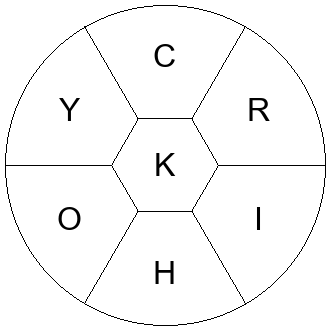
The official answers for today's puzzle are:

Click on the arrow to show the definition.
Click outside the pop-up to close it.


Number of Pangrams: 1

Maximum Puzzle Score: 81

Number of Answers: 24

Points Needed for Genius: 57

Genius requires between 10 and 21 words. You need at least a 5-letter word to reach genius. If you don't get the pangram, you need 85% of the total points to reach genius. If you get the pangram, you only need 64% of the remaining points to reach genius.

Other days with this pangram:

The button below will reveal a chart with the number of words by each letter. Red bars indicate that there is a pangram(s) starting with that letter.


How does this puzzle compare to other puzzles?

Today's score of 81 was in the 4th percentile of all puzzles.
The last time there was a score this low was on March 4, 2025.
The highest score ever was 537 on January 22, 2021.
The lowest score ever was 47 on March 27, 2023.

This puzzle's 24 possible answers rank it in the 9th percentile of all puzzles.
The last time there were fewer answers than this was on April 17, 2025.
The highest number of answers was 81 on June 8, 2019.
The lowest number of answers was 16 on March 27, 2023.

It takes a 5-letter word for genius.
The last time this happened was on November 19, 2024.

Today's puzzle has an average word length of 4.6.
For all Bees, the average word length has been 5.3.


Haven't I seen these letters before?

Hover over a letter to see its first and most recent appearance in the Bee!


Haven't I seen these words before?

The most common words in the Bee are:

  • noon 203
  • loll 198
  • toot 191
  • naan 173
  • nana 173
  • lilt 140
  • till 140
  • tilt 140
  • tint 138
  • nene 135
  • mama 133
  • mamma 133
  • onto 126
  • toon 126
  • acacia 124
  • acai 124
  • onion 122
  • anal 118
  • anon 116
  • olio 116
  • boob 112
  • booboo 112
  • dodo 112
  • papa 110
  • baba 109
  • poop 109
  • tact 109
  • call 106
  • calla 106
  • lull 106
  • lulu 106
  • mitt 106
  • ratatat 105
  • tart 105
  • tartar 105
  • attar 104
  • tatty 104
  • mono 103
  • moon 103
  • tattoo 103
  • allay 102
  • ally 102
  • ammo 102
  • momma 102
  • cocci 101
  • tutu 101
  • epee 100
  • peep 100
  • loon 99
  • roar 97


How long are words in the Bee?

There have been 103,027 answers ever accepted in the Bee - with 10,632 unique words.
Below are the distributions of the lengths of these words.


Valid dictionary words not in today's official answers

You may be wondering why these words aren't here*:

  • chickory
  • chirk
  • choky
  • chook
  • coky
  • cooky
  • hoick
  • hork
  • iroko
  • kirk
  • rooky
  • yock

*Because the New York Times considers them obscure or offensive.

chick

Etymology 1

noun
  1. A young bird.
  2. A young chicken.
  3. (term of endearment) A young child.
  4. A young, especially attractive, woman or teenage girl.
verb
  1. To sprout, as seed does in the ground; to vegetate.

Etymology 2

noun
  1. A screen or blind made of finely slit bamboo and twine, hung in doorways or windows.

chock

Etymology 1

noun
  1. Any object used as a wedge or filler, especially when placed behind a wheel to prevent it from rolling.
  2. Any fitting or fixture used to restrict movement, especially movement of a line; traditionally was a fixture near a bulwark with two horns pointing towards each other, with a gap between where the line can be inserted.
verb
  1. To stop or fasten, as with a wedge, or block; to scotch.
  2. To fill up, as a cavity.
  3. To insert a line in a chock.
adverb
  1. Entirely; quite.

Etymology 2

noun
  1. An encounter.
verb
  1. To encounter.

Etymology 3

verb
  1. To make a dull sound.

cock

Etymology 1

noun
  1. A male bird, especially:
  2. A valve or tap for controlling flow in plumbing.
  3. The hammer of a firearm trigger mechanism.
  4. The notch of an arrow or crossbow.
  5. The penis.
  6. The circle at the end of the rink.
  7. The state of being cocked; an upward turn, tilt or angle.
  8. A stupid person.
  9. Nonsense; rubbish.
  10. (Tasmania) Term of address.
  11. A boastful tilt of one's head or hat.
  12. Shuttlecock
  13. A vane in the shape of a cock; a weathercock.
  14. A chief man; a leader or master.
  15. The crow of a cock, especially the first crow in the morning; cockcrow.
  16. A male fish, especially a salmon or trout.
  17. The style or gnomon of a sundial.
  18. The indicator of a balance.
  19. The bridge piece that affords a bearing for the pivot of a balance in a clock or watch.
verb
  1. To lift the cock of a firearm or crossbow; to prepare (a gun or crossbow) to be fired.
  2. To be prepared to be triggered by having the cock lifted.
  3. To erect; to turn up.
  4. To copulate with.
  5. To turn or twist something upwards or to one side; to lift or tilt (e.g. headwear) boastfully.
  6. To turn (the eye) obliquely and partially close its lid, as an expression of derision or insinuation.
  7. To strut; to swagger; to look big, pert, or menacing.
  8. To make a nestle-cock of, to pamper or spoil (of children)
interjection
  1. Expression of annoyance.

Etymology 2

noun
  1. (where it is still sometimes used) Vulva, vagina.

Etymology 3

noun
  1. A small conical pile of hay.
verb
  1. To form into piles.

Etymology 4

noun
  1. Abbreviation of cock-boat, a type of small boat.

Etymology 5

proper noun
  1. A corruption of the word God, used in oaths.

cocky

Etymology 1

adjective
  1. Overly confident; arrogant and boastful.

Etymology 2

noun
  1. Used as a term of endearment, originally for a person of either sex, but later primarily for a man.

Etymology 3

noun
  1. A (familiar name for a) cockatoo.
  2. Short for cockatoo farmer; (by extension) any farmer or owner of rural land.
verb
  1. To operate a small-scale farm.

cook

Etymology 1

noun
  1. A person who prepares food.
  2. The head cook of a manor house
  3. The degree or quality of cookedness of food
  4. One who manufactures certain illegal drugs, especially meth.
  5. A session of manufacturing certain illegal drugs, especially meth.
  6. A fish, the European striped wrasse, Labrus mixtus.

Etymology 2

verb
  1. To prepare (food) for eating by heating it, often by combining it with other ingredients.
  2. To prepare (unspecified) food for eating by heating it, often by combining it with other ingredients.
  3. To be cooked.
  4. To be uncomfortably hot.
  5. To execute by electric chair.
  6. To hold onto (a grenade) briefly after igniting the fuse, so that it explodes almost immediately after being thrown.
  7. To concoct or prepare.
  8. To tamper with or alter; to cook up.
  9. To play or improvise in an inspired and rhythmically exciting way. (From 1930s jive talk.)
  10. To play music vigorously.

Etymology 3

verb
  1. To make the noise of the cuckoo.

Etymology 4

verb
  1. To throw.

cork

Etymology 1

noun
  1. The bark of the cork oak, which is very light and porous and used for making bottle stoppers, flotation devices, and insulation material.
  2. A bottle stopper made from this or any other material.
  3. An angling float, also traditionally made of oak cork.
  4. The cork oak, Quercus suber.
  5. The dead protective tissue between the bark and cambium in woody plants, with suberin deposits making it impervious to gasses and water.
verb
  1. To seal or stop up, especially with a cork stopper.
  2. To blacken (as) with a burnt cork
  3. To leave the cork in a bottle after attempting to uncork it.
  4. To fill with cork, as the center of a baseball bat.
  5. To injure through a blow; to induce a haematoma.
  6. To position one's drift net just outside of another person's net, thereby intercepting and catching all the fish that would have gone into that person's net.

Etymology 2

noun
  1. An aerialist maneuver involving a rotation where the rider goes heels over head, with the board overhead.
verb
  1. To perform such a maneuver.
adjective
  1. Having the property of a head over heels rotation.

corky

Etymology 1

adjective
  1. Of wine, contaminated by a faulty or tainted cork.
  2. Consisting of, or like, cork; dry; shrivelled.

Etymology 2

noun
  1. A deep bruise, usually on the leg or buttock, caused by a blow; a haematoma.

crick

Etymology 1

noun
  1. A painful muscular cramp or spasm of some part of the body, as of the neck or back, making it difficult to move the part affected. (Compare catch.)
  2. A small jackscrew.
verb
  1. To develop a crick (cramp, spasm).
  2. To cause to develop a crick; to create a crick in.
  3. To twist, bend, or contort, especially in a way that produces strain.

Etymology 2

noun
  1. A small inlet or bay, often saltwater, narrower and extending farther into the land than a cove; a recess in the shore of the sea, or of a river; the inner part of a port that is used as a dock for small boats.
  2. A stream of water (often freshwater) smaller than a river and larger than a brook.
  3. Any turn or winding.

Etymology 3

noun
  1. The creaking of a door, or a noise resembling it.

crock

Etymology 1

noun
  1. A stoneware or earthenware jar or storage container.
  2. A piece of broken pottery, a shard.
  3. A person who is physically limited by age, illness or injury.
  4. An old or broken-down vehicle (and formerly a horse or ewe).
  5. Silly talk, a foolish belief, a poor excuse, nonsense.
  6. A low stool.
  7. A patient who is difficult to treat, especially one who complains of a minor or imagined illness.
verb
  1. To break something or injure someone.
  2. (leatherworking) To transfer coloring through abrasion from one item to another.
  3. To cover the drain holes of a planter with stones or similar material, in order to ensure proper drainage.
  4. To put or store (something) in a crock or pot.

Etymology 2

noun
  1. The loose black particles collected from combustion, as on pots and kettles, or in a chimney; soot; smut.
  2. Colouring matter that rubs off from cloth.
verb
  1. To give off crock or smut.

crook

Etymology 1

noun
  1. A bend; turn; curve; curvature; a flexure.
  2. A bending of the knee; a genuflection.
  3. A bent or curved part; a curving piece or portion (of anything).
  4. A lock or curl of hair.
  5. A gibbet.
  6. A support beam consisting of a post with a cross-beam resting upon it; a bracket or truss consisting of a vertical piece, a horizontal piece, and a strut.
  7. A shepherd's crook; a staff with a semi-circular bend ("hook") at one end used by shepherds.
  8. A bishop's staff of office.
  9. An artifice; a trick; a contrivance.
  10. A person who steals, lies, cheats or does other dishonest or illegal things; a criminal.
  11. A pothook.
  12. A small tube, usually curved, applied to a trumpet, horn, etc., to change its pitch or key.
verb
  1. To bend, or form into a hook.
  2. To become bent or hooked.
  3. To turn from the path of rectitude; to pervert; to misapply; to twist.

Etymology 2

adjective
  1. Bad, unsatisfactory, not up to standard.
  2. Ill, sick.
  3. Annoyed, angry; upset.

hick

Etymology 1

noun
  1. An awkward, naive, clumsy and/or rude country person.

Etymology 2

verb
  1. To hiccup

hickory

noun
  1. Any of various deciduous hardwood trees of the genus Carya or Annamocarya.
  2. The wood of these trees.
adjective
  1. Of or pertaining to the hickory tree or its wood.

hock

Etymology 1

noun
  1. A Rhenish wine, of a light yellow color, either sparkling or still, from the Hochheim region; often applied to all Rhenish wines.

Etymology 2

noun
  1. The tarsal joint of a digitigrade quadruped, such as a horse, pig or dog.
  2. Meat from that part of a food animal.
verb
  1. To disable by cutting the tendons of the hock; to hamstring; to hough.

Etymology 3

noun
  1. Pawn, obligation as collateral for a loan.
  2. Debt.
  3. Installment purchase.
  4. Prison.
verb
  1. To leave with a pawnbroker as security for a loan.

Etymology 4

verb
  1. To bother; to pester; to annoy incessantly

Etymology 5

noun
  1. To cough heavily, esp. causing uvular frication.

hook

noun
  1. A rod bent into a curved shape, typically with one end free and the other end secured to a rope or other attachment.
  2. A barbed metal hook used for fishing; a fishhook.
  3. Any of various hook-shaped agricultural implements such as a billhook.
  4. The curved needle used in the art of crochet.
  5. The part of a hinge which is fixed to a post, and on which a door or gate hangs and turns.
  6. A loop shaped like a hook under certain written letters, for example, g and j.
  7. A tie-in to a current event or trend that makes a news story or editorial relevant and timely.
  8. A snare; a trap.
  9. (in the plural) The projecting points of the thighbones of cattle; called also hook bones.
  10. Removal or expulsion from a group or activity
  11. A field sown two years in succession.
  12. (authorship) A brief, punchy opening statement intended to get attention from an audience, reader, or viewer, and make them want to continue to listen to a speech, read a book, or watch a play.
  13. (authorship) A gimmick or element of a creative work intended to be attention-grabbing for the audience; a compelling idea for a story that will be sure to attract people's attention.
  14. A finesse.
  15. A jack (the playing card).
  16. A spit or narrow cape of sand or gravel turned landward at the outer end, such as Sandy Hook in New Jersey.
  17. A catchy musical phrase which forms the basis of a popular song.
  18. A ship's anchor.
  19. Part of a system's operation that can be intercepted to change or augment its behaviour.
  20. (Scrabble) An instance of playing a word perpendicular to a word already on the board, adding a letter to the start or the end of the word to form a new word.
  21. A diacritical mark shaped like the upper part of a question mark, as in ỏ.
  22. A háček.
  23. Senses relating to sports.
verb
  1. To attach a hook to.
  2. To catch with a hook (hook a fish).
  3. To work yarn into a fabric using a hook; to crochet.
  4. To insert in a curved way reminiscent of a hook.
  5. To ensnare or obligate someone, as if with a hook.
  6. To steal.
  7. To connect (hook into, hook together).
  8. (usually in passive) To make addicted; to captivate.
  9. To play a hook shot.
  10. To succeed in heeling the ball back out of a scrum (used particularly of the team's designated hooker).
  11. To engage in the illegal maneuver of hooking (i.e., using the hockey stick to trip or block another player)
  12. To swerve a ball; kick a ball so it swerves or bends.
  13. To engage in prostitution.
  14. (Scrabble) To play a word perpendicular to another word by adding a single letter to the existing word.
  15. To finesse.
  16. To seize or pierce with the points of the horns, as cattle in attacking enemies; to gore.
  17. To move or go with a sudden turn.

hooky

Etymology 1

noun
  1. Absence from school or work.

Etymology 2

adjective
  1. Full of hooks.
  2. Shaped like a hook.

icky

adjective
  1. Unpleasantly sticky; yucky; disgusting.
  2. Excessively sentimental.
  3. Unwell or upset; in a bad state of mind or health.

kick

Etymology 1

noun
  1. A hit or strike with the leg, foot or knee.
  2. The action of swinging a foot or leg.
  3. Something that tickles the fancy; something fun or amusing.
  4. The removal of a person from an online activity.
  5. Any bucking motion of an object that lacks legs or feet.
  6. Piquancy.
  7. A stimulation provided by an intoxicating substance.
  8. A pass played by kicking with the foot.
  9. The distance traveled by kicking the ball.
  10. A recoil of a gun.
  11. Pocket.
  12. An increase in speed in the final part of a running race.
verb
  1. To strike or hit with the foot or other extremity of the leg.
  2. To make a sharp jerking movement of the leg, as to strike something.
  3. To direct to a particular place by a blow with the foot or leg.
  4. (with "off" or "out") To eject summarily.
  5. To forcibly remove a participant from an online activity.
  6. To overcome (a bothersome or difficult issue or obstacle); to free oneself of (a problem).
  7. To move or push suddenly and violently.
  8. (of a firearm) To recoil; to push by recoiling.
  9. To attack (a piece) in order to force it to move.
  10. To accelerate quickly with a few pedal strokes in an effort to break away from other riders.
  11. To show opposition or resistance.
  12. To work a press by impact of the foot on a treadle.
noun
  1. One who kicks.
  2. One who takes kicks.
  3. The kicking strap.
  4. An outboard motor.
  5. An unexpected situation, detail or circumstance, often unpleasant.
  6. An enticement for investors, e.g. warranty added to the investment contract.
  7. An unpaired card which is part of a pair, two pair, or three of a kind poker hand.
  8. Small text above a headline that indicates the topic of the story.
  9. The last one or two paragraphs of a story.
  10. A lighthearted or humorous item used to round off a news broadcast.
  11. A device that periodically displaces a newspaper from the print production line, to aid in gathering the newspapers into fixed-size bundles.
  12. A launch ramp.
  13. The fermenting mass of fruit that is the basis of pruno, or "prison wine".
  14. A relaxed party.
  15. A backlight positioned at an angle.
noun
  1. A particular type of Texan who is associated with country/western attire, attitudes and/or philosophy.
noun
  1. An introduction; something that leads into the beginning of something.
  2. A region of data at the beginning of a compact disc, holding the table of contents.
  3. A short phrase that begins the caption of a photograph.

Etymology 2

verb
  1. To die.

kicky

adjective
  1. Lively, exciting, thrilling.
  2. Characterised by kicking motions.
  3. Describing a wicket that sometimes causes the ball to kick (bounce unevenly).

kook

noun
  1. An eccentric, strange or crazy person.
  2. (kiteboarding, wakeboarding) A boardsport participant who lacks style or skill; a newbie who acts as if they are better at the sport than they are.

kooky

adjective
  1. Eccentric, strange, or foolish; crazy or insane; kookish.
  2. Behaving like a kook (a person with poor style or skill); kook-like.

rick

Etymology 1

noun
  1. Straw, hay etc. stored in a stack for winter fodder, commonly protected with thatch.
  2. A stack of wood, especially cut to a regular length; also used as a measure of wood, typically four by eight feet.
verb
  1. To heap up (hay, etc.) in ricks.

Etymology 2

verb
  1. To slightly sprain or strain the neck, back, ankle etc.

Etymology 3

noun
  1. A brand new (naive) boot camp inductee.

rock

Etymology 1

noun
  1. A formation of minerals, specifically:
  2. A large hill or island having no vegetation.
  3. Something that is strong, stable, and dependable; a person who provides security or support to another.
  4. A lump or cube of ice.
  5. A type of confectionery made from sugar in the shape of a stick, traditionally having some text running through its length.
  6. A crystallized lump of crack cocaine.
  7. An unintelligent person, especially one who repeats mistakes.
  8. An Afrikaner.
  9. An extremely conservative player who is willing to play only the very strongest hands.
  10. Any of several fish:
  11. A basketball.
  12. (rock paper scissors) A closed hand (a handshape resembling a rock), that beats scissors and loses to paper. It beats lizard and loses to Spock in rock-paper-scissors-lizard-Spock.
  13. A cricket ball, especially a new one that has not been softened by use
  14. A crystal used to control the radio frequency.

Etymology 2

noun
  1. An act of rocking; a rocking motion; a sway.
verb
  1. To move gently back and forth.
  2. To cause to shake or sway violently.
  3. To sway or tilt violently back and forth.
  4. (of ore etc.) To be washed and panned in a cradle or in a rocker.
  5. To disturb the emotional equilibrium of; to distress; to greatly impact (most often positively).
  6. To do well or to be operating at high efficiency.
  7. To make love to or have sex with.

Etymology 3

noun
  1. A style of music characterized by basic drum-beat, generally 4/4 riffs, based on (usually electric) guitar, bass guitar, drums and vocals.
verb
  1. To play, perform, or enjoy rock music, especially with a lot of skill or energy.
  2. To be very favourable or skilful; excel; be fantastic.
  3. To thrill or excite, especially with rock music
  4. To do something with excitement yet skillfully
  5. To wear (a piece of clothing, outfit etc.) successfully or with style; to carry off (a particular look, style).

Etymology 4

noun
  1. Distaff.
  2. The flax or wool on a distaff.

Etymology 5

noun
  1. An enormous mythical bird in Eastern legend.
noun
  1. Rocuronium.

rocky

Etymology 1

adjective
  1. Unstable; easily rocked.
  2. In the style of rock music.
  3. Troubled; or difficult; in danger or distress.

Etymology 2

adjective
  1. Full of, or abounding in, rocks; consisting of rocks.
  2. Like a rock.
  3. Not easily impressed or affected; hard; unfeeling; obdurate

rook

Etymology 1

noun
  1. A European bird, Corvus frugilegus, of the crow family.
  2. A cheat or swindler; someone who betrays.
  3. A type of firecracker used by farmers to scare birds of the same name.
  4. A trick-taking game, usually played with a specialized deck of cards.
  5. A bad deal, a rip-off.
verb
  1. To cheat or swindle.

Etymology 2

noun
  1. A piece shaped like a castle tower, that can be moved only up, down, left or right (but not diagonally) or in castling.
  2. A castle or other fortification.

Etymology 3

noun
  1. A rookie.

Etymology 4

noun
  1. Mist; fog; roke

Etymology 5

verb
  1. To squat; to ruck.

Etymology 6

verb
  1. Pronunciation spelling of look.