Saturday, July 26, 2025

Answers to yesterday's Bee

Jump to answers for


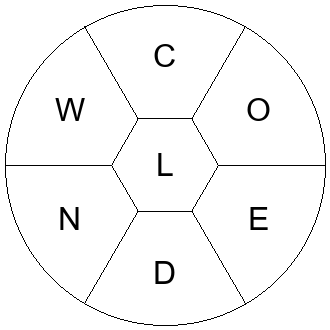
The official answers for today's puzzle are:

Click on the arrow to show the definition.
Click outside the pop-up to close it.


Number of Pangrams: 1

Maximum Puzzle Score: 254

Number of Answers: 57

Points Needed for Genius: 178

Genius requires between 26 and 48 words. You need at least a 7-letter word to reach genius. If you don't get the pangram, you need 74% of the total points to reach genius. If you get the pangram, you only need 68% of the remaining points to reach genius.

Other days with this pangram:

The button below will reveal a chart with the number of words by each letter. Red bars indicate that there is a pangram(s) starting with that letter.


How does this puzzle compare to other puzzles?

Today's score of 254 was in the 84th percentile of all puzzles.
The last time there was a score this high was on July 20, 2025.
The highest score ever was 537 on January 22, 2021.
The lowest score ever was 47 on March 27, 2023.

This puzzle's 57 possible answers rank it in the 87th percentile of all puzzles.
The last time there were more answers than this was on July 20, 2025.
The highest number of answers was 81 on June 8, 2019.
The lowest number of answers was 16 on March 27, 2023.

It takes a 7-letter word for genius.
The last time this happened was on July 24, 2025.

Today's puzzle has an average word length of 5.4.
For all Bees, the average word length has been 5.3.


Haven't I seen these letters before?

Hover over a letter to see its first and most recent appearance in the Bee!


Haven't I seen these words before?

The most common words in the Bee are:

  • noon 205
  • loll 201
  • toot 193
  • naan 175
  • nana 175
  • lilt 143
  • till 143
  • tilt 143
  • tint 138
  • mama 135
  • mamma 135
  • nene 135
  • acacia 129
  • acai 129
  • onto 127
  • toon 127
  • onion 123
  • anal 119
  • anon 119
  • olio 116
  • boob 113
  • booboo 113
  • dodo 113
  • poop 112
  • tact 112
  • papa 111
  • baba 110
  • call 108
  • calla 108
  • lull 108
  • lulu 108
  • mitt 108
  • ratatat 106
  • tart 106
  • tartar 106
  • attar 105
  • tatty 105
  • ammo 104
  • momma 104
  • mono 104
  • moon 104
  • tattoo 104
  • allay 103
  • ally 103
  • cocci 103
  • tutu 103
  • loon 101
  • epee 100
  • peep 100
  • roar 99


How long are words in the Bee?

There have been 104,590 answers ever accepted in the Bee - with 10,690 unique words.
Below are the distributions of the lengths of these words.


Valid dictionary words not in today's official answers

You may be wondering why these words aren't here*:

  • clew
  • clewed
  • clon
  • cole
  • coled
  • colone
  • cowled
  • dele
  • deled
  • dewool
  • dewooled
  • doddle
  • dolce
  • doolee
  • doweled
  • dowelled
  • enol
  • leno
  • leone
  • locoed
  • loden
  • looed
  • lowe
  • lown
  • noddle
  • noddled
  • nolo
  • nonwool
  • olde
  • wedel
  • wedeled
  • wedeln
  • weel
  • wold
  • wooled
  • woolled
  • woollen

*Because the New York Times considers them obscure or offensive.

cell

Etymology 1

noun
  1. A single-room dwelling for a hermit.
  2. A small monastery or nunnery dependent on a larger religious establishment.
  3. A small room in a monastery or nunnery accommodating one person.
  4. A room in a prison or jail for one or more inmates.
  5. Each of the small hexagonal compartments in a honeycomb.
  6. Any of various chambers in a tissue or organism having specific functions.
  7. The discal cell of the wing of a lepidopteran insect.
  8. Specifically, any of the supposed compartments of the brain, formerly thought to be the source of specific mental capacities, knowledge, or memories.
  9. A section or compartment of a larger structure.
  10. Any small dwelling; a remote nook, a den.
  11. A device which stores electrical power; used either singly or together in batteries; the basic unit of a battery.
  12. The basic unit of a living organism, consisting of a quantity of protoplasm surrounded by a cell membrane, which is able to synthesize proteins and replicate itself.
  13. A small thunderstorm, caused by convection, that forms ahead of a storm front.
  14. The minimal unit of a cellular automaton that can change state and has an associated behavior.
  15. In FreeCell-type games, a space where one card can be placed.
  16. A small group of people forming part of a larger organization, often an outlawed one.
  17. (communication) A short, fixed-length packet as in asynchronous transfer mode.
  18. (communication) A region of radio reception that is a part of a larger radio network.
  19. A three-dimensional facet of a polytope.
  20. The unit in a statistical array (a spreadsheet, for example) where a row and a column intersect.
  21. The space between the ribs of a vaulted roof.
  22. A cella.
  23. An area of an insect wing bounded by veins
verb
  1. To place or enclose in a cell.

Etymology 2

noun
  1. A cellular phone.

celled

No Definition Found.

cello

Etymology 1

noun
  1. A large stringed instrument of the violin family with four strings, tuned from lowest to highest C-G-D-A, and played with a bow, also possessing an endpin to support the instrument's weight.

Etymology 2

noun
  1. Cellophane

clod

noun
  1. A lump of something, especially of earth or clay.
  2. The ground; the earth; a spot of earth or turf.
  3. A stupid person; a dolt.
  4. Part of a shoulder of beef, or of the neck piece near the shoulder.
verb
  1. To pelt with clods.
  2. To throw violently; to hurl.
  3. To collect into clods, or into a thick mass; to coagulate; to clot.

clone

noun
  1. A living organism (originally a plant) produced asexually from a single ancestor, to which it is genetically identical.
  2. A group of identical cells derived from a single cell.http//www.medterms.com/script/main/art.asp?articlekey=2754
  3. A copy or imitation of something already existing, especially when designed to simulate it.
  4. Two people who are exactly alike, as far as looks or behavior.
verb
  1. To create a clone of.

cloned

verb
  1. To create a clone of.

clown

noun
  1. A slapstick performance artist often associated with a circus and usually characterized by bright, oversized clothing, a red nose, face paint, and a brightly colored wig.
  2. A person who acts in a silly fashion.
  3. A stupid person.
  4. A man of coarse nature and manners; an awkward fellow; an illbred person; a boor.
  5. One who works upon the soil; a rustic; a churl; a yokel.
verb
  1. To act in a silly or playful fashion.
  2. To ridicule.

clowned

verb
  1. To act in a silly or playful fashion.
  2. To ridicule.

coddle

noun
  1. An Irish dish comprising layers of roughly sliced pork sausages and bacon rashers with sliced potatoes and onions.
  2. An effeminate person.
verb
  1. To treat gently or with great care.
  2. To cook slowly in hot water that is below the boiling point.
  3. To exercise excessive or damaging authority in an attempt to protect. To overprotect.

coddled

verb
  1. To treat gently or with great care.
  2. To cook slowly in hot water that is below the boiling point.
  3. To exercise excessive or damaging authority in an attempt to protect. To overprotect.

cold

Etymology 1

adjective
  1. (of a thing) Having a low temperature.
  2. (of the weather) Causing the air to be cold.
  3. (of a person or animal) Feeling the sensation of coldness, especially to the point of discomfort.
  4. Unfriendly, emotionally distant or unfeeling.
  5. Dispassionate, not prejudiced or partisan, impartial.
  6. Completely unprepared; without introduction.
  7. Unconscious or deeply asleep; deprived of the metaphorical heat associated with life or consciousness.
  8. (usually with "have" or "know" transitively) Perfectly, exactly, completely; by heart.
  9. (usually with "have" transitively) Cornered, done for.
  10. Not pungent or acrid.
  11. Unexciting; dull; uninteresting.
  12. Affecting the sense of smell (as of hunting dogs) only feebly; having lost its odour.
  13. Not sensitive; not acute.
  14. Distant; said, in the game of hunting for some object, of a seeker remote from the thing concealed. Compare warm and hot.
  15. Having a bluish effect; not warm in colour.
  16. Rarely used or accessed, and thus able to be relegated to slower storage.
  17. Without compassion; heartless; ruthless

Etymology 2

noun
  1. A condition of low temperature.
  2. (with 'the') A harsh place; a place of abandonment.
  3. A common, usually harmless, viral illness, usually with congestion of the nasal passages and sometimes fever.
  4. Rheum, sleepy dust

Etymology 3

adverb
  1. While at low temperature.
  2. Without preparation.
  3. With finality.
  4. In a cold, frank, or realistically honest manner.

colleen

noun
  1. Girl
  2. Young single woman

colon

Etymology 1

noun
  1. The punctuation mark ":".
  2. The triangular colon (especially in context of not being able to type the actual triangular colon).
  3. A rhetorical figure consisting of a clause which is grammatically, but not logically, complete.
  4. A clause or group of clauses written as a line, or taken as a standard of measure in ancient manuscripts or texts.

Etymology 2

noun
  1. Part of the large intestine; the final segment of the digestive system, after (distal to) the ileum and before (proximal to) the anus.

Etymology 3

noun
  1. A husbandman.
  2. A European colonial settler, especially in a French colony.

colonel

noun
  1. A commissioned officer in an armed military organization, typically the highest rank before flag officer ranks (generals). It is generally found in armies, air forces or naval infantry (marines).
verb
  1. To act as or like a colonel.

condole

verb
  1. To express sympathetic sorrow; to lament in sympathy (with someone on something).
  2. To condole with (someone).
  3. To say in an expression of sympathy.
  4. To lament, grieve, bemoan (something).

condoled

verb
  1. To express sympathetic sorrow; to lament in sympathy (with someone on something).
  2. To condole with (someone).
  3. To say in an expression of sympathy.
  4. To lament, grieve, bemoan (something).

condolence

noun
  1. Comfort, support or sympathy.
  2. (usually in the plural) An expression of comfort, support, or sympathy offered to the family and friends of somebody who has died.

cool

Etymology 1

noun
  1. A moderate or refreshing state of cold; moderate temperature of the air between hot and cold; coolness.
  2. A calm temperament.
  3. The property of being cool, popular or in fashion.
adjective
  1. Having a slightly low temperature; mildly or pleasantly cold.
  2. Allowing or suggesting heat relief.
  3. Of a color, in the range of violet to green.
  4. Of a person, not showing emotion; calm and in control of oneself.
  5. Unenthusiastic, lukewarm, skeptical.
  6. Calmly audacious.
  7. Applied facetiously to a sum of money, commonly as if to give emphasis to the largeness of the amount.
  8. Of a person, knowing what to do and how to behave; considered popular by others.
  9. In fashion, part of or fitting the in crowd; originally hipster slang.
  10. Of an action, all right; acceptable; that does not present a problem.
  11. Of a person, not upset by circumstances that might ordinarily be upsetting.
  12. Quietly impudent, defiant, or selfish; deliberately presuming: said of persons and acts.

Etymology 2

verb
  1. To lose heat, to get colder.
  2. To make cooler, less warm.
  3. To become less intense, e.g. less amicable or passionate.
  4. To make less intense, e.g. less amicable or passionate.
  5. To kill.

cooldown

No Definition Found.

cooled

verb
  1. To lose heat, to get colder.
  2. To make cooler, less warm.
  3. To become less intense, e.g. less amicable or passionate.
  4. To make less intense, e.g. less amicable or passionate.
  5. To kill.
adjective
  1. Brought to a lower temperature.
  2. Brought to a lower temperature by means of (often in compounds).
  3. Brought to a reduced degree of anger or fervour.

cowl

Etymology 1

noun
  1. A monk's hood that can be pulled forward to cover the face; a robe with such a hood attached to it.
  2. A mask that covers the majority of the head.
  3. A thin protective covering over all or part of an engine; also cowling.
  4. A usually hood-shaped covering used to increase the draft of a chimney and prevent backflow.
  5. A ship's ventilator with a bell-shaped top which can be swivelled to catch the wind and force it below.
  6. A vertical projection of a ship's funnel that directs the smoke away from the bridge.
  7. (metonymy) A monk.
verb
  1. To cover with, or as if with, a cowl (hood).
  2. To wrap or form (something made of fabric) like a cowl.
  3. To make a monk of (a person).

Etymology 2

noun
  1. A vessel carried on a pole, a soe.

Etymology 3

noun
  1. A caul (the amnion which encloses the foetus before birth, especially that part of it which sometimes shrouds a baby’s head at birth).

dell

Etymology 1

noun
  1. A valley, especially in the form of a natural hollow, small and deep.

Etymology 2

noun
  1. A young woman; a wench.

dole

Etymology 1

noun
  1. Money or other goods given as charity.
  2. Distribution; dealing; apportionment.
  3. Payment by the state to the unemployed.
  4. A boundary; a landmark.
  5. A void space left in tillage.
verb
  1. To distribute in small amounts; to share out small portions of a meager resource.

Etymology 2

noun
  1. Sorrow or grief; dolour.
  2. Dolus.

doled

verb
  1. To distribute in small amounts; to share out small portions of a meager resource.

doll

noun
  1. A toy in the form of a human.
  2. (sometimes offensive) An attractive young woman
  3. A term of endearment: darling, sweetheart.
  4. A dollar.
  5. (now possibly offensive) A good-natured, cooperative or helpful girl.
  6. The smallest or pet pig in a litter.

dolled

No Definition Found.

doodle

Etymology 1

noun
  1. A fool, a simpleton, a mindless person.
  2. A small mindless sketch, etc.
  3. (sometimes childish) Penis.
verb
  1. To draw or scribble aimlessly.
  2. To drone like a bagpipe.

Etymology 2

noun
  1. Any crossbreed of a poodle with a different breed of dog.

doodled

verb
  1. To draw or scribble aimlessly.
  2. To drone like a bagpipe.

dowel

noun
  1. A pin, or block, of wood or metal, fitting into holes in the abutting portions of two pieces, and being partly in one piece and partly in the other, to keep them in their proper relative position.
  2. A wooden rod, as one to make short pins from.
  3. A piece of wood or similar material fitted into a surface not suitable for fastening so that other pieces may be fastened to it.
verb
  1. To fasten together with dowels.
  2. To furnish with dowels.

dwell

noun
  1. A period of time in which a system or component remains in a given state.
  2. A brief pause in the motion of part of a mechanism to allow an operation to be completed.
  3. A planned delay in a timed control program.
  4. In a petrol engine, the period of time the ignition points are closed to let current flow through the ignition coil in between each spark. This is measured as an angle in degrees around the camshaft in the distributor which controls the points, for example in a 4-cylinder engine it might be 55° (spark at 90° intervals, points closed for 55° between each).
verb
  1. To live; to reside.
  2. To linger (on) a particular thought, idea etc.; to remain fixated (on).
  3. To be in a given state.
  4. To abide; to remain; to continue.

dwelled

verb
  1. To live; to reside.
  2. To linger (on) a particular thought, idea etc.; to remain fixated (on).
  3. To be in a given state.
  4. To abide; to remain; to continue.

lede

Etymology 1

noun
  1. (singular) A man; person.
  2. (collective plural) Men; people, folk.
  3. (singular) A people or nation.
  4. (plural) Tenements; holdings; possessions.

Etymology 2

noun
  1. (chiefly US) The introductory paragraph(s) of a newspaper or other news article.

lend

Etymology 1

noun
  1. The lumbar region; loin.
  2. (of a person or animal) The loins; flank; buttocks.

Etymology 2

verb
  1. To allow to be used by someone temporarily, on condition that it or its equivalent will be returned.
  2. To make a loan.
  3. To be suitable or applicable, to fit.
  4. To afford; to grant or furnish in general.
  5. To borrow.

lewd

verb
  1. To get high on quaalude.
  2. To express lust; to behave in a lewd manner.
adjective
  1. Lascivious, sexually promiscuous, rude.
  2. Lay; not clerical.
  3. Uneducated.
  4. Vulgar, common; typical of the lower orders.
  5. Base, vile, reprehensible.

loco

Etymology 1

adverb
  1. A direction in written or printed music to be returning to the proper pitch after having played an octave higher or lower.

Etymology 2

noun
  1. A certain species of Astragalus or Oxytropis, capable of causing locoism.
verb
  1. To poison with the loco plant; to affect with locoism.
  2. (by extension) To render insane.
adjective
  1. Crazy.
  2. Intoxicated by eating locoweed.

Etymology 3

noun
  1. A locomotive.

locoweed

noun
  1. Any of several plants indigenous to the western United States, of genus Oxytropis or Astragalus.

lode

noun
  1. A way or path; a road.
  2. A watercourse.
  3. A vein of metallic ore that lies within definite boundaries, or within a fissure.
  4. (by extension) A rich source of supply.

loll

verb
  1. To act lazily or indolently while reclining; to lean; to lie at ease.
  2. To hang extended from the mouth, like the tongue of an animal heated from exertion.
  3. To let (the tongue) hang from the mouth in this way.

lolled

verb
  1. To laugh out loud.
verb
  1. To act lazily or indolently while reclining; to lean; to lie at ease.
  2. To hang extended from the mouth, like the tongue of an animal heated from exertion.
  3. To let (the tongue) hang from the mouth in this way.

lone

adjective
  1. Solitary; having no companion.
  2. Isolated or lonely; lacking companionship.
  3. Sole; being the only one of a type.
  4. Situated by itself or by oneself, with no neighbours.
  5. Unfrequented by human beings; solitary.
  6. Single; unmarried, or in widowhood.

loon

Etymology 1

noun
  1. An idler, a lout.
  2. A boy, a lad.
  3. A harlot; mistress.
  4. A simpleton.
  5. A crazy or deranged person.
  6. An English soldier of an expeditionary army in Ireland.

Etymology 2

noun
  1. Any of various birds, of the order Gaviiformes, of North America and Europe that dive for fish and have a short tail, webbed feet and a yodeling cry.

lowdown

noun
  1. The story or truth.
adjective
  1. Unfair; shameful.

lowed

verb
  1. To depress; to lower.
verb
  1. To moo.
verb
  1. To burn; to blaze.

needle

noun
  1. A fine, sharp implement usually for piercing such as sewing, or knitting, acupuncture, tattooing, body piercing, medical injections, etc.
  2. Any slender, pointed object resembling a needle, such as a pointed crystal, a sharp pinnacle of rock, an obelisk, etc.
  3. A fine measurement indicator on a dial or graph, e.g. a compass needle.
  4. A sensor for playing phonograph records, a phonograph stylus.
  5. A needle-like leaf found on some conifers.
  6. A strong beam resting on props, used as a temporary support during building repairs.
  7. (usually preceded by the) The death penalty carried out by lethal injection.
  8. A text string that is searched for within another string. (see: needle in a haystack)
verb
  1. To pierce with a needle, especially for sewing or acupuncture.
  2. To tease in order to provoke; to poke fun at.
  3. To form, or be formed, in the shape of a needle.

needled

verb
  1. To pierce with a needle, especially for sewing or acupuncture.
  2. To tease in order to provoke; to poke fun at.
  3. To form, or be formed, in the shape of a needle.
adjective
  1. Covered or armored with needles.

newel

Etymology 1

noun
  1. A central pillar around which a staircase spirals.
  2. A sturdy pillar at the top or bottom of a flight of stairs, supporting the handrail.

Etymology 2

noun
  1. A novelty; a new thing.

noel

noun
  1. Christmas
  2. A kind of hymn, or canticle, of mediaeval origin, sung in honor of the birth of Christ; a Christmas carol.

noodle

noun
  1. (usually in the plural) a string or strip of pasta
  2. A person with poor judgement; a fool
  3. The brain, the head
  4. A pool noodle
verb
  1. To think or ponder.
  2. To fiddle, play with, or mess around.
  3. To improvise music.
  4. To fish (usually for very large catfish) without any equipment other than the fisherman's own body
  5. To fossick, especially for opals.

noodled

verb
  1. To think or ponder.
  2. To fiddle, play with, or mess around.
  3. To improvise music.
  4. To fish (usually for very large catfish) without any equipment other than the fisherman's own body
  5. To fossick, especially for opals.

olden

Etymology 1

adjective
  1. From or relating to a previous era.
  2. Old; ancient.

Etymology 2

verb
  1. To grow old; age; assume an older appearance or character; become affected by age.

oleo

Etymology 1

noun
  1. The various fats and oils that go into the making of margarine.

Etymology 2

noun
  1. Margarine

weld

Etymology 1

noun
  1. A herb (Reseda luteola) related to mignonette, growing in Europe, and to some extent in America, used to make a yellow dye.
  2. The yellow coloring matter or dye extracted from this plant.

Etymology 2

noun
  1. The joint made by welding.
verb
  1. To join two materials (especially two metals) together by applying heat, pressure and filler, either separately or in any combination.
  2. To bind together inseparably; to unite closely or intimately.

Etymology 3

verb
  1. To wield.

welded

verb
  1. To join two materials (especially two metals) together by applying heat, pressure and filler, either separately or in any combination.
  2. To bind together inseparably; to unite closely or intimately.
verb
  1. To wield.

well

Etymology 1

adjective
  1. In good health.
  2. Good, content.
  3. Prudent; good; well-advised.
adverb
  1. (manner) Accurately, competently, satisfactorily.
  2. (manner) Completely, fully.
  3. (degree) To a significant degree.
  4. (degree) Very (as a general-purpose intensifier).
  5. In a desirable manner; so as one could wish; satisfactorily; favourably; advantageously.
interjection
  1. Used to acknowledge a statement or situation.
  2. An exclamation of surprise (often doubled or tripled).
  3. An exclamation of indignance.
  4. Used in speech to express the overcoming of reluctance to say something.
  5. Used in speech to fill gaps, particularly at the beginning of a response to a question; filled pause.
  6. (Hiberno-English) Used as a greeting

Etymology 2

noun
  1. A hole sunk into the ground as a source of water, oil, natural gas or other fluids.
  2. A place where a liquid such as water surfaces naturally; a spring.
  3. A small depression suitable for holding liquid or other objects.
  4. A source of supply.
  5. A vertical, cylindrical trunk in a ship, reaching down to the lowest part of the hull, through which the bilge pumps operate.
  6. The cockpit of a sailboat.
  7. A compartment in the middle of the hold of a fishing vessel, made tight at the sides, but having holes perforated in the bottom to let in water to keep fish alive while they are transported to market.
  8. A vertical passage in the stern into which an auxiliary screw propeller may be drawn up out of the water.
  9. A hole or excavation in the earth, in mining, from which run branches or galleries.
  10. An opening through the floors of a building, as for a staircase or an elevator; a wellhole.
  11. The open space between the bench and the counsel tables in a courtroom.
  12. The lower part of a furnace, into which the metal falls.
  13. A well drink.
  14. The playfield of Tetris and similar video games, into which the blocks fall.
  15. In a microtiter plate, each of the small equal circular or square sections which serve as test tubes.

Etymology 3

verb
  1. To issue forth, as water from the earth; to flow; to spring.
  2. To have something seep out of the surface.

welled

verb
  1. To issue forth, as water from the earth; to flow; to spring.
  2. To have something seep out of the surface.

wool

noun
  1. The hair of the sheep, llama and some other ruminants.
  2. A cloth or yarn made from the wool of sheep.
  3. Anything with a texture like that of wool.
  4. A fine fiber obtained from the leaves of certain trees, such as firs and pines.
  5. Short, thick hair, especially when crisped or curled.
  6. Yarn (including that which is made from synthetic fibers.)
  7. Derogatory term for residents of the satellite towns outside Liverpool, such as St Helens or Warrington. See also Yonner.

woolen

noun
  1. An item of clothing made from wool
adjective
  1. Made of wool.
  2. Of or relating to wool or woolen cloths.