Monday, August 4, 2025

Answers to yesterday's Bee

Jump to answers for


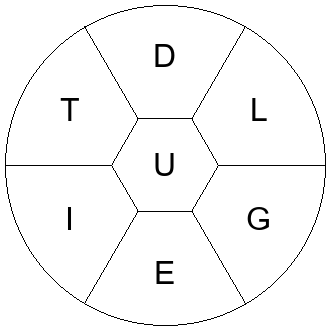
The official answers for today's puzzle are:

Click on the arrow to show the definition.
Click outside the pop-up to close it.


Number of Pangrams: 1

Maximum Puzzle Score: 230

Number of Answers: 50

Points Needed for Genius: 161

Genius requires between 25 and 41 words. You need at least a 6-letter word to reach genius. If you don't get the pangram, you need 75% of the total points to reach genius. If you get the pangram, you only need 68% of the remaining points to reach genius.

Other days with this pangram:

The button below will reveal a chart with the number of words by each letter. Red bars indicate that there is a pangram(s) starting with that letter.


How does this puzzle compare to other puzzles?

Today's score of 230 was in the 76th percentile of all puzzles.
The last time there was a score this high was on July 31, 2025.
The highest score ever was 537 on January 22, 2021.
The lowest score ever was 47 on March 27, 2023.

This puzzle's 50 possible answers rank it in the 76th percentile of all puzzles.
The last time there were more answers than this was on August 3, 2025.
The highest number of answers was 81 on June 8, 2019.
The lowest number of answers was 16 on March 27, 2023.

It takes a 6-letter word for genius.
The last time this happened was on August 3, 2025.

Today's puzzle has an average word length of 5.3.
For all Bees, the average word length has been 5.3.


Haven't I seen these letters before?

Hover over a letter to see its first and most recent appearance in the Bee!


Haven't I seen these words before?

The most common words in the Bee are:

  • noon 206
  • loll 201
  • toot 193
  • naan 177
  • nana 177
  • lilt 143
  • till 143
  • tilt 143
  • tint 138
  • nene 137
  • mama 135
  • mamma 135
  • acacia 130
  • acai 130
  • onto 127
  • toon 127
  • onion 123
  • anon 120
  • anal 119
  • olio 116
  • tact 114
  • boob 113
  • booboo 113
  • dodo 113
  • papa 112
  • poop 112
  • baba 111
  • lull 110
  • lulu 110
  • call 108
  • calla 108
  • mitt 108
  • ratatat 106
  • tart 106
  • tartar 106
  • attar 105
  • mono 105
  • moon 105
  • tatty 105
  • tutu 105
  • ammo 104
  • momma 104
  • tattoo 104
  • allay 103
  • ally 103
  • cocci 103
  • loon 101
  • epee 100
  • peep 100
  • roar 99


How long are words in the Bee?

There have been 104,993 answers ever accepted in the Bee - with 10,702 unique words.
Below are the distributions of the lengths of these words.


Valid dictionary words not in today's official answers

You may be wondering why these words aren't here*:

  • duddie
  • duded
  • dudette
  • duelled
  • duelli
  • dueted
  • duit
  • elute
  • eluted
  • etui
  • gude
  • guggle
  • guggled
  • guglet
  • guid
  • guiled
  • guitguit
  • gullied
  • guttle
  • guttled
  • iglu
  • illude
  • illuded
  • leud
  • ligule
  • litu
  • lude
  • luggie
  • luted
  • tegu
  • teledu
  • tuile
  • tuille
  • tule
  • tutued

*Because the New York Times considers them obscure or offensive.

delude

verb
  1. To deceive into believing something which is false; to lead into error; to dupe.
  2. To frustrate or disappoint.

deluded

verb
  1. To deceive into believing something which is false; to lead into error; to dupe.
  2. To frustrate or disappoint.
adjective
  1. Being affected by delusions.

deluge

noun
  1. A great flood or rain.
  2. An overwhelming amount of something; anything that overwhelms or causes great destruction.
  3. (military engineering) A damage control system on navy warships which is activated by excessive temperature within the Vertical Launching System.
verb
  1. To flood with water.
  2. To overwhelm.

deluged

verb
  1. To flood with water.
  2. To overwhelm.

dilute

noun
  1. An animal having a lighter-coloured coat than is usual.
verb
  1. To make thinner by adding solvent to a solution, especially by adding water.
  2. To weaken, especially by adding a foreign substance.
  3. To cause the value of individual shares or the stake of a shareholder to decrease by increasing the total number of shares.
  4. To become attenuated, thin, or weak.
adjective
  1. Having a low concentration.
  2. Weak; reduced in strength by dilution; diluted.
  3. Of an animal: having a lighter-coloured coat than is usual.

diluted

verb
  1. To make thinner by adding solvent to a solution, especially by adding water.
  2. To weaken, especially by adding a foreign substance.
  3. To cause the value of individual shares or the stake of a shareholder to decrease by increasing the total number of shares.
  4. To become attenuated, thin, or weak.
adjective
  1. That has had something added in order to dilute it.

dude

noun
  1. A man, generally a younger man.
  2. (used in the vocative) A term of address for someone, typically a man, particularly when cautioning him or offering him advice.
  3. An inexperienced cowboy.
  4. A tourist.
  5. A man who is very concerned about his dress and appearance; a dandy, a fop.
verb
  1. To address someone as dude.
  2. To take a vacation in a dude ranch.
  3. Usually followed by up: to dress up, to wear smart or special clothes.
interjection
  1. A term of address, usually for a man, conveying awe, excitement, surprise, etc.

duel

noun
  1. Arranged, regular combat between two private persons, often over a matter of honor.
  2. Historically, the wager of battle (judicial combat)
  3. Any struggle between two contending persons, groups or ideas.
verb
  1. To engage in a battle.

dueled

verb
  1. To engage in a battle.

duet

noun
  1. A musical composition in two parts, each performed by a single voice (singer, instrument or univoce ensemble).
  2. A song composed for and/or performed by a duo.
  3. A pair or couple, especially one that is harmonious or elegant.
verb
  1. To perform a duet.
  2. (of pairs of animals) To communicate (warnings, mating calls, etc.) through song.
  3. To perform (sing, play, etc.) as a duet.
  4. (of two people) To say at the same time, to chorus.

duetted

No Definition Found.

dull

verb
  1. To render dull; to remove or blunt an edge or something that was sharp.
  2. To soften, moderate or blunt; to make dull, stupid, or sluggish; to stupefy.
  3. To lose a sharp edge; to become dull.
  4. To render dim or obscure; to sully; to tarnish.
adjective
  1. Lacking the ability to cut easily; not sharp.
  2. Boring; not exciting or interesting.
  3. Not shiny; having a matte finish or no particular luster or brightness.
  4. Not bright or intelligent; stupid; having slow understanding.
  5. Sluggish, listless.
  6. Cloudy, overcast.
  7. Insensible; unfeeling.
  8. Heavy; lifeless; inert.
  9. (of pain etc) Not intense; felt indistinctly or only slightly.
  10. (of a noise or sound) Not clear, muffled.

dulled

verb
  1. To render dull; to remove or blunt an edge or something that was sharp.
  2. To soften, moderate or blunt; to make dull, stupid, or sluggish; to stupefy.
  3. To lose a sharp edge; to become dull.
  4. To render dim or obscure; to sully; to tarnish.

elude

verb
  1. To evade, or escape from someone or something, especially by using cunning or skill
  2. To shake off a pursuer; to give someone the slip
  3. To escape understanding of; to be incomprehensible to

eluded

verb
  1. To evade, or escape from someone or something, especially by using cunning or skill
  2. To shake off a pursuer; to give someone the slip
  3. To escape understanding of; to be incomprehensible to

etude

noun
  1. A short piece of music, designed to give a performer practice in a particular area or skill.

gigue

noun
  1. An Irish dance, derived from the jig, used in the Partita form (Baroque Period).

glue

noun
  1. A hard gelatin made by boiling bones and hides, used in solution as an adhesive; or any sticky adhesive substance.
  2. Anything that binds two things or people together.
  3. Birdlime.
verb
  1. To join or attach something using glue.
  2. To cause something to adhere closely to; to follow attentively.

glued

verb
  1. To join or attach something using glue.
  2. To cause something to adhere closely to; to follow attentively.

glug

noun
  1. The sound made when a significant amount of liquid is poured suddenly out of something, such as a jug or bottle.
  2. The amount of liquid issued when the "glug" sound is heard.
verb
  1. To flow in noisy bursts.
  2. To quickly swallow liquid.

glugged

verb
  1. To flow in noisy bursts.
  2. To quickly swallow liquid.

glut

noun
  1. An excess, too much.
  2. That which is swallowed.
  3. Something that fills up an opening.
  4. A wooden wedge used in splitting blocks.
  5. A piece of wood used to fill up behind cribbing or tubbing.
  6. (bricklaying) A bat, or small piece of brick, used to fill out a course.
  7. An arched opening to the ashpit of a kiln.
  8. A block used for a fulcrum.
  9. The broad-nosed eel (Anguilla anguilla, syn. Anguilla latirostris), found in Europe, Asia, the West Indies, etc.
verb
  1. To fill to capacity; to satisfy all demand or requirement; to sate.
  2. To eat gluttonously or to satiety.

glute

noun
  1. (exercise) A gluteal muscle.

glutei

noun
  1. One of the several muscles of nates, which arises from a pelvis and inserted into a femur.
  2. Short for gluteus maximus, the large muscles in the human buttocks.

glutted

verb
  1. To fill to capacity; to satisfy all demand or requirement; to sate.
  2. To eat gluttonously or to satiety.

guide

Etymology 1

noun
  1. Someone who guides, especially someone hired to show people around a place or an institution and offer information and explanation.
  2. A document or book that offers information or instruction; guidebook.
  3. A sign that guides people; guidepost.
  4. Any marking or object that catches the eye to provide quick reference.
  5. A device that guides part of a machine, or guides motion or action.
  6. A spirit believed to speak through a medium.
  7. A member of a group marching in formation who sets the pattern of movement or alignment for the rest.

Etymology 2

verb
  1. To serve as a guide for someone or something; to lead or direct in a way; to conduct in a course or path.
  2. To steer or navigate, especially a ship or as a pilot.
  3. To exert control or influence over someone or something.
  4. To supervise the education or training of someone.
  5. To act as a guide.

guided

verb
  1. To serve as a guide for someone or something; to lead or direct in a way; to conduct in a course or path.
  2. To steer or navigate, especially a ship or as a pilot.
  3. To exert control or influence over someone or something.
  4. To supervise the education or training of someone.
  5. To act as a guide.
adjective
  1. Subject to guidance.

guild

noun
  1. A group or association mainly of tradespeople made up of merchants, craftspeople, or artisans for mutual aid, particularly in the Middle Ages.
  2. A corporation.
  3. A group of diverse species that share common characteristics or habits.
  4. An organized group of players who regularly play together in a multiplayer game.

guile

noun
  1. Astuteness often marked by a certain sense of cunning or artful deception.
  2. Deceptiveness, deceit, fraud, duplicity, dishonesty.
verb
  1. To deceive, beguile, bewile.

guilt

Etymology 1

noun
  1. Responsibility for wrongdoing.
  2. The state of having been found guilty or admitted guilt in legal proceedings.
  3. The regret of having done wrong.

Etymology 2

verb
  1. To commit offenses; act criminally.
  2. To cause someone to feel guilt, particularly in order to influence their behaviour.

guilted

verb
  1. To commit offenses; act criminally.
  2. To cause someone to feel guilt, particularly in order to influence their behaviour.

gull

Etymology 1

noun
  1. A seabird of the genus Larus or of the family Laridae.
  2. Any of various pierid butterflies of the genus Cepora.

Etymology 2

noun
  1. A cheating trick; a fraud.
  2. One easily cheated; a dupe.
  3. (Oxford University slang) A swindler or trickster.
verb
  1. To deceive or cheat.
  2. To mislead.
  3. To trick and defraud.

gulled

verb
  1. To deceive or cheat.
  2. To mislead.
  3. To trick and defraud.

gullet

noun
  1. The throat or esophagus.
  2. The cytopharynx of a ciliate, through which food is ingested.
  3. The space between the teeth of a saw blade.
  4. A channel for water.
  5. A preparatory cut or channel in excavations, of sufficient width for the passage of earth wagons.
  6. The wide room under the pommel of a saddle, the hollow over the withers.

gutted

verb
  1. To eviscerate.
  2. To remove or destroy the most important parts of.
adjective
  1. Eviscerated.
  2. With the most important parts destroyed (often by fire), removed or rendered useless.
  3. Having a gut or guts.
  4. Deeply disappointed; annoyed; down.

lieu

noun
  1. Place, stead; See in lieu or in lieu of

luge

noun
  1. A racing sled for one or two people that is ridden with the rider or riders lying on their back.
  2. The sport of racing on luges.
  3. A piece of ice, bone or other material with a channel down which a (usually alcoholic) drink can be poured into someone's mouth.
verb
  1. To travel by luge; to ride a luge.

luged

verb
  1. To travel by luge; to ride a luge.

lugged

verb
  1. (sometimes figurative) To haul or drag along (especially something heavy); to carry; to pull.
  2. To run at too slow a speed.
  3. To carry an excessive amount of sail for the conditions prevailing.
  4. To pull toward the inside rail ("lugging in") or the outside rail ("lugging out") during a race.
adjective
  1. Having ears.

lull

noun
  1. A period of rest or soothing.
  2. A period of reduced activity; a respite
  3. A period without waves or wind.
  4. An extended pause between sets of waves.
verb
  1. To cause to rest by soothing influences; to compose; to calm
  2. To become gradually calm; to subside; to cease or abate.

lulled

verb
  1. To cause to rest by soothing influences; to compose; to calm
  2. To become gradually calm; to subside; to cease or abate.

lulu

noun
  1. A remarkable person, object or idea.
  2. A very attractive or alluring person.
  3. A very bad mistake or error.
  4. A fixed allowance paid to a legislator in lieu of reimbursement for actual expenses.

lute

Etymology 1

noun
  1. A fretted stringed instrument of European origin, similar to the guitar, having a bowl-shaped body or soundbox; any of a wide variety of chordophones with a pear-shaped body and a neck whose upper surface is in the same plane as the soundboard, with strings along the neck and parallel to the soundboard.
verb
  1. To play on a lute, or as if on a lute.

Etymology 2

noun
  1. Thick sticky clay or cement used to close up a hole or gap, especially to make something air-tight.
  2. A packing ring, as of rubber, for fruit jars, etc.
  3. (brickmaking) A straight-edged piece of wood for striking off superfluous clay from earth.
verb
  1. To fix or fasten something with lute.

tugged

verb
  1. To pull or drag with great effort
  2. To pull hard repeatedly
  3. To tow by tugboat

tulle

noun
  1. A kind of silk lace or light netting, used for clothing, veils, etc.

tutee

noun
  1. A student of a tutor.

tutted

verb
  1. To make a tut tut sound of disapproval.
verb
  1. To work by the piece; to carry out tut-work.

tutti

noun
  1. A passage in which all members of an orchestra are playing
adjective
  1. All together; with all playing at once.
adverb
  1. All together. Indicates that the remainder of a group should join in playing after a solo or other passage with a reduced number of voices.

tutu

Etymology 1

noun
  1. A ballet skirt made of layered stiff but light netting.

Etymology 2

noun
  1. Any of the genus Coriaria of shrubs and trees found in New Zealand.

utile

noun
  1. A theoretical unit of measure of utility, for indicating a supposed quantity of satisfaction derived from an economic transaction.
adjective
  1. Useful.