Wednesday, August 13, 2025

Answers to yesterday's Bee

Jump to answers for


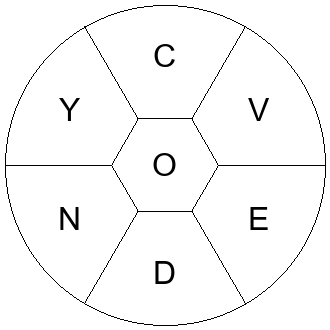
The official answers for today's puzzle are:

Click on the arrow to show the definition.
Click outside the pop-up to close it.


Number of Pangrams: 2

Maximum Puzzle Score: 251

Number of Answers: 51

Points Needed for Genius: 176

Genius requires between 24 and 44 words. You need at least a 7-letter word to reach genius. If you don't get the pangrams, you need 80% of the total points to reach genius. If you get the pangrams, you only need 66% of the remaining points to reach genius.

Other days with this pangram:

The button below will reveal a chart with the number of words by each letter. Red bars indicate that there is a pangram(s) starting with that letter.


How does this puzzle compare to other puzzles?

Today's score of 251 was in the 83rd percentile of all puzzles.
The last time there was a score this high was on August 10, 2025.
The highest score ever was 537 on January 22, 2021.
The lowest score ever was 47 on March 27, 2023.

This puzzle's 51 possible answers rank it in the 78th percentile of all puzzles.
The last time there were more answers than this was on August 10, 2025.
The highest number of answers was 81 on June 8, 2019.
The lowest number of answers was 16 on March 27, 2023.

It takes a 7-letter word for genius.
The last time this happened was on August 12, 2025.

Today's puzzle has an average word length of 5.5.
For all Bees, the average word length has been 5.3.


Haven't I seen these letters before?

Hover over a letter to see its first and most recent appearance in the Bee!


Haven't I seen these words before?

The most common words in the Bee are:

  • noon 208
  • loll 201
  • toot 193
  • naan 177
  • nana 177
  • lilt 144
  • till 144
  • tilt 144
  • tint 138
  • nene 137
  • mama 135
  • mamma 135
  • acacia 130
  • acai 130
  • onto 127
  • toon 127
  • onion 124
  • anon 120
  • anal 119
  • olio 116
  • dodo 115
  • tact 114
  • boob 113
  • booboo 113
  • papa 112
  • poop 112
  • baba 111
  • lull 110
  • lulu 110
  • call 108
  • calla 108
  • mitt 108
  • ratatat 106
  • tart 106
  • tartar 106
  • tutu 106
  • attar 105
  • mono 105
  • moon 105
  • tatty 105
  • ammo 104
  • cocci 104
  • momma 104
  • tattoo 104
  • allay 103
  • ally 103
  • loon 101
  • epee 100
  • peep 100
  • roar 99


How long are words in the Bee?

There have been 105,358 answers ever accepted in the Bee - with 10,716 unique words.
Below are the distributions of the lengths of these words.


Valid dictionary words not in today's official answers

You may be wondering why these words aren't here*:

  • coco
  • codded
  • codec
  • coden
  • coney
  • conn
  • cony
  • coocoo
  • cooee
  • cooeed
  • cooey
  • cooeyed
  • coon
  • coved
  • coyed
  • devon
  • donne
  • donnee
  • doodoo
  • doody
  • doven
  • dovened
  • dynode
  • eddo
  • eocene
  • neoned
  • noddy
  • voodooed

*Because the New York Times considers them obscure or offensive.

cocoon

noun
  1. The silky protective case spun by the larvae of some insects in which they metamorphose, the pupa.
  2. Any similar protective case, whether real or metaphorical.
verb
  1. To envelop in a protective case
  2. To withdraw into such a case.

cocooned

verb
  1. To envelop in a protective case
  2. To withdraw into such a case.

code

Etymology 1

noun
  1. A short symbol, often with little relation to the item it represents.
  2. A body of law, sanctioned by legislation, in which the rules of law to be specifically applied by the courts are set forth in systematic form; a compilation of laws by public authority; a digest.
  3. Any system of principles, rules or regulations relating to one subject.
  4. A set of rules for converting information into another form or representation.
  5. A message represented by rules intended to conceal its meaning.
  6. A cryptographic system using a codebook that converts words or phrases into codewords.
  7. Instructions for a computer, written in a programming language; the input of a translator, an interpreter or a browser, namely: source code, machine code, bytecode.
  8. (scientific programming) A program.
  9. A particular lect or language variety.
  10. An emergency requiring situation-trained members of the staff.
verb
  1. To write software programs.
  2. To add codes to a dataset.
  3. To categorise by assigning identifiers from a schedule, for example CPT coding for medical insurance purposes.
  4. To encode.
  5. To encode a protein.
  6. To call a hospital emergency code.

Etymology 2

verb
  1. Of a patient, to suffer a sudden medical emergency (a code blue) such as cardiac arrest.

coded

verb
  1. To write software programs.
  2. To add codes to a dataset.
  3. To categorise by assigning identifiers from a schedule, for example CPT coding for medical insurance purposes.
  4. To encode.
  5. To encode a protein.
  6. To call a hospital emergency code.
verb
  1. Of a patient, to suffer a sudden medical emergency (a code blue) such as cardiac arrest.
adjective
  1. Encoded; written in code or cipher.

codon

Etymology 1

noun
  1. A handbell used for summoning monks.
  2. The "bell" or flaring mouth of a trumpet.

Etymology 2

noun
  1. A sequence of three adjacent nucleotides, which encode for a specific amino acid during protein synthesis or translation.

coed

noun
  1. A young woman who attends college.
  2. A (generally young) woman, especially on the campus of a college or other educational institute.
adjective
  1. Of an educational institution, that teaches both males and females.
  2. Of any location, that mixes males and females.

concede

verb
  1. To yield or suffer; to surrender; to grant
  2. To grant, as a right or privilege; to make concession of.
  3. To admit to be true; to acknowledge.
  4. To yield or make concession.
  5. To have a goal or point scored against
  6. (of a bowler) to have runs scored off of one's bowling.

conceded

verb
  1. To yield or suffer; to surrender; to grant
  2. To grant, as a right or privilege; to make concession of.
  3. To admit to be true; to acknowledge.
  4. To yield or make concession.
  5. To have a goal or point scored against
  6. (of a bowler) to have runs scored off of one's bowling.

condo

noun
  1. Joint sovereignty over a territory by two or more countries.
  2. A region or territory under such rule.
  3. A building in which each unit is owned by an individual but the grounds, structure etc are owned jointly.
  4. The system of ownership by which such condominiums operate
  5. A unit or apartment in such a complex.
  6. The legal tenure involved.

condone

verb
  1. To forgive, excuse or overlook (something that is considered morally wrong, offensive, or generally disliked).
  2. To allow, accept or permit (something that is considered morally wrong, offensive, or generally disliked).
  3. To forgive (marital infidelity or other marital offense).

condoned

verb
  1. To forgive, excuse or overlook (something that is considered morally wrong, offensive, or generally disliked).
  2. To allow, accept or permit (something that is considered morally wrong, offensive, or generally disliked).
  3. To forgive (marital infidelity or other marital offense).

cone

noun
  1. A surface of revolution formed by rotating a segment of a line around another line that intersects the first line.
  2. A solid of revolution formed by rotating a triangle around one of its altitudes.
  3. A space formed by taking the direct product of a given space with a closed interval and identifying all of one end to a point.
  4. Anything shaped like a cone.
  5. The fruit of a conifer.
  6. A cone-shaped flower head of various plants, such as banksias and proteas.
  7. An ice cream cone.
  8. A traffic cone
  9. A unit of volume, applied solely to marijuana and only while it is in a smokable state; roughly 1.5 cubic centimetres, depending on use.
  10. Any of the small cone-shaped structures in the retina.
  11. The bowl piece on a bong.
  12. The process of smoking cannabis in a bong.
  13. A cone-shaped cannabis joint.
  14. A passenger on a cruise ship (so-called by employees after traffic cones, from the need to navigate around them)
  15. An object V together with an arrow going from V to each object of a diagram such that for any arrow A in the diagram, the pair of arrows from V which subtend A also commute with it. (Then V can be said to be the cone’s vertex and the diagram which the cone subtends can be said to be its base.)
  16. A shell of the genus Conus, having a conical form.
  17. A set of formal languages with certain desirable closure properties, in particular those of the regular languages, the context-free languages and the recursively enumerable languages.
verb
  1. To fashion into the shape of a cone.
  2. To form a cone shape.
  3. (frequently followed by "off") To segregate or delineate an area using traffic cones

coned

verb
  1. To fashion into the shape of a cone.
  2. To form a cone shape.
  3. (frequently followed by "off") To segregate or delineate an area using traffic cones
adjective
  1. (of an area) segregated or delineated by traffic cones

conned

verb
  1. To study or examine carefully, especially in order to gain knowledge of; to learn, or learn by heart.
  2. To know, understand, acknowledge.
verb
  1. To trick or defraud, usually for personal gain.
verb
  1. To direct a ship; to superintend the steering of (a vessel); to watch the course of (a vessel) and direct the helmsman how to steer (especially through a channel, etc, rather than steer a compass direction).

convene

verb
  1. To come together; to meet; to unite.
  2. To come together, as in one body or for a public purpose; to meet; to assemble.
  3. To cause to assemble; to call together; to convoke.
  4. To summon judicially to meet or appear.

convened

verb
  1. To come together; to meet; to unite.
  2. To come together, as in one body or for a public purpose; to meet; to assemble.
  3. To cause to assemble; to call together; to convoke.
  4. To summon judicially to meet or appear.

convey

verb
  1. To move (something) from one place to another.
  2. To take or carry (someone) from one place to another.
  3. To communicate; to make known; to portray.
  4. To transfer legal rights (to).
  5. To manage with privacy; to carry out.
  6. To carry or take away secretly; to steal; to thieve.

conveyed

verb
  1. To move (something) from one place to another.
  2. To take or carry (someone) from one place to another.
  3. To communicate; to make known; to portray.
  4. To transfer legal rights (to).
  5. To manage with privacy; to carry out.
  6. To carry or take away secretly; to steal; to thieve.

convoy

noun
  1. One or more merchant ships sailing in company to the same general destination under the protection of naval vessels.
  2. A group of vehicles travelling together for safety, especially one with an escort.
  3. The act of convoying; protection.
verb
  1. To escort a group of vehicles, and provide protection.

convoyed

verb
  1. To escort a group of vehicles, and provide protection.

cooed

verb
  1. To make a soft murmuring sound, as a pigeon.
  2. To speak in an admiring fashion, to be enthusiastic about.

cove

Etymology 1

noun
  1. A hollow in a rock; a cave or cavern.
  2. A concave vault or archway, especially the arch of a ceiling.
  3. A small coastal inlet, especially one having high cliffs protecting vessels from prevailing winds.
  4. A strip of prairie extending into woodland.
  5. A recess or sheltered area on the slopes of a mountain.
  6. The wooden roof of the stern gallery of an old sailing warship.
  7. A thin line, sometimes gilded, along a yacht's strake below deck level.
verb
  1. To arch over; to build in a hollow concave form; to make in the form of a cove.

Etymology 2

noun
  1. (thieves' cant) A fellow; a man.
  2. A friend; a mate.

Etymology 3

verb
  1. To brood, cover, over, or sit over, as birds their eggs.

coven

noun
  1. A formal group or assembly of witches.
  2. A family, group or assembly of vampires.
  3. A clique that shares common interests or activities.

covey

Etymology 1

noun
  1. A group of 8–12 (or more) quail.
  2. A brood of partridges, grouse, etc.
  3. A party or group (of persons or things).
verb
  1. To brood; to incubate.

Etymology 2

noun
  1. A man.

deco

Etymology 1

noun
  1. (underwater diving) Decompression.

Etymology 2

noun
  1. A friendship book in which people add decorative elements such as drawings, stickers and sequins.

decode

noun
  1. A product of decoding
  2. Output from a program or device used to interpret communication protocols
verb
  1. To convert from an encrypted form to plain text.
  2. To figure out something difficult to interpret.

decoded

verb
  1. To convert from an encrypted form to plain text.
  2. To figure out something difficult to interpret.

decoy

noun
  1. A person or object meant to lure somebody into danger.
  2. A real or fake animal used by hunters to lure game.
verb
  1. To lead into danger by artifice; to lure into a net or snare; to entrap.
  2. To act as, or use, a decoy.

decoyed

verb
  1. To lead into danger by artifice; to lure into a net or snare; to entrap.
  2. To act as, or use, a decoy.

dodo

Etymology 1

noun
  1. A large, flightless bird, †Raphus cucullatus, related to the pigeon, that is now extinct (since the 1600s) and was native to Mauritius.
  2. A person or organisation which is very old or has very old-fashioned views or is not willing to change and adapt.

Etymology 2

noun
  1. Fried plantain.

done

Etymology 1

verb
  1. (auxiliary) A syntactic marker.
  2. To perform; to execute.
  3. To cause, make (someone) (do something).
  4. To suffice.
  5. To be reasonable or acceptable.
  6. (ditransitive) To have (as an effect).
  7. To fare, perform (well or poorly).
  8. (chiefly in questions) To have as one's job.
  9. To perform the tasks or actions associated with (something).
  10. To cook.
  11. To travel in, to tour, to make a circuit of.
  12. To treat in a certain way.
  13. To work for or on, by way of caring for, looking after, preparing, cleaning, keeping in order, etc.
  14. To act or behave in a certain manner; to conduct oneself.
  15. To spend (time) in jail. (See also do time)
  16. To impersonate or depict.
  17. (with 'a' and the name of a person, place, event, etc.) To copy or emulate the actions or behaviour that is associated with the person or thing mentioned.
  18. To kill.
  19. To deal with for good and all; to finish up; to undo; to ruin; to do for.
  20. To punish for a misdemeanor.
  21. To have sex with. (See also do it)
  22. To cheat or swindle.
  23. To convert into a certain form; especially, to translate.
  24. To finish.
  25. To work as a domestic servant (with for).
  26. (auxiliary) Used to form the present progressive of verbs.
  27. To cash or to advance money for, as a bill or note.
  28. (ditransitive) To make or provide.
  29. To injure (one's own body part).
  30. To take drugs.
  31. (in the form be doing [somewhere]) To exist with a purpose or for a reason.
adjective
  1. (of food) Ready, fully cooked.
  2. Having completed or finished an activity.
  3. Being exhausted or fully spent.
  4. Without hope or prospect of completion or success.
  5. Fashionable, socially acceptable, tasteful.

Etymology 2

noun
  1. A synthetic opioid analgesic, used to wean addicts off heroin or other opiate based narcotics, and in chronic pain management.

donee

noun
  1. Someone who receives a gift from a donor.

donned

verb
  1. (clothing) To put on, to dress in.

dove

Etymology 1

noun
  1. A pigeon, especially one smaller in size; a bird (often arbitrarily called either a pigeon or a dove or both) of more than 300 species of the family Columbidae.
  2. A person favouring conciliation and negotiation rather than conflict.
  3. Term of endearment for one regarded as pure and gentle.
  4. A greyish, bluish, pinkish colour like that of the bird.

Etymology 2

verb
  1. To swim under water.
  2. To jump into water head-first.
  3. To jump headfirst toward the ground or into another substance.
  4. To descend sharply or steeply.
  5. (especially with in) To undertake with enthusiasm.
  6. To deliberately fall down after a challenge, imitating being fouled, in the hope of getting one's opponent penalised.
  7. To cause to descend, dunk; to plunge something into water.
  8. To explore by diving; to plunge into.
  9. To plunge or to go deeply into any subject, question, business, etc.; to penetrate; to explore.

doyen

noun
  1. A commander in charge of ten men.
  2. The senior, or eldest male member of a group.
  3. A leading light, or exemplar of a particular practice or movement.

doyenne

noun
  1. A female doyen.
  2. The senior or eldest female member of a group, especially one who is most or highly respected.
  3. A woman who is highly experienced and knowledgeable in a particular field, subject, or line of work; expert

encode

verb
  1. To convert (plain text) into code.
  2. (communication) To convert source information into another form.
  3. To constitute the code necessary for the biosynthesis of a protein by means of a matrix so as to transcribe DNA material.

encoded

verb
  1. To convert (plain text) into code.
  2. (communication) To convert source information into another form.
  3. To constitute the code necessary for the biosynthesis of a protein by means of a matrix so as to transcribe DNA material.

envoy

noun
  1. A short stanza at the end of a poem, used either to address a person or to comment on the preceding body of the poem.
noun
  1. A diplomatic agent of the second rank, next in status after an ambassador.
  2. A representative.
  3. A diplomat.
  4. A messenger.

neocon

noun
  1. A neoconservative.

neon

noun
  1. The chemical element (symbol Ne) with an atomic number of 10. The lightest of the noble gases, it is a colourless, odorless inert gas.
  2. A form or sample of the element.
  3. Neon signs or lights, collectively.
  4. A neon tetra fish.
adjective
  1. (of a color) That resembles a neon light; extremely bright; fluorescent

nodded

verb
  1. To incline the head up and down, as to indicate agreement.
  2. To briefly incline the head downwards as a cursory greeting.
  3. To sway, move up and down.
  4. To gradually fall asleep.
  5. To signify by a nod.
  6. To make a mistake by being temporarily inattentive or tired
  7. To head; to strike the ball with one's head.
  8. To allude to something.
  9. To fall asleep while under the influence of opiates.

node

noun
  1. A knot, knob, protuberance or swelling.
  2. The point where the orbit of a planet, as viewed from the Sun, intersects the ecliptic. The ascending and descending nodes refer respectively to the points where the planet moves from South to North and N to S; their respective symbols are ☊ and ☋.
  3. A leaf node.
  4. A computer or other device attached to a network.
  5. The point at which the lines of a funicular machine meet from different angular directions; — called also knot.
  6. The point at which a curve crosses itself, being a double point of the curve. See crunode and acnode.
  7. A similar point on a surface, where there is more than one tangent-plane.
  8. A vertex or a leaf in a graph of a network, or other element in a data structure.
  9. A hard concretion or incrustation which forms upon bones attacked with rheumatism, gout, or syphilis; sometimes also, a swelling in the neighborhood of a joint.
  10. A point along a standing wave where the wave has minimal amplitude.
  11. The knot, intrigue, or plot of a dramatic work.
  12. A hole in the gnomon of a sundial, through which passes the ray of light which marks the hour of the day, the parallels of the Sun's declination, his place in the ecliptic, etc.
  13. The word of interest in a KWIC, surrounded by left and right cotexts.

nonce

Etymology 1

noun
  1. The one or single occasion; the present reason or purpose (now only in for the nonce).
  2. A nonce word.
  3. A value constructed so as to be unique to a particular message in a stream, in order to prevent replay attacks.
adjective
  1. One-off; produced or created for a single occasion or use. Denoting something occurring once.

Etymology 2

noun
  1. (prisons) A sex offender, especially one who is guilty of sexual offences against children.
  2. (prisons) A police informer, one who betrays a criminal enterprise
  3. A stupid or worthless person.

none

Etymology 1

noun
  1. A person without religious affiliation.
adverb
  1. To no extent, in no way.
  2. Not at all, not very.
  3. No, not.
pronoun
  1. Not any of a given number or group.

Etymology 2

noun
  1. Those without any religious affiliation: atheists and others outside any organized religion.
noun
  1. A light meal usually eaten around midday, notably when not as main meal of the day.
  2. A break in play between the first and second sessions.
  3. (Minnesota) Any small meal, especially one eaten at a social gathering.
noun
  1. The middle of the afternoon, normally between 2 and 4 pm.
noun
  1. (often capitalized) The notional first-quarter day of a Roman month, occurring on the 7th day of the four original 31-day months (March, May, Quintilis or July, and October) and on the 5th day of all other months.
  2. (sometimes capitalized) The ninth hour after dawn (about 3 pm).
  3. The divine office appointed to the hour.
noun
  1. The ninth hour of the day counted from sunrise; around three o'clock in the afternoon.
  2. Time of day when the sun is in its zenith; twelve o'clock in the day, midday.
  3. The corresponding time in the middle of the night; midnight.
  4. The highest point; culmination.
noun
  1. The letter ن in the Arabic script.

noon

Etymology 1

noun
  1. The ninth hour of the day counted from sunrise; around three o'clock in the afternoon.
  2. Time of day when the sun is in its zenith; twelve o'clock in the day, midday.
  3. The corresponding time in the middle of the night; midnight.
  4. The highest point; culmination.
verb
  1. To relax or sleep around midday

Etymology 2

noun
  1. The letter ن in the Arabic script.

odeon

noun
  1. An ancient Greek or Roman building used for performances of music and poetry.
  2. A theatre or concert hall.

once

adverb
  1. (frequency) One and only one time.
  2. (temporal location) Formerly; during some period in the past.
  3. Multiplied by one: indicating that a number is multiplied by one.
  4. As soon as.
  5. At a future time.
conjunction
  1. As soon as; when; after.

oven

noun
  1. A chamber used for baking or heating.

voodoo

noun
  1. Any of a group of related religious practices found chiefly in and around the Caribbean, particularly in Haiti and Louisiana.
  2. The spiritual beliefs of the Ewe/Fon of West Africa, practiced chiefly in Benin and in the south of Togo.
  3. Any sort of magical or irrational approach to a problem.
  4. One who practices voodoo; a native sorcerer.
verb
  1. To bewitch someone or something using voodoo

yond

Etymology 1

adjective
  1. Further; more distant
  2. Yonder
adverb
  1. Yonder

Etymology 2

adjective
  1. Furious; mad; angry; fierce.