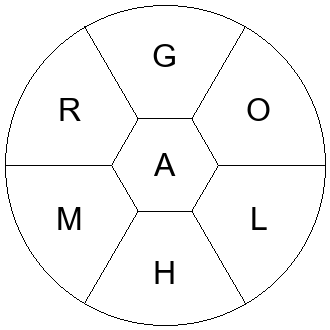
Friday, September 26, 2025

Answers to yesterday's Bee

Jump to answers for


The official answers for today's puzzle are:

Click on the arrow to show the definition.
Click outside the pop-up to close it.


Number of Pangrams: 1

Maximum Puzzle Score: 196

Number of Answers: 53

Points Needed for Genius: 137

Genius requires between 22 and 46 words. You need at least a 6-letter word to reach genius. If you don't get the pangram, you need 76% of the total points to reach genius. If you get the pangram, you only need 67% of the remaining points to reach genius.

Other days with this pangram:

The button below will reveal a chart with the number of words by each letter. Red bars indicate that there is a pangram(s) starting with that letter.


How does this puzzle compare to other puzzles?

Today's score of 196 was in the 63rd percentile of all puzzles.
The last time there was a score this high was on September 25, 2025.
The highest score ever was 537 on January 22, 2021.
The lowest score ever was 47 on March 27, 2023.

This puzzle's 53 possible answers rank it in the 81st percentile of all puzzles.
The last time there were more answers than this was on September 24, 2025.
The highest number of answers was 81 on June 8, 2019.
The lowest number of answers was 16 on March 27, 2023.

It takes a 6-letter word for genius.
The last time this happened was on September 24, 2025.

Today's puzzle has an average word length of 4.9.
For all Bees, the average word length has been 5.3.


Haven't I seen these letters before?

Hover over a letter to see its first and most recent appearance in the Bee!


Haven't I seen these words before?

The most common words in the Bee are:

  • noon 213
  • loll 203
  • toot 196
  • naan 180
  • nana 180
  • lilt 144
  • till 144
  • tilt 144
  • mama 139
  • mamma 139
  • nene 139
  • tint 139
  • acacia 133
  • acai 133
  • onto 130
  • toon 130
  • onion 126
  • anal 122
  • anon 121
  • dodo 118
  • tact 118
  • olio 116
  • boob 115
  • booboo 115
  • baba 114
  • papa 113
  • poop 113
  • lull 111
  • lulu 111
  • call 109
  • calla 109
  • mitt 108
  • mono 107
  • moon 107
  • ratatat 107
  • tart 107
  • tartar 107
  • tutu 107
  • allay 106
  • ally 106
  • attar 106
  • cocci 106
  • tattoo 106
  • ammo 105
  • loon 105
  • momma 105
  • tatty 105
  • epee 101
  • peep 101
  • roar 100


How long are words in the Bee?

There have been 107,275 answers ever accepted in the Bee - with 10,801 unique words.
Below are the distributions of the lengths of these words.


Valid dictionary words not in today's official answers

You may be wondering why these words aren't here*:

  • aarrgh
  • aarrghh
  • agama
  • aggro
  • agha
  • agloo
  • agma
  • agro
  • alamo
  • alar
  • algor
  • alma
  • almah
  • amah
  • argal
  • argala
  • argh
  • argol
  • galago
  • galah
  • gama
  • gaol
  • gloam
  • gooral
  • goral
  • graal
  • graham
  • grama
  • grogram
  • haar
  • haha
  • halala
  • halalah
  • hallah
  • hallal
  • hallo
  • halloa
  • halloo
  • halm
  • halma
  • hamal
  • hammal
  • hammam
  • harl
  • holla
  • holloa
  • homa
  • horah
  • horal
  • lahal
  • lahar
  • lall
  • loral
  • maar
  • magalog
  • malar
  • malaroma
  • malm
  • mara
  • marl
  • marram
  • mola
  • molal
  • mollah
  • mora
  • ogam
  • ogham
  • olla
  • orra
  • ragg
  • ragga
  • ramal

*Because the New York Times considers them obscure or offensive.

aargh

interjection
  1. Expressing annoyance, dismay, embarrassment or frustration.

agar

noun
  1. A gelatinous material obtained from red algae, especially Gracilaria species, used as a bacterial culture medium, in electrophoresis and as a food additive.
  2. A culture medium based on this material.

agog

adjective
  1. In eager desire, eager, astir.
  2. (chiefly of eyes) Wide open.
adverb
  1. In a state of high anticipation, excitement, or interest.

agora

Etymology 1

noun
  1. A place for gathering.
  2. A marketplace, especially in Classical Greece.

Etymology 2

noun
  1. Since 1960, a monetary unit and coin of Israel, the 100th part of a shekel / sheqel.

alarm

noun
  1. A summons to arms, as on the approach of an enemy.
  2. Any sound or information intended to give notice of approaching danger; a warning sound to arouse attention; a warning of danger.
  3. A sudden attack; disturbance.
  4. Sudden surprise with fear or terror excited by apprehension of danger; in the military use, commonly, sudden apprehension of being attacked by surprise.
  5. A mechanical device for awaking people, or rousing their attention.
  6. An instance of an alarm ringing, beeping or clanging, to give a noise signal at a certain time.
verb
  1. To call to arms for defense
  2. To give (someone) notice of approaching danger
  3. To rouse to vigilance and action; to put on the alert.
  4. To surprise with apprehension of danger; to fill with anxiety in regard to threatening evil; to excite with sudden fear.
  5. To keep in excitement; to disturb.

alga

noun
  1. Any of many aquatic photosynthetic organisms, including the seaweeds, whose size ranges from a single cell to giant kelps and whose biochemistry and forms are very diverse, some being eukaryotic.

algal

noun
  1. An alga.
adjective
  1. Pertaining to, or like, algae

aloha

noun
  1. Good wishes, love.
  2. An utterance of aloha (see Interjection, below).
interjection
  1. Expressing good wishes when greeting or parting from someone; hello; goodbye.

amalgam

noun
  1. An alloy containing mercury.
  2. A combination of different things.
  3. One of the ingredients in an alloy.
verb
  1. To amalgamate.

ammo

noun
  1. Ammunition.
verb
  1. To load up on ammunition.

amoral

adjective
  1. (of acts) Neither moral nor immoral.
  2. (of people) Not believing in or caring for morality and immorality.

armor

noun
  1. A protective layer over a body, vehicle, or other object intended to deflect or diffuse damaging forces.
  2. A natural form of this kind of protection on an animal's body.
  3. Metal plate, protecting a ship, military vehicle, or aircraft.
  4. A tank, or other heavy mobile assault vehicle.
  5. A military formation consisting primarily of tanks or other armoured fighting vehicles, collectively.
  6. The naturally occurring surface of pebbles, rocks or boulders that line the bed of a waterway or beach and provide protection against erosion.
verb
  1. To equip something with armor or a protective coating or hardening.
  2. To provide something with an analogous form of protection.

aroma

noun
  1. A smell; especially a pleasant spicy or fragrant one.

gaga

Etymology 1

adjective
  1. Mentally senile.
  2. Crazy.
  3. Infatuated.

Etymology 2

noun
  1. A variant of dodgeball played inside a fenced area, usually a hexagon or octagon.

gala

Etymology 1

noun
  1. Pomp, show, or festivity.
  2. A showy and festive party.
adjective
  1. Celebratory; festive.

Etymology 2

noun
  1. A member of an androgynous class of priests of the Sumerian goddess Inanna.

gall

Etymology 1

noun
  1. Bile, especially that of an animal; the greenish, profoundly bitter-tasting fluid found in bile ducts and gall bladders, structures associated with the liver.
  2. The gall bladder.
  3. Great misery or physical suffering, likened to the bitterest-tasting of substances.
  4. A feeling of exasperation.
  5. Impudence or brazenness; temerity, chutzpah.
  6. A sore or open wound caused by chafing, which may become infected, as with a blister.
  7. A sore on a horse caused by an ill-fitted or ill-adjusted saddle; a saddle sore.
  8. A pit on a surface being cut caused by the friction between the two surfaces exceeding the bond of the material at a point.
verb
  1. To bother or trouble.
  2. To harass, to harry, often with the intent to cause injury.
  3. To chafe, to rub or subject to friction; to create a sore on the skin.
  4. To exasperate.
  5. To cause pitting on a surface being cut from the friction between the two surfaces exceeding the bond of the material at a point.
  6. To scoff; to jeer.

Etymology 2

noun
  1. A blister or tumor-like growth found on the surface of plants, caused by burrowing of insect larvae into the living tissues, especially that of the common oak gall wasp Cynips quercusfolii.
  2. A bump-like imperfection resembling a gall.
verb
  1. To impregnate with a decoction of gallnuts in dyeing.

gamma

noun
  1. The third letter of the Greek alphabet (Γ, γ), preceded by beta (Β, β) and followed by delta, (Δ, δ).
  2. The Gamma function, symbolized by Γ.
  3. A constant approximately equal to 0.55721566, symbolized by γ (also known as the Euler–Mascheroni constant).
  4. A non-SI unit of measure of magnetic flux density, equal to 1 nT.
  5. (industries) slope of log-log plot of video input and luminance output.
  6. A second-order measure of derivative price sensitivity, expressed as the rate of change in delta with respect to changes in the underlying asset price.
noun
  1. A nonlinear operation used to encode and decode luminance or tristimulus values in video or still image systems.

glam

noun
  1. Glamour.
  2. A style of rock music, glam rock, associated with an androgynous yet masculine look and a driving, pounding bluesy form of psychedelic rock; the fashion and culture associated with this genre.
verb
  1. To make glamorous or more glamorous.
adjective
  1. Glamorous.

glamor

noun
  1. Originally, enchantment; magic charm; especially, the effect of a spell that causes one to see objects in a form that differs from reality, typically to make filthy, ugly, or repulsive things seems beauteous.
  2. Alluring beauty or charm (often with sex appeal).
  3. Any excitement, appeal, or attractiveness associated with a person, place, or thing; that which makes something appealing.
  4. Any artificial interest in, or association with, an object, or person, through which it or they appear delusively magnified or glorified.
  5. A kind of haze in the air, causing things to appear different from what they really are.
  6. An item, motif, person, image that by association improves appearance.
verb
  1. To enchant; to bewitch.

goal

noun
  1. A result that one is attempting to achieve.
  2. In many sports, an area into which the players attempt to put an object.
  3. The act of placing the object into the goal.
  4. A point scored in a game as a result of placing the object into the goal.
  5. A noun or noun phrase that receives the action of a verb. The subject of a passive verb or the direct object of an active verb. Also called a patient, target, or undergoer.
verb
  1. To score a goal.

gram

Etymology 1

noun
  1. A unit of mass equal to one-thousandth of a kilogram. Symbol: g

Etymology 2

noun
  1. A leguminous plant grown for its seeds, especially the chickpea.
  2. The seeds of these plants.

Etymology 3

noun
  1. Grandmother

Etymology 4

adjective
  1. Angry

Etymology 5

noun
  1. A photograph or video shared on this service.

gramma

Etymology 1

noun
  1. Grandmother

Etymology 2

noun
  1. A variety of pumpkin, a cultivar of Cucurbita moschata.

grammar

noun
  1. A system of rules and principles for speaking and writing a language.
  2. The study of the internal structure of words (morphology) and the use of words in the construction of phrases and sentences (syntax).
  3. A book describing the rules of grammar of a language.
  4. A formal system specifying the syntax of a language.
  5. Actual or presumed prescriptive notions about the correct use of a language.
  6. A formal system defining a formal language
  7. The basic rules or principles of a field of knowledge or a particular skill.
  8. A textbook.
  9. A grammar school.
verb
  1. To discourse according to the rules of grammar; to use grammar.

halal

verb
  1. To make halal.
adjective
  1. Permissible, according to Muslim religious customs, to have or do.
  2. (of food) Fit to eat according to Muslim religious customs.
adverb
  1. In a halal manner; in accordance with Muslim religious customs.

hall

noun
  1. A corridor; a hallway.
  2. A meeting room.
  3. A manor house (originally because a magistrate's court was held in the hall of his mansion).
  4. A building providing student accommodation at a university.
  5. The principal room of a secular medieval building.
  6. Cleared passageway through a crowd, as for dancing.
  7. A place for special professional education, or for conferring professional degrees or licences.
  8. A living room.

halo

noun
  1. A circular band of coloured light, visible around the sun or moon etc., caused by reflection and refraction of light by ice crystals in the atmosphere.
  2. A cloud of gas and other matter surrounding and captured by the gravitational field of a large diffuse astronomical object, such as a galaxy or cluster of galaxies.
  3. Anything resembling this band, such as an effect caused by imperfect developing of photographs.
  4. Nimbus, a luminous disc, often of gold, around or over the heads of saints, etc., in religious paintings.
  5. The metaphorical aura of glory, veneration or sentiment which surrounds an idealized entity.
  6. (iconography) a circular annulus ring, frequently luminous, often golden, floating above the head
  7. A circular brace used to keep the head and neck in position.
  8. A rollbar placed in front of the driver, used to protect the cockpit of a open cockpit racecar.
verb
  1. To encircle with a halo.

haram

noun
  1. A sin.
adjective
  1. (fiqh) Forbidden by Islam: unlawful, sinful.

harm

noun
  1. Physical injury; hurt; damage
  2. Emotional or figurative hurt
  3. Detriment; misfortune.
  4. That which causes injury, damage, or loss.
verb
  1. To cause injury to another; to hurt; to cause damage to something.

hoar

noun
  1. A white or greyish-white colour.
  2. Hoariness; antiquity.
verb
  1. To become mouldy or musty.
adjective
  1. Of a white or greyish-white colour.
  2. Hoarily bearded.
  3. Musty; mouldy; stale.

hologram

noun
  1. A three-dimensional image of an object created by holography.

hoorah

No Definition Found.

hora

Etymology 1

noun
  1. A circle dance popular in the Balkans, Israel and Yiddish culture worldwide.

Etymology 2

noun
  1. A branch of traditional Indian astrology, dealing with the finer points of predictive methods.

lama

Etymology 1

noun
  1. A master of Tibetan Buddhism.

Etymology 2

noun
  1. A South American mammal of the camel family, Lama glama, used as a domestic beast of burden and a source of wool and meat.

largo

noun
  1. A very slow tempo
  2. A musical piece or movement in such a tempo
adjective
  1. Strong and stately

llama

noun
  1. A South American mammal of the camel family, Lama glama, used as a domestic beast of burden and a source of wool and meat.

loam

noun
  1. A type of soil; an earthy mixture of sand, silt and clay, with organic matter to which its fertility is chiefly due.
  2. A mixture of sand, clay, and other materials, used in making moulds for large castings, often without a pattern.
verb
  1. To cover, smear, or fill with loam.
adjective
  1. Made of loam; consisting of loam.

logogram

noun
  1. A character or symbol that represents a word or phrase.
  2. A kind of word puzzle: a logogriph.

magma

noun
  1. The molten matter within the earth, the source of the material of lava flows, dikes of eruptive rocks, etc.
  2. A basic algebraic structure consisting of a set equipped with a single binary operation.
  3. Any soft doughy mass.
  4. The residuum after expressing the juice from fruits.

mall

noun
  1. A pedestrianised street, especially a shopping precinct.
  2. An enclosed shopping centre.
  3. An alley where the game of pall mall was played.
  4. A public walk; a level shaded walk, a promenade.
  5. A heavy wooden mallet or hammer used in the game of pall mall.
  6. The game of polo.
  7. An old game played with malls or mallets and balls; pall mall.
verb
  1. To beat with a mall, or mallet; to beat with something heavy; to bruise
  2. To build up with the development of shopping malls
  3. To shop at the mall

mama

noun
  1. (hypocoristic, usually childish) Mother, female parent.

mamma

Etymology 1

noun
  1. The milk-secreting organ of female humans and other mammals which includes the mammary gland and the nipple or teat; a breast; an udder. (plural: mammae)
  2. An accessory cloud like a mammary in appearance, which can form on the underside of most cloud genera

Etymology 2

noun
  1. (hypocoristic, usually childish) Mother, female parent.

mammal

noun
  1. An animal of the class Mammalia, characterized by being warm-blooded, having hair and feeding milk to its young.
  2. A vertebrate with three bones in the inner ear and one in the jaw.

mammogram

noun
  1. An X-ray picture of the breasts (mammaries), used to screen for breast cancer.

molar

Etymology 1

noun
  1. A back tooth having a broad surface used for grinding one's food.
adjective
  1. Of or relating to the molar teeth, or to grinding.

Etymology 2

noun
  1. A unit of concentration equal to one mole per litre.
adjective
  1. Of, relating to, or being a solution containing one mole of solute per litre of solution.
  2. Of or relating to a complete body of matter as distinct from its molecular or atomic constituents.

momma

noun
  1. Mother
  2. A voluptuous woman.
  3. One's wife or girlfriend.

moola

noun
  1. Money, cash.

moolah

Etymology 1

noun
  1. A religious scholar and teacher of sharia law.

Etymology 2

noun
  1. Money, cash.

moral

noun
  1. (of a narrative) The ethical significance or practical lesson.
  2. (chiefly in the plural) Moral practices or teachings: modes of conduct.
  3. A morality play.
  4. A moral certainty.
  5. An exact counterpart.
verb
  1. To moralize.
adjective
  1. Of or relating to principles of right and wrong in behaviour, especially for teaching right behaviour.
  2. Conforming to a standard of right behaviour; sanctioned by or operative on one's conscience or ethical judgment.
  3. Capable of right and wrong action.
  4. Probable but not proved.
  5. Positively affecting the mind, confidence, or will.

oral

noun
  1. A spoken test or examination, particularly in a language class.
  2. A physical examination of the mouth.
  3. Oral sex.
adjective
  1. Relating to the mouth.
  2. Spoken rather than written.

raga

noun
  1. Any of various melodic forms used in Indian classical music, or a piece of music composed in such a form.
  2. Passion, love, lust.

roam

verb
  1. To wander or travel freely and with no specific destination.
  2. To use a network or service from different locations or devices.
  3. To transmit (resources) between different locations or devices, to allow comparable usage from any of them.
  4. To range or wander over.

roar

noun
  1. A long, loud, deep shout, as of rage or laughter, made with the mouth wide open.
  2. The cry of the lion.
  3. The deep cry of the bull.
  4. A loud resounding noise.
  5. A show of strength or character.
verb
  1. To make a loud, deep cry, especially from pain, anger, or other strong emotion.
  2. To laugh in a particularly loud manner.
  3. Of animals (especially the lion), to make a loud deep noise.
  4. Generally, of inanimate objects etc., to make a loud resounding noise.
  5. To proceed vigorously.
  6. To cry aloud; to proclaim loudly.
  7. To be boisterous; to be disorderly.
  8. To make a loud noise in breathing, as horses do when they have a certain disease.
  9. (North Midlands) to cry

marm

noun
  1. Madam; a polite term of address for a lady.