Sunday, October 5, 2025

Answers to yesterday's Bee

Jump to answers for


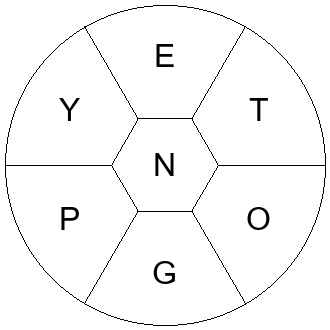
The official answers for today's puzzle are:

Click on the arrow to show the definition.
Click outside the pop-up to close it.


Number of Pangrams: 1

Maximum Puzzle Score: 149

Number of Answers: 45

Points Needed for Genius: 104

Genius requires between 16 and 40 words. You need at least a 6-letter word to reach genius. If you don't get the pangram, you need 78% of the total points to reach genius. If you get the pangram, you only need 66% of the remaining points to reach genius.

Other days with this pangram:

The button below will reveal a chart with the number of words by each letter. Red bars indicate that there is a pangram(s) starting with that letter.


How does this puzzle compare to other puzzles?

Today's score of 149 was in the 39th percentile of all puzzles.
The last time there was a score this low was on September 29, 2025.
The highest score ever was 537 on January 22, 2021.
The lowest score ever was 47 on March 27, 2023.

This puzzle's 45 possible answers rank it in the 64th percentile of all puzzles.
The last time there were more answers than this was on October 3, 2025.
The highest number of answers was 81 on June 8, 2019.
The lowest number of answers was 16 on March 27, 2023.

It takes a 6-letter word for genius.
The last time this happened was on September 29, 2025.

Today's puzzle has an average word length of 4.8.
For all Bees, the average word length has been 5.3.


Haven't I seen these letters before?

Hover over a letter to see its first and most recent appearance in the Bee!


Haven't I seen these words before?

The most common words in the Bee are:

  • noon 216
  • loll 203
  • toot 197
  • naan 180
  • nana 180
  • lilt 146
  • till 146
  • tilt 146
  • nene 140
  • tint 140
  • mama 139
  • mamma 139
  • acacia 133
  • acai 133
  • onto 132
  • toon 132
  • onion 128
  • anal 122
  • anon 121
  • dodo 119
  • tact 118
  • olio 117
  • boob 115
  • booboo 115
  • baba 114
  • papa 114
  • poop 114
  • lull 111
  • lulu 111
  • call 109
  • calla 109
  • mitt 108
  • mono 108
  • moon 108
  • cocci 107
  • ratatat 107
  • tart 107
  • tartar 107
  • tutu 107
  • allay 106
  • ally 106
  • attar 106
  • tattoo 106
  • ammo 105
  • loon 105
  • momma 105
  • tatty 105
  • epee 101
  • peep 101
  • roar 100


How long are words in the Bee?

There have been 107,676 answers ever accepted in the Bee - with 10,817 unique words.
Below are the distributions of the lengths of these words.


Valid dictionary words not in today's official answers

You may be wondering why these words aren't here*:

  • eyen
  • eyne
  • genet
  • genette
  • gentoo
  • gooney
  • gyno
  • neep
  • neogene
  • neoteny
  • neotype
  • netop
  • nett
  • nogg
  • nonego
  • oogeny
  • pengo
  • pennon
  • pentene
  • peptone
  • ponent
  • pongo
  • pongy
  • ponton
  • poon
  • poteen
  • potteen
  • tenge
  • tenne
  • tenno
  • tenny
  • tenpenny
  • tenty
  • tonette
  • toney
  • toyon
  • tyne

*Because the New York Times considers them obscure or offensive.

eggnog

noun
  1. A beverage based on milk, eggs, sugar, and nutmeg; often made alcoholic with rum, brandy or whisky; popular at Christmas.

entente

noun
  1. An informal alliance or friendly understanding between two states.

gene

noun
  1. A theoretical unit of heredity of living organisms; a gene may take several values and in principle predetermines a precise trait of an organism's form (phenotype), such as hair color.
  2. A segment of DNA or RNA from a cell's or an organism's genome, that may take several forms and thus parameterizes a phenomenon, in general the structure of a protein; locus.

genotype

Etymology 1

noun
  1. The part (DNA sequence) of the genetic makeup of an organism which determines a specific characteristic (phenotype) of that organism.
  2. A group of organisms having the same genetic constitution.
verb
  1. To determine the genotype of.

Etymology 2

noun
  1. The type species of a genus; generitype.

gent

Etymology 1

noun
  1. A gentleman.

Etymology 2

adjective
  1. Noble; well-bred, courteous; graceful.
  2. Neat; pretty; elegant

Etymology 3

noun
  1. Short for gentamicin.

gone

verb
  1. To move:
  2. (chiefly of a machine) To work or function (properly); to move or perform (as required).
  3. To start; to begin (an action or process).
  4. To take a turn, especially in a game.
  5. To attend.
  6. To proceed:
  7. To follow or travel along (a path):
  8. To extend (from one point in time or space to another).
  9. To lead (to a place); to give access to.
  10. To become. (The adjective that follows usually describes a negative state.)
  11. To assume the obligation or function of; to be, to serve as.
  12. To continuously or habitually be in a state.
  13. To come to (a certain condition or state).
  14. To change (from one value to another) in the meaning of wend.
  15. To turn out, to result; to come to (a certain result).
  16. To tend (toward a result).
  17. To contribute to a (specified) end product or result.
  18. To pass, to be used up:
  19. To die.
  20. To be discarded.
  21. To be lost or out:
  22. To break down or apart:
  23. To be sold.
  24. To be given, especially to be assigned or allotted.
  25. To survive or get by; to last or persist for a stated length of time.
  26. To have a certain record.
  27. To be authoritative, accepted, or valid:
  28. To say (something), to make a sound:
  29. To be expressed or composed (a certain way).
  30. To resort (to).
  31. To apply or subject oneself to:
  32. To fit (in a place, or together with something):
  33. To date.
  34. To attack:
  35. To be in general; to be usually.
  36. To take (a particular part or share); to participate in to the extent of.
  37. To yield or weigh.
  38. To offer, bid or bet an amount; to pay.
  39. To enjoy. (Compare go for.)
  40. To urinate or defecate.
adjective
  1. Away, having left.
  2. No longer part of the present situation.
  3. No longer existing, having passed.
  4. Used up.
  5. Dead.
  6. Intoxicated to the point of being unaware of one's surroundings.
  7. Entirely given up to; infatuated with; used with on.
  8. Excellent; wonderful.
  9. Ago (used post-positionally).
  10. Weak; faint; feeling a sense of goneness.
  11. Of an arrow: wide of the mark.
preposition
  1. Past, after, later than (a time).

gong

Etymology 1

noun
  1. A percussion instrument consisting of a metal disk that emits a sonorous sound when struck with a soft hammer.
  2. A medal or award, particularly Knight Bachelor.
verb
  1. To make the sound of a gong; to ring a gong.
  2. To send a signal to, using a gong or similar device.
  3. To give an award or medal to.

Etymology 2

noun
  1. An outhouse: an outbuilding used as a lavatory.
  2. The contents of an outhouse pit: shit.

Etymology 3

noun
  1. A kind of cultivation energy, more powerful than qi.
  2. An advanced practice that cultivates such energy.

goon

Etymology 1

noun
  1. A thug; a usually muscular henchman with little intelligence (also known as a 'hired goon').
  2. A fool; someone considered silly, stupid, awkward, or outlandish.
  3. An enforcer or fighter.
  4. (WWII, PoW slang) A German guard in a prisoner-of-war camp.
  5. A member of the comedy web site Something Awful.

Etymology 2

noun
  1. A wine flagon or cask.
  2. Cheap or inferior cask wine.

goony

No Definition Found.

gotten

verb
  1. (ditransitive) To obtain; to acquire.
  2. To receive.
  3. (in a perfect construction, with present-tense meaning) To have. See usage notes.
  4. To fetch, bring, take.
  5. To become, or cause oneself to become.
  6. To cause to become; to bring about.
  7. To cause to do.
  8. To cause to come or go or move.
  9. To cause to be in a certain status or position.
  10. (with various prepositions, such as into, over, or behind; for specific idiomatic senses see individual entries get into, get over, etc.) To adopt, assume, arrive at, or progress towards (a certain position, location, state).
  11. To cover (a certain distance) while travelling.
  12. To begin (doing something or to do something).
  13. To take or catch (a scheduled transportation service).
  14. To respond to (a telephone call, a doorbell, etc).
  15. (followed by infinitive) To be able, be permitted, or have the opportunity (to do something desirable or ironically implied to be desirable).
  16. To understand. (compare get it)
  17. To be told; be the recipient of (a question, comparison, opinion, etc.).
  18. To be. Used to form the passive of verbs.
  19. To become ill with or catch (a disease).
  20. To catch out, trick successfully.
  21. To perplex, stump.
  22. To find as an answer.
  23. To bring to reckoning; to catch (as a criminal); to effect retribution.
  24. To hear completely; catch.
  25. To getter.
  26. To beget (of a father).
  27. To learn; to commit to memory; to memorize; sometimes with out.
  28. Used with a personal pronoun to indicate that someone is being pretentious or grandiose.
  29. To go, to leave; to scram.
  30. To kill.
  31. To make acquisitions; to gain; to profit.
  32. To measure.
adjective
  1. (mostly in combination) obtained, acquired

nene

noun
  1. The Hawaiian goose, Branta sandvicensis, which was designated the state bird of Hawaii in 1957.

neon

noun
  1. The chemical element (symbol Ne) with an atomic number of 10. The lightest of the noble gases, it is a colourless, odorless inert gas.
  2. A form or sample of the element.
  3. Neon signs or lights, collectively.
  4. A neon tetra fish.
adjective
  1. (of a color) That resembles a neon light; extremely bright; fluorescent

netty

Etymology 1

adjective
  1. Neat, well-groomed, natty.

Etymology 2

adjective
  1. Netted: made of or employing a net.
  2. Netlike.

Etymology 3

noun
  1. An outhouse: an outbuilding used as a lavatory.
  2. Any other place or fixture used for urination and defecation: a lavatory; a toilet.

none

Etymology 1

noun
  1. A person without religious affiliation.
adverb
  1. To no extent, in no way.
  2. Not at all, not very.
  3. No, not.
pronoun
  1. Not any of a given number or group.

Etymology 2

noun
  1. Those without any religious affiliation: atheists and others outside any organized religion.
noun
  1. A light meal usually eaten around midday, notably when not as main meal of the day.
  2. A break in play between the first and second sessions.
  3. (Minnesota) Any small meal, especially one eaten at a social gathering.
noun
  1. The middle of the afternoon, normally between 2 and 4 pm.
noun
  1. (often capitalized) The notional first-quarter day of a Roman month, occurring on the 7th day of the four original 31-day months (March, May, Quintilis or July, and October) and on the 5th day of all other months.
  2. (sometimes capitalized) The ninth hour after dawn (about 3 pm).
  3. The divine office appointed to the hour.
noun
  1. The ninth hour of the day counted from sunrise; around three o'clock in the afternoon.
  2. Time of day when the sun is in its zenith; twelve o'clock in the day, midday.
  3. The corresponding time in the middle of the night; midnight.
  4. The highest point; culmination.
noun
  1. The letter ن in the Arabic script.

nonet

noun
  1. A composition for nine instruments or nine voices.
  2. A group of nine nuclear or subatomic particles.
  3. A byte of nine bits.

noon

Etymology 1

noun
  1. The ninth hour of the day counted from sunrise; around three o'clock in the afternoon.
  2. Time of day when the sun is in its zenith; twelve o'clock in the day, midday.
  3. The corresponding time in the middle of the night; midnight.
  4. The highest point; culmination.
verb
  1. To relax or sleep around midday

Etymology 2

noun
  1. The letter ن in the Arabic script.

nope

Etymology 1

noun
  1. A negative reply, no.
  2. An intensely undesirable thing, such as a circumstance or an animal, eliciting immediate repulsion without possibility of further consideration.

Etymology 2

noun
  1. (except near Staffordshire) A bullfinch

Etymology 3

noun
  1. A blow to the head.
verb
  1. To hit someone on the head.

note

Etymology 1

noun
  1. (heading) A symbol or annotation.
  2. (heading) A written or printed communication or commitment.
  3. (heading) A sound.
  4. Observation; notice; heed.
  5. Reputation; distinction.
  6. Notification; information; intelligence.
  7. Mark of disgrace.
verb
  1. To notice with care; to observe; to remark; to heed.
  2. To record in writing; to make a memorandum of.
  3. To denote; to designate.
  4. To annotate.
  5. To set down in musical characters.
  6. To record on the back of (a bill, draft, etc.) a refusal of acceptance, as the ground of a protest, which is done officially by a notary.

Etymology 2

noun
  1. That which is needed or necessary; business; duty; work.
  2. The giving of milk by a cow or sow; the period following calving or farrowing during which a cow or sow is at her most useful (i.e. gives milk); the milk given by a cow or sow during such a period.

onto

adjective
  1. (of a function) Assuming each of the values in its codomain; having its range equal to its codomain.
preposition
  1. Upon; on top of.
  2. Aware of.
  3. Being an onto function with a codomain of (see below).

ontogeny

noun
  1. Ontogenesis

open

Etymology 1

adjective
  1. Not closed
  2. Not physically drawn together, closed, folded or contracted; extended
  3. Actively conducting or prepared to conduct business.
  4. Receptive.
  5. Public
  6. Candid, ingenuous, not subtle in character.
  7. (of a formula) Having a free variable.
  8. (of a set) Which is part of a predefined collection of subsets of X, that defines a topological space on X.
  9. (of a walk) Whose first and last vertices are different.
  10. (of a file, document, etc.) In current use; mapped to part of memory.
  11. Not fulfilled.
  12. Not settled or adjusted; not decided or determined; not closed or withdrawn from consideration.
  13. (stringed instruments) Of a note, played without pressing the string against the fingerboard.
  14. (wind instruments) Of a note, played without closing any finger-hole, key or valve.
  15. Not of a quality to prevent communication, as by closing waterways, blocking roads, etc.; hence, not frosty or inclement; mild; used of the weather or the climate.
  16. (Of correspondence) Written or sent with the intention that it may made public or referred to at any trial, rather than by way of confidential private negotiation for a settlement. (Opposite of "without prejudice")
  17. Uttered with a relatively wide opening of the articulating organs; said of vowels.
  18. Uttered, as a consonant, with the oral passage simply narrowed without closure.
  19. (of a syllable) That ends in a vowel; not having a coda.
  20. Made public, usable with a free licence and without proprietary components.
  21. Resulting from an incision, puncture or any other process by which the skin no longer protects an internal part of the body.

Etymology 2

verb
  1. To make something accessible or allow for passage by moving from a shut position.
  2. To make (an open space, etc.) by clearing away an obstacle or obstacles, in order to allow for passage, access, or visibility.
  3. To bring up, broach.
  4. To enter upon, begin.
  5. To spread; to expand into an open or loose position.
  6. To make accessible to customers or clients.
  7. To start (a campaign).
  8. To become open.
  9. To begin conducting business.
  10. To begin a side's innings as one of the first two batsmen.
  11. To bet before any other player has in a particular betting round in a game of poker.
  12. To reveal one's hand.
  13. (of a file, document, etc.) To load into memory for viewing or editing.
  14. To disclose; to reveal; to interpret; to explain.

Etymology 3

noun
  1. (with the) Open or unobstructed space; an exposed location.
  2. (with the) Public knowledge or scrutiny; full view.
  3. A defect in an electrical circuit preventing current from flowing.
  4. A sports event in which anybody can compete

opponent

noun
  1. One who opposes another; one who works or takes a position against someone or something; one who attempts to stop the progress of someone or something.
adjective
  1. Opposing; adverse; antagonistic.
  2. Situated in front; opposite.

peen

Etymology 1

noun
  1. The (often spherical) end of the head of a hammer opposite the main hammering end.
verb
  1. To shape metal by striking it, especially with a peen.

Etymology 2

noun
  1. Penis.

penne

noun
  1. A type of short, diagonally cut pasta.

penny

noun
  1. In the United Kingdom and Ireland, a copper coin worth 1/240 of a pound sterling or Irish pound before decimalisation. Abbreviation: d.
  2. In the United Kingdom, a copper coin worth 1/100 of a pound sterling. Abbreviation: p.
  3. In Ireland, a coin worth 1/100 of an Irish pound before the introduction of the euro. Abbreviation: p.
  4. In the US and Canada, a one-cent coin, worth 1/100 of a dollar. Abbreviation: ¢.
  5. In various countries, a small-denomination copper or brass coin.
  6. A unit of nail size, said to be either the cost per 100 nails, or the number of nails per penny. Abbreviation: d.
  7. Money in general.
verb
  1. To jam a door shut by inserting pennies between the doorframe and the door.
  2. To circumvent the tripping of an electrical circuit breaker by the dangerous practice of inserting a coin in place of a fuse in a fuse socket.

pent

Etymology 1

verb
  1. To enclose in a pen.
noun
  1. Confinement; concealment.
adjective
  1. Confined in a pen, imprisoned.

Etymology 2

noun
  1. A pentatonic scale.

Etymology 3

noun
  1. A pentacle or pentagram.

peon

noun
  1. A lowly person; a peasant or serf; a labourer who is obliged to do menial work.
  2. A person of low rank or importance.
  3. A messenger, foot soldier, or native policeman.

peony

noun
  1. A flowering plant of the genus Paeonia with large fragrant flowers.
  2. A dark red colour.

pone

Etymology 1

noun
  1. A writ in law used by the superior courts to remove cases from inferior courts.
  2. A writ to enforce appearance in court by attaching goods or requiring securities.

Etymology 2

noun
  1. A baked or fried cornbread (bread made of cornmeal), often made without milk or eggs.

Etymology 3

noun
  1. The last player to bet or play in turn.

pong

Etymology 1

noun
  1. A stench, a bad smell.
verb
  1. To stink, to smell bad.
  2. To deliver a line of a play in an arch, suggestive or unnatural way, so as to draw undue attention to it.

Etymology 2

noun
  1. A packet sent in reply to a ping, thereby indicating the presence of a host.

Etymology 3

noun
  1. A set of three identical tiles.

pongee

noun
  1. A soft unbleached silk, from China or India, from silkworms that feed on oak leaves.

pontoon

Etymology 1

noun
  1. A flat-bottomed boat used as a support for a temporary bridge.
  2. A floating structure supporting a bridge or dock.
  3. A box used to raise a sunken vessel.
  4. A float of a seaplane.
  5. A lighter or barge used for loading or unloading ships.

Etymology 2

noun
  1. A card game in which the object is to obtain cards whose value adds up to, or nearly to, 21 but not exceed it.

pony

Etymology 1

noun
  1. A small horse; specifically, any of several small breeds of horse under 14.2 hands at the withers.
  2. A small serving of an alcoholic beverage, especially beer.
  3. (New South Wales, Victoria) A serving of 140 millilitres of beer (formerly 5 fl oz); a quarter pint.
  4. Twenty-five pounds sterling.
  5. A translation used as a study aid; loosely, a crib, a cheat-sheet.
  6. A ponytail hairstyle.
verb
  1. To lead (a horse) from another horse.
  2. To use a crib or cheat-sheet in translating.

Etymology 2

noun
  1. Crap; rubbish, nonsense.
adjective
  1. Of little worth.

potent

noun
  1. A heraldic fur formed by a regular tessellation of blue and white T shapes.
  2. A prince; a potentate.
  3. A staff or crutch.
adjective
  1. Possessing strength.
  2. Powerfully effective.
  3. Having a sharp or offensive taste.
  4. (of a male) Able to procreate.
  5. Very powerful or effective.

teen

Etymology 1

noun
  1. A teenager.
adjective
  1. Of or having to do with teenagers; teenage

Etymology 2

noun
  1. Grief; sorrow; trouble.
  2. Vexation; anger; hate.

Etymology 3

verb
  1. To excite; to provoke; to vex; to afflict; to injure.
  2. To become angry or distressed.

Etymology 4

verb
  1. (provincial) To hedge or fence in; to enclose.

teeny

Etymology 1

adjective
  1. Very small; tiny.

Etymology 2

adjective
  1. Fretful; peevish; cross

tenet

noun
  1. An opinion, belief, or principle that is held as absolute truth by someone or especially an organization.

tenon

noun
  1. A projecting member left by cutting away the wood around it, and made to insert into a mortise, and in this way secure together the parts of a frame.
verb
  1. To make into a tenon.
  2. To fit with tenons.

tent

Etymology 1

noun
  1. A pavilion or portable lodge consisting of skins, canvas, or some strong cloth, stretched and sustained by poles, used for sheltering people from the weather.
  2. The representation of a tent used as a bearing.
  3. A portable pulpit set up outside to accommodate worshippers who cannot fit into a church.
  4. A trouser tent; a piece of fabric, etc. protruding outward like a tent.
verb
  1. To go camping.
  2. To prop up aluminum foil in an inverted "V" (reminiscent of a pop-up tent) over food to reduce splatter, before putting it in the oven.
  3. To form into a tent-like shape.

Etymology 2

noun
  1. Attention; regard, care.
  2. Intention; design.
verb
  1. To attend to; to heed
  2. To guard; to hinder.

Etymology 3

noun
  1. A roll of lint or linen, or a conical or cylindrical piece of sponge or other absorbent, used chiefly to dilate a natural canal, to keep open the orifice of a wound, or to absorb discharges.
  2. A probe for searching a wound.
verb
  1. (sometimes figurative) To probe or to search with a tent; to keep open with a tent.

Etymology 4

noun
  1. A kind of wine of a deep red color, chiefly from Galicia or Malaga in Spain; called also tent wine, and tinta.

tone

Etymology 1

noun
  1. A specific pitch.
  2. (in the diatonic scale) An interval of a major second.
  3. (in a Gregorian chant) A recitational melody.
  4. The character of a sound, especially the timbre of an instrument or voice.
  5. General character, mood, or trend.
  6. The pitch of a word that distinguishes a difference in meaning, for example in Chinese.
  7. A whining style of speaking; a kind of mournful or artificial strain of voice; an affected speaking with a measured rhythm and a regular rise and fall of the voice.
  8. The manner in which speech or writing is expressed.
  9. State of mind; temper; mood.
  10. The shade or quality of a colour.
  11. The favourable effect of a picture produced by the combination of light and shade, or of colours.
  12. The definition and firmness of a muscle or organ; see also: tonus.
  13. The state of a living body or of any of its organs or parts in which the functions are healthy and performed with due vigor.
  14. Normal tension or responsiveness to stimuli.
  15. A gun
verb
  1. To give a particular tone to
  2. To change the colour of
  3. To make (something) firmer
  4. To harmonize, especially in colour
  5. To utter with an affected tone.

Etymology 2

pronoun
  1. The one (of two)

tong

Etymology 1

noun
  1. An instrument or tool used for manipulating things in a fire without touching them with the hands.
verb
  1. To use tongs.
  2. To grab, manipulate or transport something using tongs.

Etymology 2

noun
  1. A Chinese secret society or gang.

Etymology 3

noun
  1. The flexible muscular organ in the mouth that is used to move food around, for tasting and that is moved into various positions to modify the flow of air from the lungs in order to produce different sounds in speech.
  2. This organ, as taken from animals used for food (especially cows).−
  3. (metonym) A language.
  4. Speakers of a language, collectively.
  5. Voice (the distinctive sound of a person's speech); accent (distinctive manner of pronouncing a language).
  6. Manner of speaking, often habitually.
  7. (metonym) A person speaking in a specified manner (most often plural).
  8. The power of articulate utterance; speech generally.
  9. Discourse; fluency of speech or expression.
  10. Discourse; fluency of speech or expression.
  11. Honourable discourse; eulogy.
  12. (often in the plural) Glossolalia.
  13. In a shoe, the flap of material that goes between the laces and the foot (so called because it resembles a tongue in the mouth).
  14. Any large or long physical protrusion on an automotive or machine part or any other part that fits into a long groove on another part.
  15. A projection, or slender appendage or fixture.
  16. A long, narrow strip of land, projecting from the mainland into a sea or lake.
  17. The pole of a vehicle; especially, the pole of an ox cart, to the end of which the oxen are yoked.
  18. The clapper of a bell.
  19. An individual point of flame from a fire.
  20. A small sole (type of fish).
  21. A short piece of rope spliced into the upper part of standing backstays, etc.; also, the upper main piece of a mast composed of several pieces.
  22. A reed.
  23. A division of formation; A layer or member of a formation that pinches out in one direction.

tonne

noun
  1. A metric unit of mass equal to 1000 kilograms. Symbol: t
  2. A score of 100.

tony

Etymology 1

adjective
  1. Stylish, high-toned, upscale.

Etymology 2

noun
  1. A simpleton.

toon

Etymology 1

noun
  1. A cartoon, especially an animated television show.
  2. A player's avatar or visible character in a massively multiplayer online role-playing game.

Etymology 2

noun
  1. A southeast Asian and Australian tree (Toona ciliata or Toona australis) of the mahogany family with fragrant dark red wood and flowers that yield a dye.
  2. The wood of this tree.

Etymology 3

noun
  1. A town.

Etymology 4

noun
  1. A melody.
  2. A song, or short musical composition.
  3. The act of tuning or maintenance.
  4. The state or condition of being correctly tuned.
  5. Temper; frame of mind.
  6. A sound; a note; a tone.
  7. Order; harmony; concord.

yente

No Definition Found.