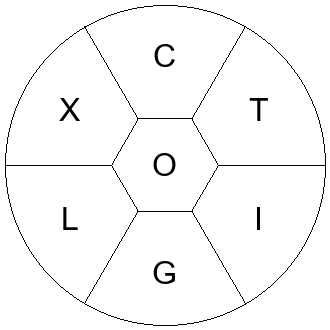
Wednesday, October 22, 2025

Answers to yesterday's Bee

Jump to answers for


The official answers for today's puzzle are:

Click on the arrow to show the definition.
Click outside the pop-up to close it.


Number of Pangrams: 1

Maximum Puzzle Score: 83

Number of Answers: 26

Points Needed for Genius: 58

Genius requires between 9 and 24 words. You need at least a 6-letter word to reach genius. If you don't get the pangram, you need 89% of the total points to reach genius. If you get the pangram, you only need 62% of the remaining points to reach genius.

The button below will reveal a chart with the number of words by each letter. Red bars indicate that there is a pangram(s) starting with that letter.


How does this puzzle compare to other puzzles?

Today's score of 83 was in the 5th percentile of all puzzles.
The last time there was a score this low was on September 12, 2025.
The highest score ever was 537 on January 22, 2021.
The lowest score ever was 47 on March 27, 2023.

This puzzle's 26 possible answers rank it in the 14th percentile of all puzzles.
The last time there were fewer answers than this was on October 13, 2025.
The highest number of answers was 81 on June 8, 2019.
The lowest number of answers was 16 on March 27, 2023.

It takes a 6-letter word for genius.
The last time this happened was on October 13, 2025.

Today's puzzle has an average word length of 4.8.
For all Bees, the average word length has been 5.3.


Haven't I seen these letters before?

Hover over a letter to see its first and most recent appearance in the Bee!


Haven't I seen these words before?

The most common words in the Bee are:

  • noon 219
  • loll 206
  • toot 200
  • naan 181
  • nana 181
  • lilt 146
  • till 146
  • tilt 146
  • nene 141
  • tint 141
  • mama 139
  • mamma 139
  • acacia 133
  • acai 133
  • onto 133
  • toon 133
  • onion 130
  • anal 123
  • anon 121
  • dodo 119
  • olio 119
  • tact 118
  • baba 115
  • boob 115
  • booboo 115
  • papa 114
  • poop 114
  • lull 112
  • lulu 112
  • call 109
  • calla 109
  • cocci 109
  • mitt 109
  • mono 109
  • moon 109
  • ratatat 108
  • tart 108
  • tartar 108
  • tutu 108
  • attar 107
  • loon 107
  • allay 106
  • ally 106
  • tattoo 106
  • tatty 106
  • ammo 105
  • momma 105
  • epee 101
  • peep 101
  • coot 100


How long are words in the Bee?

There have been 108,394 answers ever accepted in the Bee - with 10,844 unique words.
Below are the distributions of the lengths of these words.


Valid dictionary words not in today's official answers

You may be wondering why these words aren't here*:

  • cloot
  • coccic
  • coco
  • cogito
  • colitic
  • colog
  • coocoo
  • giglot
  • gigot
  • glogg
  • glottic
  • gogo
  • lilo
  • litotic
  • logoi
  • loti
  • lotic
  • loto
  • ocotillo
  • oolitic
  • oologic
  • otic
  • otitic
  • otologic
  • ototoxic
  • otto
  • oxic
  • tictoc
  • toco
  • toit
  • tolt

*Because the New York Times considers them obscure or offensive.

clog

noun
  1. A type of shoe with an inflexible, often wooden sole sometimes with an open heel.
  2. A blockage.
  3. A shoe of any type.
  4. A weight, such as a log or block of wood, attached to a person or animal to hinder motion.
  5. That which hinders or impedes motion; an encumbrance, restraint, or impediment of any kind.
verb
  1. To block or slow passage through (often with 'up').
  2. To encumber or load, especially with something that impedes motion; to hamper.
  3. To burden; to trammel; to embarrass; to perplex.
  4. To enforce a mortgage lender right that prevents a borrower from exercising a right to redeem.
  5. To perform a clog dance.

clot

noun
  1. A thrombus, solidified mass of blood.
  2. A solidified mass of any liquid.
  3. A silly person.
verb
  1. To form a clot or mass.
  2. To cause to clot or form into a mass.

cocci

Etymology 1

noun
  1. Any approximately spherical bacterium.
  2. One of the carpels or seed-vessels of a dry fruit.

Etymology 2

noun
  1. Coccidioidomycosis

coil

Etymology 1

noun
  1. Something wound in the form of a helix or spiral.
  2. Any intrauterine device (Abbreviation: IUD)—the first IUDs were coil-shaped.
  3. A coil of electrically conductive wire through which electricity can flow.
  4. Entanglement; perplexity.
verb
  1. To wind or reel e.g. a wire or rope into regular rings, often around a centerpiece.
  2. To wind into loops (roughly) around a common center.
  3. To wind cylindrically or spirally.
  4. To encircle and hold with, or as if with, coils.

Etymology 2

noun
  1. A noise, tumult, bustle, or turmoil.

colic

noun
  1. Severe pains that grip the abdomen or the disease that causes such pains (due to intestinal or bowel-related problems).
  2. A medicinal plant used to relieve such symptoms.
adjective
  1. Relating to the colon; colonic.

colt

noun
  1. A young male horse.
  2. A young crane (bird).
  3. A youthful or inexperienced person; a novice.
  4. A short piece of rope once used by petty officers as an instrument of punishment.
  5. A young camel or donkey.
verb
  1. To horse; to get with young.
  2. To befool.
  3. To frisk or frolic like a colt; to act licentiously or wantonly.

cool

Etymology 1

noun
  1. A moderate or refreshing state of cold; moderate temperature of the air between hot and cold; coolness.
  2. A calm temperament.
  3. The property of being cool, popular or in fashion.
adjective
  1. Having a slightly low temperature; mildly or pleasantly cold.
  2. Allowing or suggesting heat relief.
  3. Of a color, in the range of violet to green.
  4. Of a person, not showing emotion; calm and in control of oneself.
  5. Unenthusiastic, lukewarm, skeptical.
  6. Calmly audacious.
  7. Applied facetiously to a sum of money, commonly as if to give emphasis to the largeness of the amount.
  8. Of a person, knowing what to do and how to behave; considered popular by others.
  9. In fashion, part of or fitting the in crowd; originally hipster slang.
  10. Of an action, all right; acceptable; that does not present a problem.
  11. Of a person, not upset by circumstances that might ordinarily be upsetting.
  12. Quietly impudent, defiant, or selfish; deliberately presuming: said of persons and acts.

Etymology 2

verb
  1. To lose heat, to get colder.
  2. To make cooler, less warm.
  3. To become less intense, e.g. less amicable or passionate.
  4. To make less intense, e.g. less amicable or passionate.
  5. To kill.

coot

noun
  1. Any of various aquatic birds of the genus Fulica that are mainly black with a prominent frontal shield on the forehead.
  2. A foolish or eccentric fellow
  3. (with the) A success; something excellent.
  4. Body louse (Pediculus humanus).

gigolo

noun
  1. A man who has a sexual relationship with a woman from whom he receives payment.
  2. A hired escort or dancing partner for a woman.

googol

numeral
  1. The number 10^{100}, or ten to the power of a hundred.

igloo

noun
  1. A dome-shaped Inuit shelter, constructed of blocks cut from snow.
  2. A cavity, or excavation, made in the snow by a seal, over its breathing hole in the sea ice.
  3. A reinforced bunker for the storage of nuclear weapons.
  4. (logistics) A kind of airfreight cargo container.

illogic

noun
  1. Lack of logic; unreasonableness; a fallacy.
adjective
  1. Contrary to logic; lacking sense or sound reasoning.

loci

noun
  1. A place or locality, especially a centre of activity or the scene of a crime.
  2. The set of all points whose coordinates satisfy a given equation or condition.
  3. A fixed position on a chromosome that may be occupied by one or more genes.
  4. (chiefly in the plural) A passage in writing, especially in a collection of ancient sacred writings arranged according to a theme.

loco

Etymology 1

adverb
  1. A direction in written or printed music to be returning to the proper pitch after having played an octave higher or lower.

Etymology 2

noun
  1. A certain species of Astragalus or Oxytropis, capable of causing locoism.
verb
  1. To poison with the loco plant; to affect with locoism.
  2. (by extension) To render insane.
adjective
  1. Crazy.
  2. Intoxicated by eating locoweed.

Etymology 3

noun
  1. A locomotive.

logic

noun
  1. A method of human thought that involves thinking in a linear, step-by-step manner about how a problem can be solved. Logic is the basis of many principles including the scientific method.
  2. The study of the principles and criteria of valid inference and demonstration.
  3. The mathematical study of relationships between rigorously defined concepts and of mathematical proof of statements.
  4. A formal or informal language together with a deductive system or a model-theoretic semantics.
  5. Any system of thought, whether rigorous and productive or not, especially one associated with a particular person.
  6. The part of a system (usually electronic) that performs the boolean logic operations, short for logic gates or logic circuit.
verb
  1. To engage in excessive or inappropriate application of logic.
  2. To apply logical reasoning to.
  3. To overcome by logical argument.
adjective
  1. Logical

loll

verb
  1. To act lazily or indolently while reclining; to lean; to lie at ease.
  2. To hang extended from the mouth, like the tongue of an animal heated from exertion.
  3. To let (the tongue) hang from the mouth in this way.

loot

Etymology 1

noun
  1. A kind of scoop or ladle, chiefly used to remove the scum from brine-pans in saltworks.

Etymology 2

noun
  1. The act of plundering.
  2. Plunder, booty, especially from a ransacked city.
  3. Any prize or profit received for free, especially Christmas presents
  4. Items dropped by defeated enemies.
verb
  1. To steal, especially as part of war, riot or other group violence.
  2. To steal from.
  3. To examine the corpse of a fallen enemy for loot.

lotto

noun
  1. A game of chance similar to bingo
  2. A lottery

olio

noun
  1. A rich, thick, Spanish stew consisting of meat and vegetables.
  2. A medley or mixture; a hotchpotch.
  3. A collection of various musical, theatrical or other artistic works; a miscellany.
  4. (by extension) Vaudeville or similar miscellaneous musical or theatrical entertainment skits presented between the main acts of burlesque or minstrel shows.

toil

noun
  1. Labour, work, especially of a grueling nature.
  2. Trouble, strife.
  3. (usually in plural) A net or snare; any thread, web, or string spread for taking prey.
verb
  1. To labour; work.
  2. To struggle.
  3. To work (something); often with out.
  4. To weary through excessive labour.

toll

Etymology 1

noun
  1. Loss or damage incurred through a disaster.
  2. A fee paid for some liberty or privilege, particularly for the privilege of passing over a bridge or on a highway, or for that of vending goods in a fair, market, etc.
  3. A fee for using any kind of material processing service.
  4. A tollbooth.
  5. A liberty to buy and sell within the bounds of a manor.
  6. A portion of grain taken by a miller as a compensation for grinding.
verb
  1. To impose a fee for the use of.
  2. To levy a toll on (someone or something).
  3. To take as a toll.
  4. To pay a toll or tallage.

Etymology 2

noun
  1. The act or sound of tolling
verb
  1. To ring (a bell) slowly and repeatedly.
  2. To summon by ringing a bell.
  3. To announce by tolling.

Etymology 3

verb
  1. To draw; pull; tug; drag.
  2. To tear in pieces.
  3. To draw; entice; invite; allure.
  4. To lure with bait; tole (especially, fish and animals).

Etymology 4

verb
  1. To take away; to vacate; to annul.
  2. To suspend.

tool

noun
  1. A mechanical device intended to make a task easier.
  2. Equipment used in a profession, e.g., tools of the trade.
  3. Something to perform an operation; an instrument; a means.
  4. A piece of software used to develop software or hardware, or to perform low-level operations.
  5. A person or group which is used or controlled, usually unwittingly, by another person or group.
  6. Penis.
  7. (by extension) An obnoxious or uptight person.
verb
  1. To work on or shape with tools, e.g., hand-tooled leather.
  2. To equip with tools.
  3. To work very hard.
  4. To put down another person (possibly in a subtle, hidden way), and in that way to use him or her to meet a goal.
  5. To intentionally attack the ball so that it deflects off a blocker out of bounds.
  6. To drive (a coach or other vehicle).
  7. To carry or convey in a coach or other vehicle.
  8. To travel in a vehicle; to ride or drive.

toot

Etymology 1

noun
  1. The noise of a horn or whistle.
  2. (by extension) A fart; flatus.
  3. Cocaine.
  4. A portion of cocaine that a person snorts.
  5. A spree of drunkness.
  6. (pronounced /tʊt/) Rubbish; tat.
  7. A message on the social networking software Mastodon.
verb
  1. To stand out, or be prominent.
  2. To peep; to look narrowly.
  3. To see; to spy.
  4. To flatulate.
  5. To make the sound of a horn or whistle.
  6. To cause a horn or whistle to make its sound.
  7. To go on a drinking binge.
  8. To snort (a recreational drug).
  9. To post a message on a Mastodon instance (a self-hosted version of the networking software).

Etymology 2

noun
  1. A toilet.

toxic

adjective
  1. Having a chemical nature that is harmful to health or lethal if consumed or otherwise entering into the body in sufficient quantities.
  2. Appearing grossly unwell; characterised by serious, potentially life-threatening compromise in the respiratory, circulatory or other body systems.
  3. Severely negative or harmful.
  4. (of a person) Hateful or strongly antipathetic.

toxicologic

No Definition Found.