Saturday, December 27, 2025

Answers to yesterday's Bee

Jump to answers for


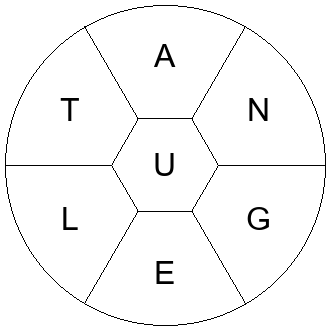
The official answers for today's puzzle are:

Click on the arrow to show the definition.
Click outside the pop-up to close it.


Number of Pangrams: 3

Maximum Puzzle Score: 291

Number of Answers: 60

Points Needed for Genius: 204

Genius requires between 27 and 52 words. You need at least a 7-letter word to reach genius. If you don't get the pangrams, you need 83% of the total points to reach genius. If you get the pangrams, you only need 65% of the remaining points to reach genius.

The button below will reveal a chart with the number of words by each letter. Red bars indicate that there is a pangram(s) starting with that letter.


How does this puzzle compare to other puzzles?

Today's score of 291 was in the 92nd percentile of all puzzles.
The last time there was a score this high was on December 20, 2025.
The highest score ever was 537 on January 22, 2021.
The lowest score ever was 47 on March 27, 2023.

This puzzle's 60 possible answers rank it in the 91st percentile of all puzzles.
The last time there were more answers than this was on December 20, 2025.
The highest number of answers was 81 on June 8, 2019.
The lowest number of answers was 16 on March 27, 2023.

It takes a 7-letter word for genius.
The last time this happened was on December 26, 2025.

Today's puzzle has an average word length of 5.5.
For all Bees, the average word length has been 5.3.


Haven't I seen these letters before?

Hover over a letter to see its first and most recent appearance in the Bee!


Haven't I seen these words before?

The most common words in the Bee are:

  • noon 226
  • loll 209
  • toot 205
  • naan 187
  • nana 187
  • lilt 150
  • till 150
  • tilt 150
  • nene 147
  • tint 144
  • mama 141
  • mamma 141
  • onion 137
  • onto 136
  • toon 136
  • acacia 134
  • acai 134
  • anal 128
  • anon 127
  • olio 123
  • dodo 120
  • papa 119
  • tact 119
  • baba 118
  • boob 116
  • booboo 116
  • lull 116
  • lulu 116
  • poop 115
  • cocci 113
  • call 112
  • calla 112
  • mitt 112
  • mono 112
  • moon 112
  • tutu 111
  • ratatat 110
  • tart 110
  • tartar 110
  • attar 109
  • loon 109
  • tattoo 109
  • allay 108
  • ally 108
  • ammo 107
  • momma 107
  • tatty 106
  • roar 104
  • epee 103
  • meme 103


How long are words in the Bee?

There have been 111,433 answers ever accepted in the Bee - with 10,887 unique words.
Below are the distributions of the lengths of these words.


Valid dictionary words not in today's official answers

You may be wondering why these words aren't here*:

  • aglu
  • alula
  • alulae
  • angulate
  • annulate
  • annulet
  • antennule
  • eluant
  • eluate
  • eluent
  • elute
  • englut
  • euglena
  • gallnut
  • gangue
  • gault
  • gaun
  • genu
  • genua
  • guan
  • guggle
  • guglet
  • gunge
  • gunnel
  • gunnen
  • gutta
  • guttae
  • guttate
  • guttle
  • laguna
  • lagune
  • langue
  • languet
  • languette
  • latu
  • lauan
  • lunet
  • lungan
  • lungee
  • lunt
  • lunulate
  • lunule
  • lutea
  • nutant
  • nutate
  • nutgall
  • nutlet
  • tautaug
  • tegu
  • tegua
  • tegula
  • tegulae
  • tule
  • tung
  • tunnage
  • ulan
  • ullage
  • ululant
  • unau
  • ungag
  • ungallant
  • ungenteel
  • ungual
  • unguenta
  • ungula
  • ungulae

*Because the New York Times considers them obscure or offensive.

ague

noun
  1. An acute fever.
  2. An intermittent fever, attended by alternate cold and hot fits.
  3. The cold fit or rigor of the intermittent fever
  4. A chill, or state of shaking, as with cold.
  5. Malaria.
verb
  1. To strike with an ague, or with a cold fit.

annual

noun
  1. An annual publication; a book, periodical, journal, report, comic book, yearbook, etc., which is published serially once a year, which may or may not be in addition to regular weekly or monthly publication.
  2. An annual plant; a plant with a life span of just one growing season; a plant which naturally germinates, flowers and dies in one year. Compare biennial, perennial.
  3. A medical checkup taking place once a year.
  4. A pantomime taking place once a year.
adjective
  1. Happening once every year.
  2. Of, for, or relating to a whole year, often as a recurring cycle; determined or reckoned by the year; accumulating in the course of a year; performed, executed, or completed over the course of a year. See also circannual.
  3. (of a plant) Having a life cycle that is completed in only one growing season; e.g. beans, corn, marigold. See Annual plant in Wikipedia. Compare biennial, perennial.
  4. Living or lasting just one season or year, as certain insects or insect colonies.

annul

verb
  1. To formally revoke the validity of.
  2. To dissolve (a marital union) on the grounds that it is not valid.

attenuate

verb
  1. To reduce in size, force, value, amount, or degree.
  2. To make thinner, as by physically reshaping, starving, or decaying.
  3. To become thin or fine; to grow less.
  4. To weaken.
  5. To rarefy.
  6. To reduce the virulence of a bacterium or virus.
  7. To reduce the amplitude of an electrical, radio, or optical signal.
  8. (of a beer) To become less dense as a result of the conversion of sugar to alcohol.
adjective
  1. (of leaves) Gradually tapering into a petiole-like extension toward the base.

attune

verb
  1. To bring into musical accord.
  2. To tune (an instrument).
  3. To bring into harmony or accord.

aunt

noun
  1. The sister or sister-in-law of one’s parent.
  2. The female cousin of one’s parent.
  3. A woman of an older generation than oneself, especially a friend of one's parents, by means of fictive kin.
  4. Any elderly woman.
  5. A procuress or bawd.

gateau

noun
  1. A rich, usually iced, cake.
  2. A dish of minced meat made up like a pudding, and boiled in a shape or mould.

gauge

noun
  1. A measure; a standard of measure; an instrument to determine dimensions, distance, or capacity; a standard
  2. An act of measuring.
  3. An estimate.
  4. Any instrument for ascertaining or regulating the level, state, dimensions or forms of things
  5. A thickness of sheet metal or wire designated by any of several numbering schemes.
  6. The distance between the rails of a railway.
  7. A semi-norm; a function that assigns a non-negative size to all vectors in a vector space.
  8. The number of stitches per inch, centimetre, or other unit of distance.
  9. Relative positions of two or more vessels with reference to the wind.
  10. The depth to which a vessel sinks in the water.
  11. (plastering) The quantity of plaster of Paris used with common plaster to make it set more quickly.
  12. That part of a shingle, slate, or tile, which is exposed to the weather, when laid; also, one course of such shingles, slates, or tiles.
  13. A unit of measurement which describes how many spheres of bore diameter of a shotgun can be had from one pound of lead; 12 gauge is roughly equivalent to .75 caliber.
  14. (by extension) A shotgun (synecdoche for 12 gauge shotgun, the most common chambering for combat and hunting shotguns).
  15. A tunnel-like ear piercing consisting of a hollow ring embedded in the lobe.
verb
  1. To measure or determine with a gauge; to measure the capacity of.
  2. To estimate.
  3. To appraise the character or ability of; to judge of.
  4. To draw into equidistant gathers by running a thread through it.
  5. To mix (a quantity of ordinary plaster) with a quantity of plaster of Paris.
  6. To chip, hew or polish (stones, bricks, etc) to a standard size and/or shape.

gaunt

adjective
  1. Lean, angular and bony
  2. Haggard, drawn and emaciated
  3. Bleak, barren and desolate

gauntlet

Etymology 1

noun
  1. Protective armor for the hands, formerly thrown down as a challenge to combat.
  2. A long glove covering the wrist.
  3. A rope on which hammocks or clothes are hung for drying.

Etymology 2

noun
  1. Two parallel rows of attackers who strike at a criminal as punishment
  2. Simultaneous attack from two or more sides
  3. Any challenging, difficult, or painful ordeal, often one performed for atonement or punishment
  4. A temporary convergence of two parallel railroad tracks allowing passage through a narrow opening in each direction without switching.

glue

noun
  1. A hard gelatin made by boiling bones and hides, used in solution as an adhesive; or any sticky adhesive substance.
  2. Anything that binds two things or people together.
  3. Birdlime.
verb
  1. To join or attach something using glue.
  2. To cause something to adhere closely to; to follow attentively.

glug

noun
  1. The sound made when a significant amount of liquid is poured suddenly out of something, such as a jug or bottle.
  2. The amount of liquid issued when the "glug" sound is heard.
verb
  1. To flow in noisy bursts.
  2. To quickly swallow liquid.

glut

noun
  1. An excess, too much.
  2. That which is swallowed.
  3. Something that fills up an opening.
  4. A wooden wedge used in splitting blocks.
  5. A piece of wood used to fill up behind cribbing or tubbing.
  6. (bricklaying) A bat, or small piece of brick, used to fill out a course.
  7. An arched opening to the ashpit of a kiln.
  8. A block used for a fulcrum.
  9. The broad-nosed eel (Anguilla anguilla, syn. Anguilla latirostris), found in Europe, Asia, the West Indies, etc.
verb
  1. To fill to capacity; to satisfy all demand or requirement; to sate.
  2. To eat gluttonously or to satiety.

glute

noun
  1. (exercise) A gluteal muscle.

gluteal

noun
  1. Any of the muscles of the buttocks, gluteus maximus, gluteus medius and gluteus minimus
adjective
  1. Relating to the buttocks

gluten

noun
  1. Fibrin (formerly considered as one of the "animal humours").
  2. Any gluey, sticky substance.
  3. The major protein in cereal grains, especially wheat; responsible for the elasticity in dough and the structure in baked bread.
  4. A gluey, sticky mass of clay, bitumen etc.

gulag

noun
  1. A prison camp.
  2. The system of all Soviet prison and/or labor camps in use during the Stalinist period.
verb
  1. To force into this prison or a similar system.

gull

Etymology 1

noun
  1. A seabird of the genus Larus or of the family Laridae.
  2. Any of various pierid butterflies of the genus Cepora.

Etymology 2

noun
  1. A cheating trick; a fraud.
  2. One easily cheated; a dupe.
  3. (Oxford University slang) A swindler or trickster.
verb
  1. To deceive or cheat.
  2. To mislead.
  3. To trick and defraud.

gullet

noun
  1. The throat or esophagus.
  2. The cytopharynx of a ciliate, through which food is ingested.
  3. The space between the teeth of a saw blade.
  4. A channel for water.
  5. A preparatory cut or channel in excavations, of sufficient width for the passage of earth wagons.
  6. The wide room under the pommel of a saddle, the hollow over the withers.

language

Etymology 1

noun
  1. A body of words, and set of methods of combining them (called a grammar), understood by a community and used as a form of communication.
  2. The ability to communicate using words.
  3. A sublanguage: the slang of a particular community or jargon of a particular specialist field.
  4. The expression of thought (the communication of meaning) in a specified way; that which communicates something, as language does.
  5. A body of sounds, signs and/or signals by which animals communicate, and by which plants are sometimes also thought to communicate.
  6. A computer language; a machine language.
  7. Manner of expression.
  8. The particular words used in a speech or a passage of text.
  9. Profanity.
verb
  1. To communicate by language; to express in language.

Etymology 2

noun
  1. A languet, a flat plate in or below the flue pipe of an organ.

league

Etymology 1

noun
  1. A group or association of cooperating members.
  2. An organization of sports teams which play against one another for a championship.
  3. (often in the negative) A class or type of people or things that are evenly matched or on the same level.
  4. A prefecture-level administrative unit in Inner Mongolia (Chinese: 盟).
verb
  1. To form an association; to unite in a league or confederacy; to combine for mutual support.
noun
  1. A version of rugby football, played between two teams of thirteen.

Etymology 2

noun
  1. (measurement) The distance that a person can walk in one hour, commonly taken to be approximately three English miles (about five kilometers).
  2. A stone erected near a public road to mark the distance of a league.

luau

noun
  1. An elaborate Hawaiian feast featuring traditional foods and entertainment.

luge

noun
  1. A racing sled for one or two people that is ridden with the rider or riders lying on their back.
  2. The sport of racing on luges.
  3. A piece of ice, bone or other material with a channel down which a (usually alcoholic) drink can be poured into someone's mouth.
verb
  1. To travel by luge; to ride a luge.

luggage

noun
  1. The bags and other containers that hold a traveller's belongings.
  2. The contents of such containers.
  3. A specific bag or container holding a traveller's belongings.

lull

noun
  1. A period of rest or soothing.
  2. A period of reduced activity; a respite
  3. A period without waves or wind.
  4. An extended pause between sets of waves.
verb
  1. To cause to rest by soothing influences; to compose; to calm
  2. To become gradually calm; to subside; to cease or abate.

lulu

noun
  1. A remarkable person, object or idea.
  2. A very attractive or alluring person.
  3. A very bad mistake or error.
  4. A fixed allowance paid to a legislator in lieu of reimbursement for actual expenses.

luna

No Definition Found.

lunate

noun
  1. A small stone artifact, probably an arrowhead, with a blunt straight edge and a sharpened, crescent-shaped back, especially characteristic of the Mesolithic Period
  2. The lunate bone
adjective
  1. Shaped like a crescent.

lune

Etymology 1

noun
  1. A fit of lunacy or madness; a period of frenzy; a crazy or unreasonable freak.

Etymology 2

noun
  1. A concave figure formed by the intersection of the arcs of two circles on a plane, or on a sphere the intersection between two great semicircles.
  2. Anything crescent-shaped.

Etymology 3

noun
  1. (hawking) A leash for a hawk.

lunette

noun
  1. A small opening in a vaulted roof of a circular or crescent shape.
  2. A crescent-shaped recess or void in the space above a window or door.
  3. An image or other representation of a crescent moon.
  4. (fortifications) A field work consisting of two projecting faces forming a wedge each of which extends from one of two parallel flanks.
  5. A luna: a crescent-shaped receptacle, often glass, for holding the (consecrated) host (the bread of communion) upright when exposed in the monstrance.
  6. A type of flattened glass used in watch-making.
  7. The circular hole in the guillotine in which the victim's neck is placed.
  8. A type of crescent-shaped dune blown up along a lake basin, especially in dry areas of Australia.
  9. A half horseshoe, lacking the sponge.
  10. A piece of felt to cover the eye of a vicious horse.
  11. An iron shoe at the end of the stock of a gun carriage.
  12. (in the plural) See lunettes.

lung

noun
  1. A biological organ of vertebrates that controls breathing and oxygenates the blood.
  2. (plural) Capacity for exercise or exertion; breath.
  3. That which supplies oxygen or fresh air, such as trees, parklands, forest, etc., to a place.

lunge

noun
  1. A sudden forward movement, especially with a sword.
  2. A long rope or flat web line, more commonly referred to as a lunge line, approximately 20–30 feet long, attached to the bridle, lungeing cavesson, or halter of a horse and used to control the animal while lungeing.
  3. An exercise performed by stepping forward one leg while kneeling with the other leg, then returning to a standing position.
  4. A fish, the namaycush.
verb
  1. To (cause to make) a sudden forward movement (present participle: lunging).
  2. To longe or work a horse in a circle around a handler (present participle: lunging or lungeing).

lunula

noun
  1. Something shaped like a crescent or half-moon; especially the pale area at the base of the fingernail.

lunulae

noun
  1. Something shaped like a crescent or half-moon; especially the pale area at the base of the fingernail.

lute

Etymology 1

noun
  1. A fretted stringed instrument of European origin, similar to the guitar, having a bowl-shaped body or soundbox; any of a wide variety of chordophones with a pear-shaped body and a neck whose upper surface is in the same plane as the soundboard, with strings along the neck and parallel to the soundboard.
verb
  1. To play on a lute, or as if on a lute.

Etymology 2

noun
  1. Thick sticky clay or cement used to close up a hole or gap, especially to make something air-tight.
  2. A packing ring, as of rubber, for fruit jars, etc.
  3. (brickmaking) A straight-edged piece of wood for striking off superfluous clay from earth.
verb
  1. To fix or fasten something with lute.

luteal

adjective
  1. Of or pertaining to the corpus luteum

nugget

noun
  1. A small, compact chunk or clump.
  2. A chicken nugget.
  3. A tidbit of something valuable.
  4. A small piece of tasty food, a tidbit.
  5. A type of boot polish.
  6. A bud from the Cannabis sativa plant, especially one that is potent.
  7. An inexperienced, newly trained fighter pilot.
  8. A partial description gleaned from data mining.

null

noun
  1. A non-existent or empty value or set of values.
  2. Zero quantity of expressions; nothing.
  3. Something that has no force or meaning.
  4. The ASCII or Unicode character (␀), represented by a zero value, that indicates no character and is sometimes used as a string terminator.
  5. The attribute of an entity that has no valid value.
  6. One of the beads in nulled work.
  7. Null hypothesis.
verb
  1. To nullify; to annul.
  2. To form nulls, or into nulls, as in a lathe.
  3. To crack; to remove restrictions or limitations in (software).
adjective
  1. Having no validity; "null and void"
  2. Insignificant.
  3. Absent or non-existent.
  4. Of the null set.
  5. Of or comprising a value of precisely zero.
  6. (of a mutation) Causing a complete loss of gene function, amorphic.

taunt

Etymology 1

noun
  1. A scornful or mocking remark; a jeer or mockery
verb
  1. To make fun of (someone); to goad (a person) into responding, often in an aggressive manner.

Etymology 2

adjective
  1. Very high or tall.

taut

verb
  1. To make taut; to tauten, to tighten.
adjective
  1. Under tension, like a stretched bowstring, rope, or sail; tight.
  2. (of a body, muscles, etc.) Not flabby; firm, toned; (of a person) having a lean, strong body.
  3. (of music, writing, etc.) Containing only relevant parts; brief and controlled.
  4. Experiencing anxiety or stress.
  5. (of a sailor, a ship, etc.) Neat and well-disciplined; (by extension) efficient and in order.
  6. Strong; uncompromising.

tauten

No Definition Found.

tulle

noun
  1. A kind of silk lace or light netting, used for clothing, veils, etc.

tuna

Etymology 1

noun
  1. Any of several species of fish of the genus Thunnus in the family Scombridae.
  2. The edible flesh of the tuna.

Etymology 2

noun
  1. The prickly pear, a type of cactus native to Mexico in the genus Opuntia.
  2. The fruit of the cactus.

tune

noun
  1. A melody.
  2. A song, or short musical composition.
  3. The act of tuning or maintenance.
  4. The state or condition of being correctly tuned.
  5. Temper; frame of mind.
  6. A sound; a note; a tone.
  7. Order; harmony; concord.
verb
  1. To adjust (a musical instrument) so that it produces the correct pitches.
  2. To adjust or modify (esp. a mechanical or electrical device) so that it functions optimally.
  3. To adjust the frequency on a radio or TV set, so as to receive the desired channel.
  4. (e.g. of senses or faculties) To adapt to or direct towards a particular target.
  5. To make more precise, intense, or effective; to put into a proper state or disposition.
  6. To attune; to adapt in style of music; to make harmonious.
  7. To give a certain tone or character to.
  8. To sing with melody or harmony.
  9. To cheek; to be impudent towards.
interjection
  1. Used to show appreciation or approval of a song.

tunnel

noun
  1. An underground or underwater passage.
  2. A passage through or under some obstacle.
  3. A hole in the ground made by an animal, a burrow.
  4. A wrapper for a protocol that cannot otherwise be used because it is unsupported, blocked, or insecure.
  5. A vessel with a broad mouth at one end, a pipe or tube at the other, for conveying liquor, fluids, etc., into casks, bottles, or other vessels; a funnel.
  6. The opening of a chimney for the passage of smoke; a flue.
  7. A level passage driven across the measures, or at right angles to veins which it is desired to reach; distinguished from the drift, or gangway, which is led along the vein when reached by the tunnel.
verb
  1. To make a tunnel through or under something; to burrow.
  2. To dig a tunnel.
  3. To transmit something through a tunnel (wrapper for insecure or unsupported protocol).
  4. To insert a catheter into a vein to allow long-term use.
  5. To undergo the quantum-mechanical phenomenon where a particle penetrates through a barrier that it classically cannot surmount.

tutee

noun
  1. A student of a tutor.

tutelage

noun
  1. The act of guarding, protecting, or guiding; guardianship; protection
  2. The state of being under a guardian or a tutor; care or protection enjoyed.
  3. Instruction; teaching; guidance

tutu

Etymology 1

noun
  1. A ballet skirt made of layered stiff but light netting.

Etymology 2

noun
  1. Any of the genus Coriaria of shrubs and trees found in New Zealand.

ulna

noun
  1. The bone of the forearm that extends from the elbow to the wrist on the side opposite to the thumb, corresponding to the fibula of the hind limb. Also, the corresponding bone in the forelimb of any vertebrate.

ulnae

noun
  1. The bone of the forearm that extends from the elbow to the wrist on the side opposite to the thumb, corresponding to the fibula of the hind limb. Also, the corresponding bone in the forelimb of any vertebrate.

ululate

verb
  1. To howl loudly or prolongedly in lamentation or joy
  2. To produce a rapid and prolonged series of sharp noises with one's voice.

uneaten

adjective
  1. Not eaten

ungentle

adjective
  1. Showing a lack of gentleness, kindness or compassion.
  2. Not acting according to accepted ethics or standards of behaviour.

unglue

No Definition Found.

unguent

noun
  1. Any cream containing medicinal ingredients applied to the skin for therapeutic purposes.

ungulate

noun
  1. An ungulate animal; a hooved mammal.
adjective
  1. Having hooves.
  2. Shaped like a hoof.

unlet

adjective
  1. (of property) Not let (not in temporary possession in return for rent)

untangle

verb
  1. To remove tangles or knots from.
  2. (by extension) To remove confusion or mystery from.

untune

No Definition Found.

untag

verb
  1. To remove a tag from.