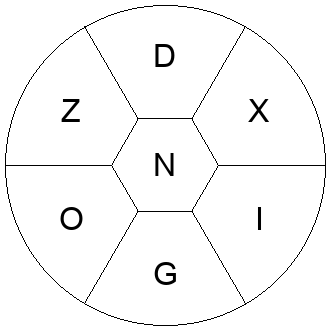
Friday, April 10, 2026

Answers to yesterday's Bee

Jump to answers for


The official answers for today's puzzle are:

Click on the arrow to show the definition.
Click outside the pop-up to close it.


Number of Pangrams: 1

Maximum Puzzle Score: 215

Number of Answers: 38

Points Needed for Genius: 151

Genius requires between 21 and 31 words. You need at least a 7-letter word to reach genius. If you don't get the pangram, you need 76% of the total points to reach genius. If you get the pangram, you only need 68% of the remaining points to reach genius.

Other days with this pangram:

The button below will reveal a chart with the number of words by each letter. Red bars indicate that there is a pangram(s) starting with that letter.


How does this puzzle compare to other puzzles?

Today's score of 215 was in the 69th percentile of all puzzles.
The last time there was a score this high was on April 08, 2026.
The highest score ever was 537 on January 22, 2021.
The lowest score ever was 47 on March 27, 2023.

This puzzle's 38 possible answers rank it in the 46th percentile of all puzzles.
The last time there were fewer answers than this was on April 08, 2026.
The highest number of answers was 81 on June 08, 2019.
The lowest number of answers was 16 on March 27, 2023.

It takes a 7-letter word for genius.
The last time this happened was on April 09, 2026.

Today's puzzle has an average word length of 6.0.
For all Bees, the average word length has been 5.3.


Haven't I seen these letters before?

Hover over a letter to see its first and most recent appearance in the Bee!


Haven't I seen these words before?

The most common words in the Bee are:

  • noon 237
  • loll 217
  • toot 214
  • nana 195
  • naan 195
  • nene 155
  • tilt 153
  • till 153
  • lilt 153
  • tint 149
  • mamma 149
  • mama 149
  • toon 144
  • onto 144
  • onion 144
  • acai 141
  • acacia 141
  • anon 132
  • anal 131
  • olio 128
  • tact 124
  • papa 124
  • lulu 124
  • lull 124
  • baba 124
  • dodo 123
  • poop 119
  • booboo 119
  • boob 119
  • moon 118
  • mono 118
  • mitt 117
  • cocci 117
  • calla 116
  • call 116
  • tattoo 114
  • tartar 114
  • tart 114
  • ratatat 114
  • loon 114
  • attar 113
  • tutu 112
  • ally 112
  • allay 112
  • momma 111
  • ammo 111
  • tatty 110
  • meme 109
  • roar 108
  • aria 108


How long are words in the Bee?

There have been 116,178 answers ever accepted in the Bee - with 10,957 unique words.
Below are the distributions of the lengths of these words.


Valid dictionary words not in today's official answers

You may be wondering why these words aren't here*:

  • digoxin
  • dingdong
  • dingdonging
  • dinning
  • doggoning
  • donging
  • ginzo
  • godding
  • gonion
  • igging
  • indign
  • indigoid
  • ingoing
  • inion
  • iodin
  • nidi
  • niding
  • ninon
  • nodi
  • nogg
  • nogging
  • nonionizing
  • nonoxidizing
  • noodging
  • nooning
  • ozonizing
  • zizzing
  • zoon
  • zooning

*Because the New York Times considers them obscure or offensive.

digging

verb
  1. To move hard-packed earth out of the way, especially downward to make a hole with a shovel. Or to drill, or the like, through rocks, roads, or the like. More generally, to make any similar hole by moving material out of the way.
  2. To get by digging; to take from the ground; often with up.
  3. To take ore from its bed, in distinction from making excavations in search of ore.
  4. To work like a digger; to study ploddingly and laboriously.
  5. To investigate, to research, often followed by out or up.
  6. To thrust; to poke.
  7. To defend against an attack hit by the opposing team by successfully passing the ball
verb
  1. To understand or show interest in.
  2. To appreciate, or like.
noun
  1. The action performed by a person or thing that digs.
  2. A place where ore is dug, especially certain localities in California, Australia, etc. where gold is obtained.
  3. Region; locality

ding

Etymology 1

noun
  1. Very minor damage, a small dent or chip.
  2. A rejection.
verb
  1. To hit or strike.
  2. To dash; to throw violently.
  3. To inflict minor damage upon, especially by hitting or striking.
  4. To fire or reject.
  5. To deduct, as points, from another, in the manner of a penalty; to penalize.
  6. To mishit (a golf ball).

Etymology 2

noun
  1. The high-pitched resonant sound of a bell.
  2. The act of levelling up.
verb
  1. To make high-pitched sound like a bell.
  2. To keep repeating; impress by reiteration, with reference to the monotonous striking of a bell.
  3. To level up.

Etymology 3

noun
  1. An ancient Chinese vessel with legs and a lid.

dinging

verb
  1. To hit or strike.
  2. To dash; to throw violently.
  3. To inflict minor damage upon, especially by hitting or striking.
  4. To fire or reject.
  5. To deduct, as points, from another, in the manner of a penalty; to penalize.
  6. To mishit (a golf ball).
verb
  1. To make high-pitched sound like a bell.
  2. To keep repeating; impress by reiteration, with reference to the monotonous striking of a bell.
  3. To level up.

dingo

noun
  1. Canis lupus dingo, a wild dog native to Australia.

dining

verb
  1. To eat; to eat dinner or supper.
  2. To give a dinner to; to furnish with the chief meal; to feed.
  3. To dine upon; to have to eat.
noun
  1. Eating dinner as a social function.
  2. Entertaining someone to dinner.

dino

noun
  1. Dinosaur.

dioxin

noun
  1. Any of a broad range of toxic or carcinogenic halogenated polycyclic compounds that occur as byproducts of herbicides.
  2. The parent compound, dibenzo-p-dioxin, in which two benzene rings are connected vio two oxygen atoms; oxanthrene.
  3. The unsaturated six-membered heterocycle having four carbon atoms, two oxygen atoms and two double bonds.

dodging

verb
  1. To avoid (something) by moving suddenly out of the way.
  2. To avoid; to sidestep.
  3. To go hither and thither.
  4. (videography) To decrease the exposure for certain areas of an image in order to make them darker (compare burn).
  5. To follow by dodging, or suddenly shifting from place to place.
  6. To trick somebody.
noun
  1. The act of dodging; a dodge.

dogging

verb
  1. To pursue with the intent to catch.
  2. To follow in an annoying or harassing way.
  3. To fasten a hatch securely.
  4. To watch, or participate, in sexual activity in a public place.
  5. To intentionally restrict one's productivity as employee; to work at the slowest rate that goes unpunished.
  6. To criticize.
  7. To divide (a watch) with a comrade.
noun
  1. The act of one who dogs or harasses.
  2. The practice of having sexual intercourse in public places, especially parks, deliberately taking the chance of being watched.

doing

Etymology 1

verb
  1. (auxiliary) A syntactic marker.
  2. To perform; to execute.
  3. To cause, make (someone) (do something).
  4. To suffice.
  5. To be reasonable or acceptable.
  6. (ditransitive) To have (as an effect).
  7. To fare, perform (well or poorly).
  8. (chiefly in questions) To have as one's job.
  9. To perform the tasks or actions associated with (something).
  10. To cook.
  11. To travel in, to tour, to make a circuit of.
  12. To treat in a certain way.
  13. To work for or on, by way of caring for, looking after, preparing, cleaning, keeping in order, etc.
  14. To act or behave in a certain manner; to conduct oneself.
  15. To spend (time) in jail. (See also do time)
  16. To impersonate or depict.
  17. (with 'a' and the name of a person, place, event, etc.) To copy or emulate the actions or behaviour that is associated with the person or thing mentioned.
  18. To kill.
  19. To deal with for good and all; to finish up; to undo; to ruin; to do for.
  20. To punish for a misdemeanor.
  21. To have sex with. (See also do it)
  22. To cheat or swindle.
  23. To convert into a certain form; especially, to translate.
  24. To finish.
  25. To work as a domestic servant (with for).
  26. (auxiliary) Used to form the present progressive of verbs.
  27. To cash or to advance money for, as a bill or note.
  28. (ditransitive) To make or provide.
  29. To injure (one's own body part).
  30. To take drugs.
  31. (in the form be doing [somewhere]) To exist with a purpose or for a reason.
noun
  1. A deed or action, especially when somebody is held responsible for it.

Etymology 2

interjection
  1. The sound made by an elastic object when struck by or striking a hard object.

dong

Etymology 1

noun
  1. The currency of Vietnam, 100 xus. Symbol: ₫

Etymology 2

noun
  1. A penis.
  2. (by extension) A dildo, specifically a synthetic anatomical replica of the penis.

Etymology 3

noun
  1. Onomatopoeia for the ringing sound made by a bell with a low pitch.
verb
  1. Of a bell: to make a low-pitched ringing sound.

Etymology 4

noun
  1. A submunicipal administrative unit of a city in North or South Korea.

donning

verb
  1. (clothing) To put on, to dress in.

dozing

verb
  1. To sleep lightly or briefly; to nap, snooze.
  2. To make dull; to stupefy.
  3. To bulldoze.
noun
  1. A light sleep.

gigging

verb
  1. To fish or catch with a gig, or fish spear.
  2. To engage in musical performances.
  3. To make fun of; to make a joke at someone's expense, often condescending.
  4. To impose a demerit for an infraction of a dress or deportment code.
verb
  1. To engender.

ginning

verb
  1. To remove the seeds from cotton with a cotton gin.
  2. To trap something in a gin.
verb
  1. To begin.
noun
  1. The act of removing seeds from cotton with a cotton gin.

going

verb
  1. To move:
  2. (chiefly of a machine) To work or function (properly); to move or perform (as required).
  3. To start; to begin (an action or process).
  4. To take a turn, especially in a game.
  5. To attend.
  6. To proceed:
  7. To follow or travel along (a path):
  8. To extend (from one point in time or space to another).
  9. To lead (to a place); to give access to.
  10. To become. (The adjective that follows usually describes a negative state.)
  11. To assume the obligation or function of; to be, to serve as.
  12. To continuously or habitually be in a state.
  13. To come to (a certain condition or state).
  14. To change (from one value to another) in the meaning of wend.
  15. To turn out, to result; to come to (a certain result).
  16. To tend (toward a result).
  17. To contribute to a (specified) end product or result.
  18. To pass, to be used up:
  19. To die.
  20. To be discarded.
  21. To be lost or out:
  22. To break down or apart:
  23. To be sold.
  24. To be given, especially to be assigned or allotted.
  25. To survive or get by; to last or persist for a stated length of time.
  26. To have a certain record.
  27. To be authoritative, accepted, or valid:
  28. To say (something), to make a sound:
  29. To be expressed or composed (a certain way).
  30. To resort (to).
  31. To apply or subject oneself to:
  32. To fit (in a place, or together with something):
  33. To date.
  34. To attack:
  35. To be in general; to be usually.
  36. To take (a particular part or share); to participate in to the extent of.
  37. To yield or weigh.
  38. To offer, bid or bet an amount; to pay.
  39. To enjoy. (Compare go for.)
  40. To urinate or defecate.
noun
  1. A departure.
  2. The suitability of ground for riding, walking etc.
  3. Progress.
  4. Conditions for advancing in any way.
  5. Pregnancy; gestation; childbearing
  6. (in the plural) Course of life; behaviour; doings; ways.
  7. (in the phrase "the going of") The whereabouts (of something).
adjective
  1. Likely to continue; viable.
  2. Current, prevailing.
  3. (especially after a noun phrase with a superlative) Available.

gong

Etymology 1

noun
  1. A percussion instrument consisting of a metal disk that emits a sonorous sound when struck with a soft hammer.
  2. A medal or award, particularly Knight Bachelor.
verb
  1. To make the sound of a gong; to ring a gong.
  2. To send a signal to, using a gong or similar device.
  3. To give an award or medal to.

Etymology 2

noun
  1. An outhouse: an outbuilding used as a lavatory.
  2. The contents of an outhouse pit: shit.

Etymology 3

noun
  1. A kind of cultivation energy, more powerful than qi.
  2. An advanced practice that cultivates such energy.

gonging

verb
  1. To make the sound of a gong; to ring a gong.
  2. To send a signal to, using a gong or similar device.
  3. To give an award or medal to.
noun
  1. The sounding of a gong.

gonzo

noun
  1. Gonzo journalism or a journalist who produces such journalism.
  2. A wild or crazy person.
adjective
  1. Using an unconventional, exaggerated and highly subjective style, often when the reporter takes part in the events of the story.
  2. Unconventional, bizarre, crazy.

goon

Etymology 1

noun
  1. A thug; a usually muscular henchman with little intelligence (also known as a 'hired goon').
  2. A fool; someone considered silly, stupid, awkward, or outlandish.
  3. An enforcer or fighter.
  4. (WWII, PoW slang) A German guard in a prisoner-of-war camp.
  5. A member of the comedy web site Something Awful.

Etymology 2

noun
  1. A wine flagon or cask.
  2. Cheap or inferior cask wine.

indigo

noun
  1. A purplish-blue colour
  2. An indigo-colored dye obtained from certain plants (the indigo plant or woad), or a similar synthetic dye.
  3. An indigo plant, such as from species in genera Indigofera, Amorpha (false indigo), Baptisia (wild indigo), and Psorothamnus and Dalea (indigo bush).
adjective
  1. Having a deep purplish-blue colour

inning

Etymology 1

noun
  1. A period of play in which members of a visiting baseball team attempt to hit a baseball pitched by the opposing home team until three players are called out, followed by a similar attempt by members of the home baseball team against the visiting team's pitching. There are nine or more innings in a regulation baseball game.
  2. A similar period of play.
  3. A player (or team)'s turn at the table to make shots until ended by a miss or a foul.
  4. A chance or opportunity to perform some deed or act.
  5. The gathering of a crop; harvesting.
  6. Lands recovered from the sea.

Etymology 2

verb
  1. To house; to lodge.
  2. To take lodging; to lodge.

iodizing

verb
  1. To treat or react with iodine.

ionizing

verb
  1. To dissociate atoms or molecules into electrically charged species; to be thus dissociated.
adjective
  1. Capable of producing ions.

nixing

verb
  1. To make something become nothing; to reject or cancel.
  2. To destroy or eradicate.

nodding

verb
  1. To incline the head up and down, as to indicate agreement.
  2. To briefly incline the head downwards as a cursory greeting.
  3. To sway, move up and down.
  4. To gradually fall asleep.
  5. To signify by a nod.
  6. To make a mistake by being temporarily inattentive or tired
  7. To head; to strike the ball with one's head.
  8. To allude to something.
  9. To fall asleep while under the influence of opiates.
noun
  1. The act by which one nods.
adjective
  1. Having the flower facing downwards.

noggin

noun
  1. A small mug, cup or ladle.
  2. (obsolete outside dialectal) A small measure of spirits equivalent to a gill.
  3. The head.
  4. A signalling molecule involved in embryo development, producing large heads at high concentrations.
noun
  1. A horizontal beam used in the construction of a building, especially to strengthen upright posts.
  2. Rough brick masonry used to fill open spaces.

noon

Etymology 1

noun
  1. The ninth hour of the day counted from sunrise; around three o'clock in the afternoon.
  2. Time of day when the sun is in its zenith; twelve o'clock in the day, midday.
  3. The corresponding time in the middle of the night; midnight.
  4. The highest point; culmination.
verb
  1. To relax or sleep around midday

Etymology 2

noun
  1. The letter ن in the Arabic script.

ongoing

verb
  1. To be ongoing (occurring, happening); to last, proceed or continue.
noun
  1. Something that is going on; a happening.
adjective
  1. Continuing, permanent, lasting.
  2. Presently or currently happening; being in progress.

onion

noun
  1. A monocotyledonous plant (Allium cepa), allied to garlic, used as vegetable and spice.
  2. The bulb of such a plant.
  3. The genus as a whole.
  4. A ball.
  5. A person from Bermuda or of Bermudian descent.

oozing

verb
  1. To be secreted or slowly leak.
  2. To give off a strong sense of (something); to exude.
noun
  1. Something that oozes; a seepage.

oxidizing

verb
  1. To combine with oxygen or otherwise make an oxide.
  2. To increase the valence (or the positive charge) of an element by removing electrons.
  3. To coat something with an oxide.
  4. To become oxidized.

zigging

verb
  1. To make such a turn.

zing

noun
  1. A short high-pitched humming sound, such as that made by a bullet or vibrating string.
  2. A witty insult or derogatory remark.
  3. Zest or vitality.
  4. Pleasant or exciting flavour of food.
verb
  1. To move very quickly, especially while making a high-pitched hum.
interjection
  1. A high pitched humming sound.
  2. Used to acknowledge a witty comeback, a zinger.

zinging

verb
  1. To move very quickly, especially while making a high-pitched hum.

zoning

verb
  1. To divide into or assign sections or areas.
  2. To define the property use classification of an area.
  3. To enter a daydream state temporarily, for instance as a result of boredom, fatigue, or intoxication; to doze off.
  4. To girdle or encircle.
noun
  1. Legislative action for the purpose of regulating the use of property and the construction of buildings within the area under the jurisdiction of the legislative body concerned.
  2. The use of zones, such as fare zones.

doxing

verb
  1. To publish personal information (of an individual) on the Internet.

doxxing

verb
  1. To publish personal information (of an individual) on the Internet.