Tuesday, July 07, 2026

Answers to yesterday's Bee

Jump to answers for


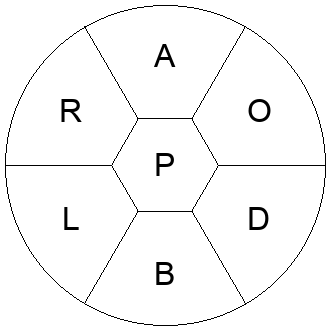
The official answers for today's puzzle are:

Click on the arrow to show the definition.
Click outside the pop-up to close it.


Number of Pangrams: 1

Maximum Puzzle Score: 119

Number of Answers: 32

Points Needed for Genius: 83

Genius requires between 12 and 29 words. You need at least a 6-letter word to reach genius. If you don't get the pangram, you need 80% of the total points to reach genius. If you get the pangram, you only need 65% of the remaining points to reach genius.

Other days with this pangram:

The button below will reveal a chart with the number of words by each letter. Red bars indicate that there is a pangram(s) starting with that letter.


How does this puzzle compare to other puzzles?

Today's score of 119 was in the 22nd percentile of all puzzles.
The last time there was a score this low was on June 27, 2026.
The highest score ever was 537 on January 22, 2021.
The lowest score ever was 47 on March 27, 2023.

This puzzle's 32 possible answers rank it in the 29th percentile of all puzzles.
The last time there were fewer answers than this was on June 29, 2026.
The highest number of answers was 81 on June 08, 2019.
The lowest number of answers was 16 on March 27, 2023.

It takes a 6-letter word for genius.
The last time this happened was on July 05, 2026.

Today's puzzle has an average word length of 5.0.
For all Bees, the average word length has been 5.3.


Haven't I seen these letters before?

Hover over a letter to see its first and most recent appearance in the Bee!


Haven't I seen these words before?

The most common words in the Bee are:

  • noon 244
  • loll 226
  • toot 218
  • nana 204
  • naan 204
  • nene 158
  • tilt 157
  • till 157
  • mamma 157
  • mama 157
  • lilt 157
  • tint 152
  • onion 150
  • acai 148
  • acacia 148
  • toon 147
  • onto 147
  • olio 137
  • anon 137
  • anal 136
  • papa 129
  • tact 128
  • baba 127
  • lulu 125
  • lull 125
  • dodo 125
  • loon 122
  • poop 121
  • mitt 121
  • calla 121
  • call 121
  • booboo 120
  • boob 120
  • cocci 119
  • moon 118
  • mono 118
  • tattoo 117
  • tartar 117
  • tart 117
  • ratatat 117
  • attar 116
  • tutu 114
  • ally 114
  • allay 114
  • cancan 113
  • aria 113
  • tatty 111
  • roar 111
  • momma 111
  • ammo 111


How long are words in the Bee?

There have been 120,015 answers ever accepted in the Bee - with 11,054 unique words.
Below are the distributions of the lengths of these words.


Valid dictionary words not in today's official answers

You may be wondering why these words aren't here*:

  • apod
  • apodal
  • apollo
  • appal
  • dopa
  • dorp
  • orlop
  • palabra
  • palpal
  • para
  • parador
  • pard
  • parr
  • parral
  • pollard
  • pood
  • prao
  • proa
  • prob
  • prolabor

*Because the New York Times considers them obscure or offensive.

appall

verb
  1. To fill with horror; to dismay.
  2. To make pale; to blanch.
  3. To weaken; to reduce in strength
  4. To grow faint; to become weak; to become dismayed or discouraged.
  5. To lose flavour or become stale.

bloop

noun
  1. A low-pitched beeping sound.
verb
  1. To make a hit just beyond the infield.
  2. To produce a low-pitched beeping sound.
  3. To cover up splices in a soundtrack tape to eliminate the unwanted noise they may produce.

dollop

noun
  1. A considerable lump, scoop, or quantity of something, especially soft food.
verb
  1. To apply haphazardly in generous lumps or scoops.
  2. To dole out in a considerable quantity; to drip in a viscous form.

droop

noun
  1. Something which is limp or sagging
  2. A condition or posture of drooping
verb
  1. To hang downward; to sag.
  2. To slowly become limp; to bend gradually.
  3. To lose all energy, enthusiasm or happiness; to flag.
  4. To allow to droop or sink.
  5. To proceed downward, or toward a close; to decline.

drop

noun
  1. A small quantity of liquid, just large enough to hold its own round shape via surface tension, especially one that falls from a source of liquid.
  2. A very small quantity of liquid, or (by extension) of anything.
  3. (now especially with "the") Alcoholic spirits in general.
  4. That which resembles or hangs like a liquid globule: a hanging diamond ornament or earring, a glass pendant on a chandelier, etc.
  5. A thing which drops or hangs down:
  6. A fall, descent; an act or instance of dropping.
  7. A release (of music, a vdeo game, etc).
  8. A decline in quantity, quality, rate, or degree; a decline (when going from one value to another).
  9. A thing, person, etc which is dropped:
  10. An unsolicited credit card issue.
  11. The amount of money that a gambler exchanges for chips in a casino.
  12. The distance below a cliff or other high position into which someone or something could fall; the distance to which someone or something drops; a steep slope.
  13. The vertical length of a hanging curtain.
  14. The depth of a (square) sail (generally applied to the courses only); the vertical dimension of a sail.
  15. The distance of the axis of a shaft below the base of a hanger.
  16. A place where items or supplies may be left for others to collect, whether openly (as with a mail drop) or secretly or illegaly (as in espionage or crime); a drop-off point.
  17. A drop-back.
  18. (Rugby football) A drop-kick.
  19. A drop target.
verb
  1. To fall in droplets (of a liquid).
  2. To drip (a liquid).
  3. Generally, to fall (straight down).
  4. To let fall; to allow to fall (either by releasing hold of, or losing one's grip on).
  5. To let drops fall; to discharge itself in drops.
  6. To lower; to move to a lower position.
  7. To set down from a vehicle; to deliver or deposit by stopping.
  8. To sink quickly to the ground.
  9. To fall dead, or to fall in death.
  10. To come to an end (by not being kept up); to stop.
  11. To mention casually or incidentally, usually in conversation.
  12. To part with or spend (money).
  13. To cease concerning oneself over; to have nothing more to do with (a subject, discussion etc.).
  14. To lessen, decrease, or diminish in value, condition, degree, etc.
  15. To let (a letter etc.) fall into a postbox; to send (a letter or message) in an offhand manner.
  16. To make (someone or something) fall to the ground from a blow, gunshot etc.; to bring down, to shoot down.
  17. To fail to write, or (especially) to pronounce (a syllable, letter etc.).
  18. (of a fielder) To fail to make a catch from a batted ball that would have led to the batsman being out.
  19. To swallow (a drug), particularly LSD.
  20. To dispose (of); get rid of; to remove; to lose.
  21. To eject; to dismiss; to cease to include, as if on a list.
  22. To drop out of the betting.
  23. (rugby football) To score (a goal) by means of a drop kick.
  24. To impart.
  25. To release to the public.
  26. To play a portion of music in the manner of a disc jockey.
  27. To enter public distribution.
  28. To tune (a guitar string, etc.) to a lower note.
  29. To cancel or end a scheduled event, project or course.
  30. (fast food) To cook, especially by deep-frying or grilling.
  31. (of a voice) To lower in timbre, often relating to puberty.
  32. (of a sound or song) To lower in pitch, tempo, key, or other quality.
  33. (of people) To visit informally; used with in or by.
  34. To give birth to.
  35. To cover with drops; to variegate; to bedrop.
  36. (of the testicles) To hang lower and begin producing sperm due to puberty.

lapboard

No Definition Found.

lollop

verb
  1. To walk or move with a bouncing or undulating motion and at an unhurried pace.
  2. To act lazily, loll, lie around.

loop

Etymology 1

noun
  1. A length of thread, line or rope that is doubled over to make an opening.
  2. The opening so formed.
  3. A shape produced by a curve that bends around and crosses itself.
  4. A ring road or beltway.
  5. An endless strip of tape or film allowing continuous repetition.
  6. A complete circuit for an electric current.
  7. A programmed sequence of instructions that is repeated until or while a particular condition is satisfied.
  8. An edge that begins and ends on the same vertex.
  9. A path that starts and ends at the same point.
  10. A bus or rail route, walking route, etc. that starts and ends at the same point.
  11. A place at a terminus where trains or trams can turn round and go back the other way without having to reverse; a balloon loop, turning loop, or reversing loop.
  12. A quasigroup with an identity element.
  13. A loop-shaped intrauterine device.
  14. An aerobatic maneuver in which an aircraft flies a circular path in a vertical plane.
  15. A small, narrow opening; a loophole.
  16. A flexible region in a protein's secondary structure.
noun
  1. A mass of iron in a pasty condition gathered into a ball for the tilt hammer or rolls.

Etymology 2

verb
  1. To form something into a loop.
  2. To fasten or encircle something with a loop.
  3. To fly an aircraft in a loop.
  4. To move something in a loop.
  5. To join electrical components to complete a circuit.
  6. To duplicate the route of a pipeline.
  7. To create an error in a computer program so that it runs in an endless loop and the computer freezes up.
  8. To form a loop.
  9. To move in a loop.

opal

noun
  1. A mineral consisting, like quartz, of silica, but inferior to quartz in hardness and specific gravity, of the chemical formula SiO2·nH2O.
  2. A colloquial name used in molecular biology referring to a particular stop codon sequence, "UGA."
  3. Any of various lycaenid butterflies of the genus Nesolycaena.

palapa

noun
  1. An open-sided dwelling with a thatched roof made of dried palm leaves.

pall

Etymology 1

noun
  1. Senses relating to cloth.
  2. Senses relating to clothing.

Etymology 2

verb
  1. To cloak or cover with, or as if with, a pall.

Etymology 3

verb
  1. To make vapid or insipid; to make lifeless or spiritless; to dull, to weaken.
  2. To become dull, insipid, tasteless, or vapid; to lose life, spirit, strength, or taste.

Etymology 4

noun
  1. A feeling of nausea caused by disgust or overindulgence.

pallor

noun
  1. Paleness; want of color; pallidity; wanness.

palp

noun
  1. A pedipalp, an appendage found near the mouth in invertebrates; has a variety of functions but is often primarily used for predating.
noun
  1. A fleshy part of a fingertip.
  2. Short for palpation.
verb
  1. To feel, to explore by touch.
adjective
  1. Palpatory; obtained by palpation.

papa

noun
  1. Dad, daddy, father; a familiar or old-fashioned term of address to one’s father.
  2. A pet name for one's grandfather.
  3. A parish priest in the Greek Orthodox Church.
  4. The letter P in the ICAO spelling alphabet.

papal

adjective
  1. Having to do with the pope or the papacy.

parabola

noun
  1. The conic section formed by the intersection of a cone with a plane parallel to a tangent plane to the cone; the locus of points equidistant from a fixed point (the focus) and line (the directrix).
  2. The explicit drawing of a parallel between two essentially dissimilar things, especially with a moral or didactic purpose. A parable.

paradrop

noun
  1. A delivery of goods or equipment by dropping of a parachute
verb
  1. To deliver goods or equipment by dropping of a parachute

parlor

noun
  1. The living room of a house, or a room for entertaining guests; a room for talking; a sitting-room or drawing room
  2. The apartment in a monastery or nunnery where the residents are permitted to meet and converse with each other or with visitors from the outside.
  3. A comfortable room in a public house.
  4. A covered open-air patio.
  5. A shop or other business selling goods specified by context.
  6. A shed used for milking cattle.

parol

Etymology 1

noun
  1. A word; an oral utterance.
  2. Oral declaration; word of mouth.
  3. A writing not under seal.
adjective
  1. Word of mouth.
  2. Verbal, oral, informal.

Etymology 2

noun
  1. An ornamental star-like Christmas lantern from the Philippines.

plod

Etymology 1

noun
  1. A slow or labored walk or other motion or activity.
verb
  1. To walk or move slowly and heavily or laboriously (+ on, through, over).
  2. To trudge over or through.
  3. To toil; to drudge; especially, to study laboriously and patiently.

Etymology 2

noun
  1. A puddle.

Etymology 3

noun
  1. (mildly, usually with "the") the police, police officers
  2. (mildly) a police officer, especially a low-ranking one.

plop

noun
  1. A sound or action like liquid hitting a hard surface, or an object falling into a body of water.
  2. Excrement; derived from the "plop" sound made when it hits water in a toilet.
verb
  1. To make the sound of an object dropping into a body of liquid.
  2. To land heavily or loosely.
  3. To defecate; derived from the "plop" sound made when excrement hits water in a toilet.

polar

noun
  1. The line joining the points of contact of tangents drawn to meet a curve from a point called the pole of the line.
adjective
  1. Of or having a pole or polarity.
  2. Of, relating to, measured from, or referred to a geographic pole (the North Pole or South Pole); within the Arctic or Antarctic circles.
  3. (space sciences) Of an orbit that passes over, or near, one of these poles.
  4. Having a dipole; ionic.
  5. Of a coordinate system, specifying the location of a point in a plane by using a radius and an angle.
  6. (of a question) Having but two possible answers, yes and no.

poll

Etymology 1

noun
  1. A survey of people, usually statistically analyzed to gauge wider public opinion.
  2. A formal election.
  3. A polling place (usually as plural, polling places)
  4. (now rare outside veterinary medicine contexts) The head, particularly the scalp or pate upon which hair (normally) grows.
  5. (in extended senses of the above) A mass of people, a mob or muster, considered as a head count.
  6. The broad or butt end of an axe or a hammer.
  7. The pollard or European chub, a kind of fish.
verb
  1. To take, record the votes of (an electorate).
  2. To solicit mock votes from (a person or group).
  3. To vote at an election.
  4. To register or deposit, as a vote; to elicit or call forth, as votes or voters.
  5. To cut off; to remove by clipping, shearing, etc.; to mow or crop.
  6. To cut the hair of (a creature).
  7. To remove the horns of (an animal).
  8. To remove the top or end of; to clip; to lop.
  9. (communication) To (repeatedly) request the status of something (such as a computer or printer on a network).
  10. (with adverb) To be judged in a poll.
  11. To extort from; to plunder; to strip.
  12. To impose a tax upon.
  13. To pay as one's personal tax.
  14. To enter, as polls or persons, in a list or register; to enroll, especially for purposes of taxation; to enumerate one by one.
  15. To cut or shave smooth or even; to cut in a straight line without indentation.
adjective
  1. (of kinds of livestock which typically have horns) Bred without horns, and thus hornless.

Etymology 2

noun
  1. A pet parrot.

Etymology 3

noun
  1. (Cambridge University) One who does not try for honors at university, but is content to take a degree merely; a passman.

polo

Etymology 1

noun
  1. A ball game where two teams of players on horseback use long-handled mallets to propel the ball along the ground and into their opponent's goal.
  2. The ice polo, one of the ancestors of ice hockey; a similar game played on the ice, or on a prepared floor, by players wearing skates.
  3. A polo shirt.

Etymology 2

noun
  1. A Spanish gypsy dance characterized by energetic movements of the body while the feet merely shuffle or glide, with unison singing and rhythmic clapping of hands.

Etymology 3

noun
  1. A dress shirt.

pool

Etymology 1

noun
  1. A small and rather deep collection of (usually) fresh water, as one supplied by a spring, or occurring in the course of a stream; a reservoir for water.
  2. A small body of standing or stagnant water; a puddle.
  3. A supply of resources.
  4. (by extension) A set of resources that are kept ready to use.
  5. A small amount of liquid on a surface.
  6. A localized glow of light.
verb
  1. (of a liquid) To form a pool.
noun
  1. A pool of water used for swimming, usually one which has been artificially constructed.

Etymology 2

noun
  1. (game) A game at billiards, in which each of the players stakes a certain sum, the winner taking the whole; also, in public billiard rooms, a game in which the loser pays the entrance fee for all who engage in the game.
  2. A cue sport played on a pool table. There are 15 balls, 7 of one colour, 7 of another, and the black ball (also called the 8 ball). A player must pocket all their own colour balls and then the black ball in order to win.
  3. In rifle shooting, a contest in which each competitor pays a certain sum for every shot he makes, the net proceeds being divided among the winners.
  4. Any gambling or commercial venture in which several persons join.
  5. The stake played for in certain games of cards, billiards, etc.; an aggregated stake to which each player has contributed a share; also, the receptacle for the stakes.
  6. A combination of persons contributing money to be used for the purpose of increasing or depressing the market price of stocks, grain, or other commodities; also, the aggregate of the sums so contributed.
  7. A set of players in quadrille etc.
  8. A mutual arrangement between competing lines, by which the receipts of all are aggregated, and then distributed pro rata according to agreement.
  9. An aggregation of properties or rights, belonging to different people in a community, in a common fund, to be charged with common liabilities.
verb
  1. To put together; contribute to a common fund, on the basis of a mutual division of profits or losses; to make a common interest of.
  2. To combine or contribute with others, as for a commercial, speculative, or gambling transaction.

poop

Etymology 1

noun
  1. Fecal matter, feces.
  2. The sound of a steam engine's whistle; typically low pitch.
verb
  1. To make a short blast on a horn
  2. To break wind.
  3. To defecate.

Etymology 2

noun
  1. A set of data or general information, written or spoken, usually concerning machinery or a process.

Etymology 3

verb
  1. To tire, exhaust. Often used with out.

Etymology 4

noun
  1. The stern of a ship.
  2. The poop deck.
verb
  1. To break seawater with the poop of a vessel, especially the poop deck.
  2. To embark a ship over the stern.

Etymology 5

noun
  1. A slothful person.

poor

noun
  1. (with "the") Those who have little or no possessions or money, taken as a group.
adjective
  1. With no or few possessions or money, particularly in relation to contemporaries who do have them.
  2. Of low quality.
  3. Used to express pity.
  4. Deficient in a specified way.
  5. Inadequate, insufficient.
  6. Free from self-assertion; not proud or arrogant; meek.

poplar

noun
  1. Any of various deciduous trees of the genus Populus.
  2. Wood from the poplar tree.

poppa

noun
  1. (sometimes childish) father, papa.

prod

Etymology 1

noun
  1. A device (now often electrical) used to goad livestock into moving.
  2. A prick or stab with such a pointed instrument.
  3. A poke.
  4. A light kind of crossbow; a prodd.
verb
  1. To poke, to push, to touch.
  2. To encourage, to prompt.
  3. To prick with a goad.

Etymology 2

noun
  1. A production.

prop

Etymology 1

noun
  1. An object placed against or under another, to support it; anything that supports.
  2. The player on either side of the hooker in a scrum.
  3. One of the seashells in the game of props.
verb
  1. (sometimes figurative) To support or shore up something.
  2. To play rugby in the prop position
  3. (usually with "up" - see prop up) To position the feet of (a person) while sitting, lying down, or reclining so that the knees are elevated at a higher level.

Etymology 2

noun
  1. An item placed on a stage or set to create a scene or scenario in which actors perform.
  2. An item placed within an advertisement in order to suggest a style of living etc.

Etymology 3

noun
  1. The propeller of an aircraft.
verb
  1. To manually start the engine of a propeller-driven aircraft with no electric starter by pulling vigorously on one of the propeller blades using the hands, so that the propeller can catch ignition.

Etymology 4

noun
  1. A proposition, especially on an election-day ballot.

Etymology 5

noun
  1. Propellant

boop

No Definition Found.