Monday, August 11, 2025

Answers to yesterday's Bee

Jump to answers for


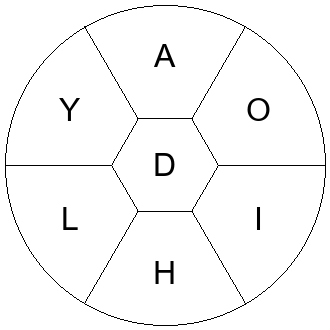
The official answers for today's puzzle are:

Click on the arrow to show the definition.
Click outside the pop-up to close it.


Number of Pangrams: 1

Maximum Puzzle Score: 118

Number of Answers: 30

Points Needed for Genius: 83

Genius requires between 13 and 27 words. You need at least a 6-letter word to reach genius. If you don't get the pangram, you need 80% of the total points to reach genius. If you get the pangram, you only need 66% of the remaining points to reach genius.

Other days with this pangram:

The button below will reveal a chart with the number of words by each letter. Red bars indicate that there is a pangram(s) starting with that letter.


How does this puzzle compare to other puzzles?

Today's score of 118 was in the 23rd percentile of all puzzles.
The last time there was a score this low was on August 5, 2025.
The highest score ever was 537 on January 22, 2021.
The lowest score ever was 47 on March 27, 2023.

This puzzle's 30 possible answers rank it in the 25th percentile of all puzzles.
The last time there were fewer answers than this was on August 5, 2025.
The highest number of answers was 81 on June 8, 2019.
The lowest number of answers was 16 on March 27, 2023.

It takes a 6-letter word for genius.
The last time this happened was on August 4, 2025.

Today's puzzle has an average word length of 5.0.
For all Bees, the average word length has been 5.3.


Haven't I seen these letters before?

Hover over a letter to see its first and most recent appearance in the Bee!


Haven't I seen these words before?

The most common words in the Bee are:

  • noon 207
  • loll 201
  • toot 193
  • naan 177
  • nana 177
  • lilt 144
  • till 144
  • tilt 144
  • tint 138
  • nene 137
  • mama 135
  • mamma 135
  • acacia 130
  • acai 130
  • onto 127
  • toon 127
  • onion 124
  • anon 120
  • anal 119
  • olio 116
  • dodo 114
  • tact 114
  • boob 113
  • booboo 113
  • papa 112
  • poop 112
  • baba 111
  • lull 110
  • lulu 110
  • call 108
  • calla 108
  • mitt 108
  • ratatat 106
  • tart 106
  • tartar 106
  • attar 105
  • mono 105
  • moon 105
  • tatty 105
  • tutu 105
  • ammo 104
  • cocci 104
  • momma 104
  • tattoo 104
  • allay 103
  • ally 103
  • loon 101
  • epee 100
  • peep 100
  • roar 99


How long are words in the Bee?

There have been 105,271 answers ever accepted in the Bee - with 10,716 unique words.
Below are the distributions of the lengths of these words.


Valid dictionary words not in today's official answers

You may be wondering why these words aren't here*:

  • ahold
  • aldol
  • alidad
  • allod
  • allodia
  • allodial
  • alodia
  • alodial
  • dada
  • dado
  • dahl
  • dhal
  • dhooly
  • dido
  • didy
  • diol
  • doodah
  • doodoo
  • doody
  • dooly
  • doyly
  • hadal
  • halid
  • haloid
  • hodad
  • hodaddy
  • holdall
  • holyday
  • hoody
  • hyaloid
  • hyoidal
  • iliad
  • iodid
  • laddy
  • ladhood
  • ladyhood
  • lido
  • loid
  • odah
  • odyl
  • oidia
  • oidioid
  • oldy
  • yald
  • yodh

*Because the New York Times considers them obscure or offensive.

daddy

noun
  1. (usually childish) Father.
  2. A male lover.
  3. An informal term of address for a man.
  4. A male juvenile delinquent in a reformatory who dominates the other inmates through threats and violence.
verb
  1. To father; to sire.

dahlia

noun
  1. Any plant of the genus Dahlia, tuberous perennial flowering plants native to Mexico.

daily

Etymology 1

noun
  1. Something that is produced, consumed, used, or done every day.
verb
  1. To drive an automobile frequently, on a daily basis, for regular and mundane tasks.
adjective
  1. That occurs every day, or at least every working day
  2. Diurnal, by daylight, as opposed to nightly

Etymology 2

adverb
  1. Quotidianly, every day
  2. Diurnally, by daylight

dally

Etymology 1

verb
  1. To waste time in trivial activities, or in idleness; to trifle.
  2. To caress, especially of a sexual nature; to fondle or pet
  3. To delay unnecessarily; to while away.

Etymology 2

noun
  1. Several wraps of rope around the saddle horn, used to stop animals in roping.
verb
  1. To wind the lasso rope (ie throw-rope) around the saddle horn (the saddle horn is attached to the pommel of a western style saddle) after the roping of an animal

daylily

noun
  1. Any of several perennial plants, of the genus Hemerocallis, that have fleshy roots, grasslike leaves and colourful flowers that bloom for just one day.

dial

noun
  1. A graduated, circular scale over which a needle moves to show a measurement (such as speed).
  2. A clock face.
  3. A sundial.
  4. A panel on a radio etc showing wavelengths or channels; a knob that is turned to change the wavelength etc.
  5. A disk with finger holes on a telephone; used to select the number to be called.
  6. A person's face.
  7. A miner's compass.
verb
  1. To control or select something with a dial, or (figuratively) as if with a dial.
  2. To select a number, or to call someone, on a telephone.
  3. To use a dial or a telephone.

diddly

Etymology 1

noun
  1. A small amount of no worth.

Etymology 2

interjection
  1. A written representation of a trill sound.

Etymology 3

noun
  1. (sometimes childish) penis

dildo

Etymology 1

noun
  1. An artificial phallus (penis) for sexual use.
  2. An idiot, a bore.
  3. A columnar cactaceous plant of the West Indies (Pilosocereus royenii).
verb
  1. To penetrate with a dildo or with another object as if it were a dildo.

Etymology 2

interjection
  1. A burden: a phrase or theme that recurs at the end of a verse of a folk song.

dill

Etymology 1

noun
  1. Anethum graveolens (the type species of the genus Anethum), a herb, the seeds of which are moderately warming, pungent, and aromatic, formerly used as a soothing medicine for children; also known as dillseed.
  2. A cucumber pickled with dill flavoring
  3. A fool.
verb
  1. To cook or flavor with dill

Etymology 2

verb
  1. To still; to assuage; to calm; to soothe, as one in pain.

dilly

Etymology 1

adjective
  1. Redolent of dill (the herb).

Etymology 2

noun
  1. Someone or something that is remarkable or unusual.

Etymology 3

noun
  1. A dilly bag.

Etymology 4

noun
  1. A kind of stagecoach.

dillydally

No Definition Found.

dodo

Etymology 1

noun
  1. A large, flightless bird, †Raphus cucullatus, related to the pigeon, that is now extinct (since the 1600s) and was native to Mauritius.
  2. A person or organisation which is very old or has very old-fashioned views or is not willing to change and adapt.

Etymology 2

noun
  1. Fried plantain.

doily

noun
  1. A small ornamental piece of lace or linen or paper used to protect a surface from scratches by hard objects such as vases or bowls; or to decorate a plate of food.
  2. An old kind of woollen material.

doll

noun
  1. A toy in the form of a human.
  2. (sometimes offensive) An attractive young woman
  3. A term of endearment: darling, sweetheart.
  4. A dollar.
  5. (now possibly offensive) A good-natured, cooperative or helpful girl.
  6. The smallest or pet pig in a litter.

dolly

Etymology 1

noun
  1. A doll.
  2. A contrivance for stirring:
  3. A tool with an indented head for shaping the head of a rivet.
  4. In pile driving, a block interposed between the head of the pile and the ram of the driver.
  5. A small truck with a single wide roller used for moving heavy beams, columns, etc., in bridge building.
  6. A small truck without means of steering, to be slipped under a load.
  7. A compact, narrow-gauge locomotive used for moving construction trains, switching, etc.
  8. A specialized piece of film equipment resembling a little cart on which a camera is mounted.
  9. A young woman, especially one who is frivolous or vapid.
  10. A fashionable young woman, one who follows the latest music or clothing fashions.
  11. A ball hit by a batsman such that it goes gently to a fielder for a simple catch.
  12. A marker placed on the winning number by the dealer at roulette.
verb
  1. To hit a dolly.
  2. To move (an object) using a dolly.
  3. To wash (laundry) in a tub using the stirring device called a dolly.
  4. To beat (red-hot metal) with a hammer.
  5. To crush ore with a dolly.

Etymology 2

adjective
  1. Pretty; attractive.

Etymology 3

noun
  1. An offering of fruit or flowers.

doodad

noun
  1. A thing (used in a vague way to refer to something whose name one cannot recall); especially an unspecified gadget, device, or part.

dyad

noun
  1. A set of two elements treated as one; a pair.
  2. Any set of two different pitch classes.
  3. A pair of things standing in particular relation; dyadic relation.
  4. An element, atom, or radical having a valence or combining power of two.
  5. A secondary unit of organisation consisting of an aggregate of monads.
  6. A tensor of order two and rank one.

hold

Etymology 1

noun
  1. A grasp or grip.
  2. An act or instance of holding.
  3. A place where animals are held for safety
  4. An order that something is to be reserved or delayed, limiting or preventing how it can be dealt with.
  5. Something reserved or kept.
  6. Power over someone or something.
  7. The ability to persist.
  8. The property of maintaining the shape of styled hair.
  9. A position or grip used to control the opponent.
  10. (exercise) An exercise involving holding a position for a set time
  11. The percentage the house wins on a gamble, the house or bookmaker's hold.
  12. The wager amount, the total hold.
  13. An instance of holding one's service game, as opposed to being broken.
  14. The part of an object one is intended to grasp, or anything one can use for grasping with hands or feet.
  15. A fruit machine feature allowing one or more of the reels to remain fixed while the others spin.
  16. A pause facility.
  17. The queueing system on telephones and similar communication systems which maintains a connection when all lines are busy.
  18. A statistic awarded to a relief pitcher who is not still pitching at the end of the game and who records at least one out and maintains a lead for his team.
  19. A region of airspace reserved for aircraft being kept in a holding pattern.
verb
  1. To grasp or grip.
  2. To contain or store.
  3. (heading) To maintain or keep to a position or state.
  4. (heading) To maintain or keep to particular opinions, promises, actions.
  5. To win one's own service game.
  6. To take place, to occur.
  7. To organise an event or meeting (usually in passive voice).
  8. To derive right or title.
  9. In a food or drink order at an informal restaurant etc., requesting that a component normally included in that order be omitted.
  10. To be in possession of illicit drugs for sale.

Etymology 2

noun
  1. The cargo area of a ship or aircraft (often holds or cargo hold).

Etymology 3

adjective
  1. Gracious; friendly; faithful; true.

holiday

noun
  1. A day on which a festival, religious event, or national celebration is traditionally observed.
  2. A day declared free from work by the state or government.
  3. A period of one or more days taken off work for leisure and often travel; often plural.
  4. A period during which pupils do not attend their school; often plural; rarely used for students at university (usually: vacation).
  5. A period during which, by agreement, the usual payments are not made.
  6. A gap in coverage, e.g. of paint on a surface, or sonar imagery.
verb
  1. To take a period of time away from work or study.
  2. To spend a period of time for travel.

hood

Etymology 1

noun
  1. A covering for the head attached to a larger garment such as a jacket or cloak.
  2. A distinctively coloured fold of material, representing a university degree.
  3. An enclosure that protects something, especially from above.
  4. A soft top of a convertible car or carriage.
  5. The hinged cover over the engine of a motor vehicle: known as a bonnet in other countries.
  6. A metal covering that leads to a vent to suck away smoke or fumes.
verb
  1. To cover something with a hood.

Etymology 2

noun
  1. Gangster, thug.

Etymology 3

noun
  1. Neighborhood.
adjective
  1. Relating to inner-city everyday life, both positive and negative aspects; especially people’s attachment to and love for their neighborhoods.

Etymology 4

noun
  1. Person wearing a hoodie.

hoodoo

noun
  1. A practitioner of voodoo.
  2. Supernatural bad luck, or something or someone believed to bring bad luck.
  3. A tall thin spire of rock that protrudes from the bottom of arid basins and badlands.
verb
  1. To jinx; to bring bad luck or misfortune to.

hyoid

noun
  1. The hyoid bone.
adjective
  1. Shaped like a U, or like the letter upsilon; specifically, designating a bone or group of bones supporting the tongue.

idly

adverb
  1. In an idle manner.
  2. Without specific purpose, intent or effort.

idol

noun
  1. A graven image or representation of anything that is revered, or believed to convey spiritual power.
  2. A cultural icon, or especially popular person.
  3. (originally Japan) Popular entertainer; usually young, captivating, attractive; and often female, with an image of being close to fans.
  4. An eidolon or phantom; something misleading or elusive.

idyl

noun
  1. Any poem or short written piece composed in the style of Theocritus' short pastoral poems, the Idylls.
  2. An episode or series of events or circumstances of pastoral or rural simplicity, fit for an idyll; a carefree or lighthearted experience.
  3. A composition, usually instrumental, of a pastoral or sentimental character, e.g. Siegfried Idyll by Richard Wagner.

idyll

noun
  1. Any poem or short written piece composed in the style of Theocritus' short pastoral poems, the Idylls.
  2. An episode or series of events or circumstances of pastoral or rural simplicity, fit for an idyll; a carefree or lighthearted experience.
  3. A composition, usually instrumental, of a pastoral or sentimental character, e.g. Siegfried Idyll by Richard Wagner.

lady

noun
  1. An aristocratic title for a woman; the wife of a lord and/or a woman who holds the position in her own right; a title for a peeress, the wife of a peer or knight, and the daughters and daughters-in-law of certain peers.
  2. A high priestess.
noun
  1. The mistress of a household.
  2. A woman of breeding or higher class, a woman of authority.
  3. The feminine of lord.
  4. A title for someone married to a lord or gentleman.
  5. A title that can be used instead of the formal terms of marchioness, countess, viscountess or baroness.
  6. (polite or used by children) A woman: an adult female human.
  7. (in the plural) A polite reference or form of address to women.
  8. Used to address a female.
  9. (ladies' or ladies) Toilets intended for use by women.
  10. (familiar) A wife or girlfriend; a sweetheart.
  11. A woman to whom the particular homage of a knight was paid; a woman to whom one is devoted or bound.
  12. A queen (the playing card).
  13. (with a professional title) Who is a woman.
  14. The triturating apparatus in the stomach of a lobster, consisting of calcareous plates; so called from a fancied resemblance to a seated female figure.
  15. A five-pound note. (Rhyming slang, Lady Godiva for fiver.)
  16. A woman’s breast.

laid

adjective
  1. (of paper) Marked with parallel lines, as if ribbed, from wires in the mould.
verb
  1. To place down in a position of rest, or in a horizontal position.
  2. To cause to subside or abate.
  3. To prepare (a plan, project etc.); to set out, establish (a law, principle).
  4. To install certain building materials, laying one thing on top of another.
  5. To produce and deposit an egg.
  6. To bet (that something is or is not the case).
  7. To deposit (a stake) as a wager; to stake; to risk.
  8. To have sex with.
  9. To take a position; to come or go.
  10. To state; to allege.
  11. To point; to aim.
  12. (ropemaking) To put the strands of (a rope, a cable, etc.) in their proper places and twist or unite them.
  13. To place and arrange (pages) for a form upon the imposing stone.
  14. To place (new type) properly in the cases.
  15. To apply; to put.
  16. To impose (a burden, punishment, command, tax, etc.).
  17. To impute; to charge; to allege.
  18. To present or offer.
verb
  1. To don or put on (tefillin (phylacteries)).

load

noun
  1. A burden; a weight to be carried.
  2. A worry or concern to be endured, especially in the phrase a load off one's mind.
  3. A certain number of articles or quantity of material that can be transported or processed at one time.
  4. A quantity of washing put into a washing machine for a wash cycle.
  5. (in combination) Used to form nouns that indicate a large quantity, often corresponding to the capacity of a vehicle
  6. (often in the plural) A large number or amount.
  7. The volume of work required to be performed.
  8. The force exerted on a structural component such as a beam, girder, cable etc.
  9. The electrical current or power delivered by a device.
  10. A resistive force encountered by a prime mover when performing work.
  11. Any component that draws current or power from an electrical circuit.
  12. A unit of measure for various quantities.
  13. The viral load
  14. A very small explosive inserted as a gag into a cigarette or cigar.
  15. The charge of powder for a firearm.
  16. Weight or violence of blows.
  17. The contents (e.g. semen) of an ejaculation.
  18. Nonsense; rubbish.
  19. The process of loading something, i.e. transferring it into memory or over a network, etc.
verb
  1. To put a load on or in (a means of conveyance or a place of storage).
  2. To place in or on a conveyance or a place of storage.
  3. To put a load on something.
  4. To receive a load.
  5. To be placed into storage or conveyance.
  6. To fill (a firearm or artillery) with munition.
  7. To insert (an item or items) into an apparatus so as to ready it for operation, such as a reel of film into a camera, sheets of paper into a printer etc.
  8. To fill (an apparatus) with raw material.
  9. To be put into use in an apparatus.
  10. To read (data or a program) from a storage medium into computer memory.
  11. To transfer from a storage medium into computer memory.
  12. To put runners on first, second and third bases
  13. To tamper with so as to produce a biased outcome.
  14. To ask or adapt a question so that it will be more likely to be answered in a certain way.
  15. To encumber with something negative, to place as an encumbrance.
  16. To provide in abundance.
  17. To weight (a cane, whip, etc.) with lead or similar.
  18. To adulterate or drug.
  19. To magnetize.

oddly

adverb
  1. In a peculiar manner; strangely; unusually.
  2. In a manner measured by an odd number.