Wednesday, January 21, 2026

Answers to yesterday's Bee

Jump to answers for


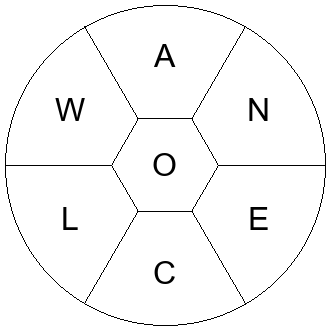
The official answers for today's puzzle are:

Click on the arrow to show the definition.
Click outside the pop-up to close it.


Number of Pangrams: 1

Maximum Puzzle Score: 207

Number of Answers: 51

Points Needed for Genius: 145

Genius requires between 22 and 44 words. You need at least a 6-letter word to reach genius. If you don't get the pangram, you need 76% of the total points to reach genius. If you get the pangram, you only need 68% of the remaining points to reach genius.

Other days with this pangram:

The button below will reveal a chart with the number of words by each letter. Red bars indicate that there is a pangram(s) starting with that letter.


How does this puzzle compare to other puzzles?

Today's score of 207 was in the 67th percentile of all puzzles.
The last time there was a score this high was on January 20, 2026.
The highest score ever was 537 on January 22, 2021.
The lowest score ever was 47 on March 27, 2023.

This puzzle's 51 possible answers rank it in the 78th percentile of all puzzles.
The last time there were more answers than this was on January 20, 2026.
The highest number of answers was 81 on June 8, 2019.
The lowest number of answers was 16 on March 27, 2023.

It takes a 6-letter word for genius.
The last time this happened was on January 17, 2026.

Today's puzzle has an average word length of 5.2.
For all Bees, the average word length has been 5.3.


Haven't I seen these letters before?

Hover over a letter to see its first and most recent appearance in the Bee!


Haven't I seen these words before?

The most common words in the Bee are:

  • noon 228
  • loll 211
  • toot 207
  • naan 190
  • nana 190
  • lilt 151
  • till 151
  • tilt 151
  • nene 148
  • tint 145
  • mama 142
  • mamma 142
  • acacia 137
  • acai 137
  • onion 137
  • onto 136
  • toon 136
  • anal 130
  • anon 129
  • olio 124
  • dodo 121
  • tact 121
  • papa 120
  • baba 119
  • boob 117
  • booboo 117
  • poop 117
  • lull 116
  • lulu 116
  • cocci 114
  • call 113
  • calla 113
  • mitt 113
  • mono 112
  • moon 112
  • tutu 112
  • ratatat 111
  • tart 111
  • tartar 111
  • tattoo 111
  • allay 110
  • ally 110
  • attar 110
  • loon 110
  • tatty 109
  • ammo 107
  • momma 107
  • epee 104
  • meme 104
  • peep 104


How long are words in the Bee?

There have been 112,585 answers ever accepted in the Bee - with 10,897 unique words.
Below are the distributions of the lengths of these words.


Valid dictionary words not in today's official answers

You may be wondering why these words aren't here*:

  • alcool
  • alencon
  • alow
  • ancon
  • anconal
  • ancone
  • anconeal
  • annona
  • anoa
  • anole
  • awol
  • calo
  • cannelon
  • cloacae
  • cloacal
  • clon
  • clonal
  • coala
  • coccal
  • coco
  • cole
  • colone
  • conn
  • coocoo
  • cooee
  • coon
  • cooncan
  • enol
  • enow
  • eocene
  • leno
  • leone
  • loanee
  • loca
  • lowe
  • lown
  • nano
  • nolo
  • nona
  • nonane
  • noncola
  • nonwool
  • olea
  • olla
  • woollen
  • wowee

*Because the New York Times considers them obscure or offensive.

aeon

noun
  1. (preferred spelling, with æon) A spirit being emanating from the Godhead.
  2. (Cosmology) Each universe in a series of universes, according to conformal cyclic cosmology.
noun
  1. Eternity.
  2. A period of 1,000,000,000 years.
  3. The longest time period used in geology.
  4. A long period of time.
  5. (usually spelled aeon or æon) A spirit being emanating from the Godhead.

allow

verb
  1. To grant, give, admit, accord, afford, or yield; to let one have.
  2. To acknowledge; to accept as true; to concede; to accede to an opinion.
  3. To grant (something) as a deduction or an addition; especially to abate or deduct.
  4. To grant license to; to permit; to consent to.
  5. To not bar or obstruct.
  6. To acknowledge or concede.
  7. To take into account by making an allowance.
  8. To render physically possible.
  9. To praise; to approve of; hence, to sanction.
  10. To sanction; to invest; to entrust.
  11. To like; to be suited or pleased with.

allowance

noun
  1. Permission; granting, conceding, or admitting
  2. Acknowledgment.
  3. That which is allowed; a share or portion allotted or granted; a sum granted as a reimbursement, a bounty, or as appropriate for any purpose; a stated quantity.
  4. Abatement; deduction; the taking into account of mitigating circumstances
  5. A customary deduction from the gross weight of goods, differing by country.
  6. A permitted reduction in the weight that a racehorse must carry.
  7. A child's allowance; pocket money.
  8. (minting) A permissible deviation in the fineness and weight of coins, owing to the difficulty in securing exact conformity to the standard prescribed by law.
  9. Approval; approbation
  10. License; indulgence
verb
  1. To put upon a fixed allowance (especially of provisions and drink).
  2. To supply in a fixed and limited quantity.

aloe

noun
  1. (in the plural) The resins of the tree Aquilaria malaccensis (syn. Aquilaria agallocha), known for their fragrant aroma, produced after infection by the fungus Phialophora parasitica.
  2. A plant of the genus Aloe.
  3. A strong, bitter drink made from the juice of such plants, used as a purgative.

alone

adjective
  1. By oneself, solitary.
  2. Apart from, or exclusive of, others.
  3. Considered separately.
  4. Without equal.
  5. Unique; rare; matchless.
adverb
  1. By oneself; apart from, or exclusive of, others; solo.
  2. Without outside help.
  3. Exclusively.

anon

Etymology 1

adverb
  1. Straight away; at once.
  2. Soon; in a little while.
  3. At another time; then; again.

Etymology 2

noun
  1. An anonymous person, especially an author.
  2. A work with an unknown author.
  3. A work without a title.
adjective
  1. Anonymous

cacao

noun
  1. A tree, Theobroma cacao, whose seed is used to make chocolate.
  2. This tree's seed, the cocoa bean.

callaloo

noun
  1. Any of various tropical plants grown in the Americas, especially of the genus Xanthosoma, cultivated for their edible leaves.
  2. A spicy soup or stew made from such leaves.

callow

noun
  1. A callow young bird.
  2. A callow or teneral phase of an insect or other arthropod, typically shortly after ecdysis, while the skin still is hardening, the colours have not yet become stable, and as a rule, before the animal is able to move effectively.
  3. An alluvial flat.
adjective
  1. Unfledged (of a young bird).
  2. (by extension) Immature, lacking in life experience.
  3. Lacking color or firmness (of some kinds of insects or other arthropods, such as spiders, just after ecdysis); teneral.
  4. Shallow or weak-willed.
  5. (of a brick) Unburnt.
  6. Of land: low-lying and liable to be submerged.
  7. Bald.

cannon

noun
  1. A complete assembly, consisting of an artillery tube and a breech mechanism, firing mechanism or base cap, which is a component of a gun, howitzer or mortar. It may include muzzle appendages.
  2. Any similar device for shooting material out of a tube.
  3. A bone of a horse's leg, between the fetlock joint and the knee or hock.
  4. A cannon bit.
  5. A large muzzle-loading artillery piece.
  6. A carom.
  7. The arm of a player that can throw well.
  8. A hollow cylindrical piece carried by a revolving shaft, on which it may, however, revolve independently.
  9. (Chinese chess) A piece which moves horizontally and vertically like a rook but captures another piece by jumping over a different piece in the line of attack.
verb
  1. To bombard with cannons.
  2. To play the carom billiard shot. To strike two balls with the cue ball
  3. To fire something, especially spherical, rapidly.
  4. To collide or strike violently, especially so as to glance off or rebound.
noun
  1. A generally accepted principle; a rule.
  2. A group of literary works that are generally accepted as representing a field.
  3. The works of a writer that have been accepted as authentic.
  4. A eucharistic prayer, particularly the Roman Canon.
  5. A religious law or body of law decreed by the church.
  6. A catalogue of saints acknowledged and canonized in the Roman Catholic Church.
  7. In monasteries, a book containing the rules of a religious order.
  8. A member of a cathedral chapter; one who possesses a prebend in a cathedral or collegiate church.
  9. A piece of music in which the same melody is played by different voices, but beginning at different times; a round.
  10. (Roman law) A rent or stipend payable at some regular time, generally annual, e.g., canon frumentarius
  11. Those sources, especially including literary works, which are considered part of the main continuity regarding a given fictional universe.
  12. A rolled and filleted loin of meat; also called cannon.
  13. A large size of type formerly used for printing the church canons, standardized as 48-point.
  14. The part of a bell by which it is suspended; the ear or shank of a bell.
  15. A carom.
noun
  1. A clergy member serving a cathedral or collegiate church.
  2. A canon regular, a member of any of several Roman Catholic religious orders.
noun
  1. A Near Eastern and Caucasian musical instrument related to the zither, dulcimer, or harp having either 26 strings and a single bridge, or twice that number and two bridges.

canoe

noun
  1. A small long and narrow boat, propelled by one or more people (depending on the size of canoe), using single-bladed paddles. The paddlers face in the direction of travel, in either a seated position, or kneeling on the bottom of the boat. Canoes are open on top, and pointed at both ends.
  2. An oversize, usually older, luxury car.
  3. Any of the deflectors positioned around a roulette wheel, shaped like upside-down boats.
verb
  1. To ride or paddle a canoe.

canola

noun
  1. Any of a number of cultivars of rapeseed (Brassica napus) and closely related field mustard (Brassica rapa), which have a lower erucic acid and glucosinolate content than traditional rapeseed.

canon

Etymology 1

noun
  1. A generally accepted principle; a rule.
  2. A group of literary works that are generally accepted as representing a field.
  3. The works of a writer that have been accepted as authentic.
  4. A eucharistic prayer, particularly the Roman Canon.
  5. A religious law or body of law decreed by the church.
  6. A catalogue of saints acknowledged and canonized in the Roman Catholic Church.
  7. In monasteries, a book containing the rules of a religious order.
  8. A member of a cathedral chapter; one who possesses a prebend in a cathedral or collegiate church.
  9. A piece of music in which the same melody is played by different voices, but beginning at different times; a round.
  10. (Roman law) A rent or stipend payable at some regular time, generally annual, e.g., canon frumentarius
  11. Those sources, especially including literary works, which are considered part of the main continuity regarding a given fictional universe.
  12. A rolled and filleted loin of meat; also called cannon.
  13. A large size of type formerly used for printing the church canons, standardized as 48-point.
  14. The part of a bell by which it is suspended; the ear or shank of a bell.
  15. A carom.

Etymology 2

noun
  1. A clergy member serving a cathedral or collegiate church.
  2. A canon regular, a member of any of several Roman Catholic religious orders.

Etymology 3

noun
  1. A Near Eastern and Caucasian musical instrument related to the zither, dulcimer, or harp having either 26 strings and a single bridge, or twice that number and two bridges.

cello

Etymology 1

noun
  1. A large stringed instrument of the violin family with four strings, tuned from lowest to highest C-G-D-A, and played with a bow, also possessing an endpin to support the instrument's weight.

Etymology 2

noun
  1. Cellophane

cloaca

noun
  1. (sometimes figurative) A sewer.
  2. The duct in reptiles, amphibians and birds, as well as most fish and some mammals, which serves as the common outlet for urination, defecation, and reproduction.
  3. An outhouse or lavatory.
  4. A duct through which gangrenous material escapes a body.

clone

noun
  1. A living organism (originally a plant) produced asexually from a single ancestor, to which it is genetically identical.
  2. A group of identical cells derived from a single cell.http//www.medterms.com/script/main/art.asp?articlekey=2754
  3. A copy or imitation of something already existing, especially when designed to simulate it.
  4. Two people who are exactly alike, as far as looks or behavior.
verb
  1. To create a clone of.

clown

noun
  1. A slapstick performance artist often associated with a circus and usually characterized by bright, oversized clothing, a red nose, face paint, and a brightly colored wig.
  2. A person who acts in a silly fashion.
  3. A stupid person.
  4. A man of coarse nature and manners; an awkward fellow; an illbred person; a boor.
  5. One who works upon the soil; a rustic; a churl; a yokel.
verb
  1. To act in a silly or playful fashion.
  2. To ridicule.

coal

noun
  1. A black rock formed from prehistoric plant remains, composed largely of carbon and burned as a fuel.
  2. A piece of coal used for burning (this use is less common in American English)
  3. A type of coal, such as bituminous, anthracite, or lignite, and grades and varieties thereof.
  4. A glowing or charred piece of coal, wood, or other solid fuel.
  5. Charcoal.
verb
  1. To take on a supply of coal (usually of steam ships).
  2. To supply with coal.
  3. To be converted to charcoal.
  4. To burn to charcoal; to char.
  5. To mark or delineate with charcoal.

coca

Etymology 1

noun
  1. Any of the four cultivated plants which belong to the family Erythroxylaceae, native to western South America.
  2. The dried leaf of one of these plants, the South American shrub (Erythroxylum coca), widely cultivated in Andean countries, which is the source of cocaine.

Etymology 2

noun
  1. A pastry typically made and consumed in the Spanish Mediterranean coast.

cocoa

Etymology 1

noun
  1. The dried and partially fermented fatty seeds of the cacao tree from which chocolate is made.
  2. An unsweetened brown powder made from roasted, ground cocoa beans, used in making chocolate, and in cooking.
  3. A hot drink made with milk, cocoa powder, and sugar.
  4. A serving of this drink.
  5. A light to medium brown colour.
adjective
  1. Of a light to medium brown colour, like that of cocoa powder.

Etymology 2

noun
  1. Coconut palm.
  2. Coconut, the fruit of the coconut palm.

cocoon

noun
  1. The silky protective case spun by the larvae of some insects in which they metamorphose, the pupa.
  2. Any similar protective case, whether real or metaphorical.
verb
  1. To envelop in a protective case
  2. To withdraw into such a case.

cola

Etymology 1

noun
  1. The kola plant, genus Cola, famous for its nut, or one of these nuts.
  2. A beverage or a drink made with kola nut flavoring, caramel and carbonated water.

Etymology 2

noun
  1. The punctuation mark ":".
  2. The triangular colon (especially in context of not being able to type the actual triangular colon).
  3. A rhetorical figure consisting of a clause which is grammatically, but not logically, complete.
  4. A clause or group of clauses written as a line, or taken as a standard of measure in ancient manuscripts or texts.
noun
  1. Part of the large intestine; the final segment of the digestive system, after (distal to) the ileum and before (proximal to) the anus.

Etymology 3

noun
  1. A cluster of buds on a cannabis plant.

colcannon

noun
  1. A traditional Irish dish made from mashed potatoes and cabbage or kale, with scallions, butter, salt and pepper added.

colleen

noun
  1. Girl
  2. Young single woman

colon

Etymology 1

noun
  1. The punctuation mark ":".
  2. The triangular colon (especially in context of not being able to type the actual triangular colon).
  3. A rhetorical figure consisting of a clause which is grammatically, but not logically, complete.
  4. A clause or group of clauses written as a line, or taken as a standard of measure in ancient manuscripts or texts.

Etymology 2

noun
  1. Part of the large intestine; the final segment of the digestive system, after (distal to) the ileum and before (proximal to) the anus.

Etymology 3

noun
  1. A husbandman.
  2. A European colonial settler, especially in a French colony.

colonel

noun
  1. A commissioned officer in an armed military organization, typically the highest rank before flag officer ranks (generals). It is generally found in armies, air forces or naval infantry (marines).
verb
  1. To act as or like a colonel.

conceal

verb
  1. To hide something from view or from public knowledge, to try to keep something secret.

cone

noun
  1. A surface of revolution formed by rotating a segment of a line around another line that intersects the first line.
  2. A solid of revolution formed by rotating a triangle around one of its altitudes.
  3. A space formed by taking the direct product of a given space with a closed interval and identifying all of one end to a point.
  4. Anything shaped like a cone.
  5. The fruit of a conifer.
  6. A cone-shaped flower head of various plants, such as banksias and proteas.
  7. An ice cream cone.
  8. A traffic cone
  9. A unit of volume, applied solely to marijuana and only while it is in a smokable state; roughly 1.5 cubic centimetres, depending on use.
  10. Any of the small cone-shaped structures in the retina.
  11. The bowl piece on a bong.
  12. The process of smoking cannabis in a bong.
  13. A cone-shaped cannabis joint.
  14. A passenger on a cruise ship (so-called by employees after traffic cones, from the need to navigate around them)
  15. An object V together with an arrow going from V to each object of a diagram such that for any arrow A in the diagram, the pair of arrows from V which subtend A also commute with it. (Then V can be said to be the cone’s vertex and the diagram which the cone subtends can be said to be its base.)
  16. A shell of the genus Conus, having a conical form.
  17. A set of formal languages with certain desirable closure properties, in particular those of the regular languages, the context-free languages and the recursively enumerable languages.
verb
  1. To fashion into the shape of a cone.
  2. To form a cone shape.
  3. (frequently followed by "off") To segregate or delineate an area using traffic cones

cool

Etymology 1

noun
  1. A moderate or refreshing state of cold; moderate temperature of the air between hot and cold; coolness.
  2. A calm temperament.
  3. The property of being cool, popular or in fashion.
adjective
  1. Having a slightly low temperature; mildly or pleasantly cold.
  2. Allowing or suggesting heat relief.
  3. Of a color, in the range of violet to green.
  4. Of a person, not showing emotion; calm and in control of oneself.
  5. Unenthusiastic, lukewarm, skeptical.
  6. Calmly audacious.
  7. Applied facetiously to a sum of money, commonly as if to give emphasis to the largeness of the amount.
  8. Of a person, knowing what to do and how to behave; considered popular by others.
  9. In fashion, part of or fitting the in crowd; originally hipster slang.
  10. Of an action, all right; acceptable; that does not present a problem.
  11. Of a person, not upset by circumstances that might ordinarily be upsetting.
  12. Quietly impudent, defiant, or selfish; deliberately presuming: said of persons and acts.

Etymology 2

verb
  1. To lose heat, to get colder.
  2. To make cooler, less warm.
  3. To become less intense, e.g. less amicable or passionate.
  4. To make less intense, e.g. less amicable or passionate.
  5. To kill.

cowl

Etymology 1

noun
  1. A monk's hood that can be pulled forward to cover the face; a robe with such a hood attached to it.
  2. A mask that covers the majority of the head.
  3. A thin protective covering over all or part of an engine; also cowling.
  4. A usually hood-shaped covering used to increase the draft of a chimney and prevent backflow.
  5. A ship's ventilator with a bell-shaped top which can be swivelled to catch the wind and force it below.
  6. A vertical projection of a ship's funnel that directs the smoke away from the bridge.
  7. (metonymy) A monk.
verb
  1. To cover with, or as if with, a cowl (hood).
  2. To wrap or form (something made of fabric) like a cowl.
  3. To make a monk of (a person).

Etymology 2

noun
  1. A vessel carried on a pole, a soe.

Etymology 3

noun
  1. A caul (the amnion which encloses the foetus before birth, especially that part of it which sometimes shrouds a baby’s head at birth).

llano

noun
  1. A plain or steppe in parts of Latin America.

loan

Etymology 1

noun
  1. An act or instance of lending, an act or instance of granting something for temporary use.
  2. A sum of money or other property that a natural or legal person borrows from another with the condition that it be returned or repaid over time or at a later date (sometimes with interest).
  3. The contract and array of legal or ethical obligations surrounding a loan.
  4. The permission to borrow any item.
verb
  1. To lend (something) to (someone).

Etymology 2

noun
  1. A lonnen.

local

noun
  1. A person who lives near a given place.
  2. A branch of a nationwide organization such as a trade union.
  3. A train that stops at all, or almost all, stations between its origin and destination, including very small ones.
  4. One's nearest or regularly frequented public house or bar.
  5. A locally scoped identifier.
  6. An item of news relating to the place where the newspaper is published.
adjective
  1. From or in a nearby location.
  2. (of a variable or identifier) Having limited scope (either lexical or dynamic); only being accessible within a certain portion of a program.
  3. (of a condition or state) Applying to each point in a space rather than the space as a whole.
  4. Of or pertaining to a restricted part of an organism.
  5. Descended from an indigenous population.
adverb
  1. In the local area; within a city, state, country, etc.
noun
  1. An anesthetic (anesthetic substance) that causes loss of sensation only to the area to which it is applied.

locale

noun
  1. The place where something happens.
  2. The set of settings related to the language and region in which a computer program executes. Examples are language, currency and time formats, character encoding etc.
  3. A partially ordered set with the following additional axiomatic properties: any finite subset of it has a meet, any arbitrary subset of it has a join, and distributivity, which states that a binary meet distributes with respect to an arbitrary join. (Note: locales are just like frames except that the category of locales is opposite to the category of frames.)

loco

Etymology 1

adverb
  1. A direction in written or printed music to be returning to the proper pitch after having played an octave higher or lower.

Etymology 2

noun
  1. A certain species of Astragalus or Oxytropis, capable of causing locoism.
verb
  1. To poison with the loco plant; to affect with locoism.
  2. (by extension) To render insane.
adjective
  1. Crazy.
  2. Intoxicated by eating locoweed.

Etymology 3

noun
  1. A locomotive.

loll

verb
  1. To act lazily or indolently while reclining; to lean; to lie at ease.
  2. To hang extended from the mouth, like the tongue of an animal heated from exertion.
  3. To let (the tongue) hang from the mouth in this way.

lone

adjective
  1. Solitary; having no companion.
  2. Isolated or lonely; lacking companionship.
  3. Sole; being the only one of a type.
  4. Situated by itself or by oneself, with no neighbours.
  5. Unfrequented by human beings; solitary.
  6. Single; unmarried, or in widowhood.

loon

Etymology 1

noun
  1. An idler, a lout.
  2. A boy, a lad.
  3. A harlot; mistress.
  4. A simpleton.
  5. A crazy or deranged person.
  6. An English soldier of an expeditionary army in Ireland.

Etymology 2

noun
  1. Any of various birds, of the order Gaviiformes, of North America and Europe that dive for fish and have a short tail, webbed feet and a yodeling cry.

neocon

noun
  1. A neoconservative.

neon

noun
  1. The chemical element (symbol Ne) with an atomic number of 10. The lightest of the noble gases, it is a colourless, odorless inert gas.
  2. A form or sample of the element.
  3. Neon signs or lights, collectively.
  4. A neon tetra fish.
adjective
  1. (of a color) That resembles a neon light; extremely bright; fluorescent

noel

noun
  1. Christmas
  2. A kind of hymn, or canticle, of mediaeval origin, sung in honor of the birth of Christ; a Christmas carol.

nonce

Etymology 1

noun
  1. The one or single occasion; the present reason or purpose (now only in for the nonce).
  2. A nonce word.
  3. A value constructed so as to be unique to a particular message in a stream, in order to prevent replay attacks.
adjective
  1. One-off; produced or created for a single occasion or use. Denoting something occurring once.

Etymology 2

noun
  1. (prisons) A sex offender, especially one who is guilty of sexual offences against children.
  2. (prisons) A police informer, one who betrays a criminal enterprise
  3. A stupid or worthless person.

none

Etymology 1

noun
  1. A person without religious affiliation.
adverb
  1. To no extent, in no way.
  2. Not at all, not very.
  3. No, not.
pronoun
  1. Not any of a given number or group.

Etymology 2

noun
  1. Those without any religious affiliation: atheists and others outside any organized religion.
noun
  1. A light meal usually eaten around midday, notably when not as main meal of the day.
  2. A break in play between the first and second sessions.
  3. (Minnesota) Any small meal, especially one eaten at a social gathering.
noun
  1. The middle of the afternoon, normally between 2 and 4 pm.
noun
  1. (often capitalized) The notional first-quarter day of a Roman month, occurring on the 7th day of the four original 31-day months (March, May, Quintilis or July, and October) and on the 5th day of all other months.
  2. (sometimes capitalized) The ninth hour after dawn (about 3 pm).
  3. The divine office appointed to the hour.
noun
  1. The ninth hour of the day counted from sunrise; around three o'clock in the afternoon.
  2. Time of day when the sun is in its zenith; twelve o'clock in the day, midday.
  3. The corresponding time in the middle of the night; midnight.
  4. The highest point; culmination.
noun
  1. The letter ن in the Arabic script.

nonlocal

No Definition Found.

noon

Etymology 1

noun
  1. The ninth hour of the day counted from sunrise; around three o'clock in the afternoon.
  2. Time of day when the sun is in its zenith; twelve o'clock in the day, midday.
  3. The corresponding time in the middle of the night; midnight.
  4. The highest point; culmination.
verb
  1. To relax or sleep around midday

Etymology 2

noun
  1. The letter ن in the Arabic script.

ocean

noun
  1. One of the large bodies of water separating the continents.
  2. Water belonging to an ocean.
  3. An immense expanse; any vast space or quantity without apparent limits.
  4. A blue colour, like that of the ocean (also called ocean blue).

oleo

Etymology 1

noun
  1. The various fats and oils that go into the making of margarine.

Etymology 2

noun
  1. Margarine

once

adverb
  1. (frequency) One and only one time.
  2. (temporal location) Formerly; during some period in the past.
  3. Multiplied by one: indicating that a number is multiplied by one.
  4. As soon as.
  5. At a future time.
conjunction
  1. As soon as; when; after.

wallow

Etymology 1

noun
  1. An instance of wallowing.
  2. A pool of water or mud in which animals wallow, or the depression left by them in the ground.
  3. A kind of rolling walk.
verb
  1. To roll oneself about in something dirty, for example in mud.
  2. To move lazily or heavily in any medium.
  3. To immerse oneself in, to occupy oneself with, metaphorically.
  4. To live or exist in filth or in a sickening manner.
  5. To wither; to fade.

Etymology 2

adjective
  1. Tasteless, flat.

wool

noun
  1. The hair of the sheep, llama and some other ruminants.
  2. A cloth or yarn made from the wool of sheep.
  3. Anything with a texture like that of wool.
  4. A fine fiber obtained from the leaves of certain trees, such as firs and pines.
  5. Short, thick hair, especially when crisped or curled.
  6. Yarn (including that which is made from synthetic fibers.)
  7. Derogatory term for residents of the satellite towns outside Liverpool, such as St Helens or Warrington. See also Yonner.

woolen

noun
  1. An item of clothing made from wool
adjective
  1. Made of wool.
  2. Of or relating to wool or woolen cloths.