Monday, April 06, 2026

Answers to yesterday's Bee

Jump to answers for


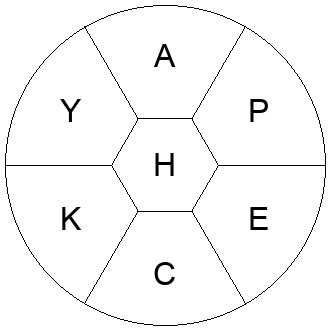
The official answers for today's puzzle are:

Click on the arrow to show the definition.
Click outside the pop-up to close it.


Number of Pangrams: 1

Maximum Puzzle Score: 79

Number of Answers: 23

Points Needed for Genius: 55

Genius requires between 9 and 21 words. You need at least a 6-letter word to reach genius. If you don't get the pangram, you need 86% of the total points to reach genius. If you get the pangram, you only need 62% of the remaining points to reach genius.

Other days with this pangram:

The button below will reveal a chart with the number of words by each letter. Red bars indicate that there is a pangram(s) starting with that letter.


How does this puzzle compare to other puzzles?

Today's score of 79 was in the 3rd percentile of all puzzles.
The last time there was a score this low was on January 30, 2026.
The highest score ever was 537 on January 22, 2021.
The lowest score ever was 47 on March 27, 2023.

This puzzle's 23 possible answers rank it in the 6th percentile of all puzzles.
The last time there were fewer answers than this was on March 24, 2026.
The highest number of answers was 81 on June 08, 2019.
The lowest number of answers was 16 on March 27, 2023.

It takes a 6-letter word for genius.
The last time this happened was on March 31, 2026.

Today's puzzle has an average word length of 4.7.
For all Bees, the average word length has been 5.3.


Haven't I seen these letters before?

Hover over a letter to see its first and most recent appearance in the Bee!


Haven't I seen these words before?

The most common words in the Bee are:

  • noon 236
  • loll 217
  • toot 213
  • nana 195
  • naan 195
  • nene 155
  • tilt 153
  • till 153
  • lilt 153
  • mamma 149
  • mama 149
  • tint 148
  • toon 143
  • onto 143
  • onion 143
  • acai 141
  • acacia 141
  • anon 132
  • anal 131
  • olio 128
  • papa 124
  • lulu 124
  • lull 124
  • baba 124
  • tact 123
  • dodo 123
  • poop 119
  • booboo 119
  • boob 119
  • moon 118
  • mono 118
  • mitt 117
  • cocci 117
  • calla 116
  • call 116
  • tartar 114
  • tart 114
  • ratatat 114
  • loon 114
  • tattoo 113
  • attar 113
  • tutu 112
  • ally 112
  • allay 112
  • momma 111
  • ammo 111
  • tatty 110
  • meme 109
  • roar 108
  • aria 108


How long are words in the Bee?

There have been 116,002 answers ever accepted in the Bee - with 10,954 unique words.
Below are the distributions of the lengths of these words.


Valid dictionary words not in today's official answers

You may be wondering why these words aren't here*:

  • apache
  • ayah
  • cachaca
  • caph
  • chachka
  • chape
  • chay
  • echappe
  • eche
  • epha
  • ephah
  • hacek
  • hackee
  • haha
  • hayey
  • heapy
  • hypha
  • hyphae
  • kaph
  • khaph
  • pacha
  • pakeha
  • pech
  • yechy

*Because the New York Times considers them obscure or offensive.

ache

Etymology 1

noun
  1. Continued dull pain, as distinguished from sudden twinges, or spasmodic pain.
verb
  1. To suffer pain; to be the source of, or be in, pain, especially continued dull pain; to be distressed.
  2. To cause someone or something to suffer pain.

Etymology 2

noun
  1. Parsley

Etymology 3

noun
  1. The name of the Latin-script letter H.

achy

adjective
  1. Suffering from aches, sore.

cache

noun
  1. A store of things that may be required in the future, which can be retrieved rapidly, protected or hidden in some way.
  2. A fast temporary storage where recently or frequently used information is stored to avoid having to reload it from a slower storage medium.
  3. (geocaching) A container containing treasure in a global treasure-hunt game.
verb
  1. To place in a cache.

chap

Etymology 1

noun
  1. (obsolete outside Britain and Australia) A man, a fellow.
  2. A customer, a buyer.
  3. A child.

Etymology 2

noun
  1. A cleft, crack, or chink, as in the surface of the earth, or in the skin.
  2. A division; a breach, as in a party.
  3. A blow; a rap.
verb
  1. Of the skin, to split or flake due to cold weather or dryness.
  2. To cause to open in slits or chinks; to split; to cause the skin of to crack or become rough.
  3. To strike, knock.

Etymology 3

noun
  1. (often in the plural) The jaw.
  2. One of the jaws or cheeks of a vice, etc.

Etymology 4

noun
  1. (authorship) One of the main sections into which the text of a book is divided.
  2. A section of a social or religious body.
  3. A sequence (of events), especially when presumed related and likely to continue.
  4. A decretal epistle.
  5. A location or compartment.

cheap

noun
  1. Trade; traffic; chaffer; chaffering.
  2. A market; marketplace.
  3. Price.
  4. A low price; a bargain.
  5. Cheapness; lowness of price; abundance of supply.
verb
  1. To trade; traffic; bargain; chaffer; ask the price of goods; cheapen goods.
  2. To bargain for; chaffer for; ask the price of; offer a price for; cheapen.
  3. To buy; purchase.
  4. To sell.
adjective
  1. Low and/or reduced in price.
  2. Of poor quality.
  3. Of little worth.
  4. (of an action or tactic in a game of skill) Underhand or unfair.
  5. Stingy; mean; excessively frugal.
  6. Trading at a price level which is low relative to historical trends, a similar asset, or (for derivatives) a theoretical value.
adverb
  1. Cheaply.

check

Etymology 1

noun
  1. A situation in which the king is directly threatened by an opposing piece.
  2. An inspection or examination.
  3. A control; a limit or stop.
  4. A mark (especially a checkmark: ✓) used as an indicator.
  5. An order to a bank to pay money to a named person or entity.
  6. A bill, particularly in a restaurant.
  7. A maneuver performed by a player to take another player out of the play.
  8. A token used instead of cash in gaming machines, or in gambling generally.
  9. A lengthwise separation through the growth rings in wood.
  10. A mark, certificate or token by which errors may be prevented, or a thing or person may be identified.
  11. The forsaking by a hawk of its proper game to follow other birds.
  12. A small chink or crack.

Etymology 2

verb
  1. To inspect; to examine.
  2. To verify the accuracy of a text or translation, usually making some corrections (proofread) or many (copyedit).
  3. (often used with "off") To mark items on a list (with a checkmark or by crossing them out) that have been chosen for keeping or removal or that have been dealt with (for example, completed or verified as correct or satisfactory).
  4. To control, limit, or halt.
  5. To verify or compare with a source of information.
  6. To leave in safekeeping.
  7. To leave with a shipping agent for shipping.
  8. To pass or bounce the ball to an opponent from behind the three-point line and have the opponent pass or bounce it back to start play.
  9. To disrupt another player with the stick or body to obtain possession of the ball or puck.
  10. To remain in a hand without betting. Only legal if no one has yet bet.
  11. To make a move which puts an adversary's king in check; to put in check.
  12. To chide, rebuke, or reprove.
  13. To slack or ease off, as a brace which is too stiffly extended.
  14. To crack or gape open, as wood in drying; or to crack in small checks, as varnish, paint, etc.
  15. To make checks or chinks in; to cause to crack.
  16. To make a stop; to pause; with at.
  17. To clash or interfere.
  18. To act as a curb or restraint.
  19. To turn, when in pursuit of proper game, and fly after other birds.

Etymology 3

noun
  1. (usually pluralized) A pattern made up of a grid of squares of alternating colors; a checkered pattern.
  2. Any fabric woven with such a pattern.
verb
  1. To mark with a check pattern.
adjective
  1. Divided into small squares by transverse, perpendicular, and horizontal lines.

cheek

noun
  1. The soft skin on each side of the face, below the eyes; the outer surface of the sides of the oral cavity.
  2. (usually in the plural) The lower part of the buttocks that is often exposed beneath very brief underwear, swimwear, or extremely short shorts.
  3. Impudence.
  4. One of the genae, flat areas on the sides of a trilobite's cephalon.
  5. One of the pieces of a machine, or of timber or stonework, that form corresponding sides or a similar pair.
  6. (in plural) The branches of a bridle bit.
  7. Either side of an axehead.
  8. The middle section of a flask, made so that it can be moved laterally, to permit the removal of the pattern from the mould.
verb
  1. To be impudent towards.
  2. To pull a horse's head back toward the saddle using the cheek strap of the bridle.

cheeky

adjective
  1. Impudent; impertinent; impertinently bold, often in a way that is regarded as endearing or amusing.
  2. (of swimwear, underwear, etc.) tending to reveal the cheeks of the buttocks.
  3. (Australian Aboriginal) Poisonous (of animals such as snakes), dangerous, cunning, violent, potent.
  4. Indulged in.

cheep

noun
  1. A short, high-pitched sound made by a small bird.
verb
  1. Of a small bird, to make short, high-pitched sounds sounding like "cheep".
  2. To express in a chirping tone.
interjection
  1. The short, high-pitched sound made by a small bird.

each

noun
  1. (operations) An individual item: the least quantitative unit in a grouping.
adverb
  1. For one; apiece; per.
pronoun
  1. Every one; every thing.

hack

Etymology 1

noun
  1. A tool for chopping.
  2. A hacking blow.
  3. A gouge or notch made by such a blow.
  4. A dry cough.
  5. A hacking; a catch in speaking; a short, broken cough.
  6. A try, an attempt.
  7. The foothold traditionally cut into the ice from which the person who throws the rock pushes off for delivery.
  8. A mattock or a miner's pickaxe.
  9. An expedient, temporary solution, such as a small patch or change to code, meant to be replaced with a more elegant solution at a later date.
  10. An interesting technical achievement, particularly in computer programming.
  11. A trick, shortcut, skill, or novelty method to increase productivity, efficiency or ease.
  12. An illegal attempt to gain access to a computer network.
  13. A video game or any computer software that has been altered from its original state.
  14. Time check.
  15. A swing of the bat at a pitched ball by the batter.
  16. A kick on the shins in football.
  17. Confinement of an officer to their stateroom as a punishment.
verb
  1. To chop or cut down in a rough manner.
  2. To cough noisily.
  3. To withstand or put up with a difficult situation.
  4. To make a quick code change to patch a computer program, often one that, while being effective, is inelegant or makes the program harder to maintain.
  5. To accomplish a difficult programming task.
  6. To work with something on an intimately technical level.
  7. (by extension) To apply a trick, shortcut, skill, or novelty method to something to increase productivity, efficiency or ease.
  8. To hack into; to gain unauthorized access to (a computer system, e.g., a website, or network) by manipulating code.
  9. (by extension) To gain unauthorised access to a computer or online account belonging to (a person or organisation).
  10. To strike an opponent's leg with one's hockey stick.
  11. To make a flailing attempt to hit the puck with a hockey stick.
  12. To swing at a pitched ball.
  13. (soccer and rugby) To kick (a player) on the shins.
  14. To strike in a frantic movement.
  15. To strike lightly as part of tapotement massage.

Etymology 2

noun
  1. A board which the falcon's food is placed on; used by extension for the state of partial freedom in which they are kept before being trained.
  2. A food-rack for cattle.
  3. A rack used to dry something, such as bricks, fish, or cheese.
  4. A grating in a mill race.
verb
  1. To lay (bricks) on a rack to dry.
  2. To keep (young hawks) in a state of partial freedom, before they are trained.

Etymology 3

noun
  1. A horse for hire, especially one which is old and tired.
  2. A person, often a journalist, hired to do routine work.
  3. Someone who is available for hire; hireling, mercenary.
  4. A taxicab (hackney cab) driver.
  5. A vehicle let for hire; originally, a hackney coach, now typically a taxicab.
  6. A hearse.
  7. (authorship) An untalented writer.
  8. One who is professionally successful despite producing mediocre work. (Usually applied to persons in a creative field.)
  9. A talented writer-for-hire, paid to put others' thoughts into felicitous language.
  10. A political agitator. (slightly derogatory)
  11. A writer who hires himself out for any sort of literary work; an overworked man; a drudge.
  12. A procuress.
verb
  1. To make common or cliched; to vulgarise.
  2. To ride a horse at a regular pace; to ride on a road (as opposed to riding cross-country etc.).
  3. To be exposed or offered or to common use for hire; to turn prostitute.
  4. To live the life of a drudge or hack.
  5. To use as a hack; to let out for hire.
  6. To use frequently and indiscriminately, so as to render trite and commonplace.

Etymology 4

noun
  1. A small ball usually made of woven cotton or suede and filled with rice, sand or some other filler, for use in hackeysack.
verb
  1. To play hackeysack.

hake

Etymology 1

noun
  1. A hook; a pot-hook.
  2. A kind of weapon; a pike.
  3. (in the plural) The draught-irons of a plough.

Etymology 2

noun
  1. One of several species of marine gadoid fishes, of the genera Phycis, Merluccius, and allies.

Etymology 3

noun
  1. A drying shed, as for unburned tile.

Etymology 4

verb
  1. To loiter; to sneak.

happy

noun
  1. A happy event, thing, person, etc.
noun
  1. Preceded by the: happy people as a group.
verb
  1. Often followed by up: to become happy; to brighten up, to cheer up.
  2. Often followed by up: to make happy; to brighten, to cheer, to enliven.
adjective
  1. Having a feeling arising from a consciousness of well-being or of enjoyment; enjoying good of any kind, such as comfort, peace, or tranquillity; blissful, contented, joyous.
  2. Experiencing the effect of favourable fortune; favored by fortune or luck; fortunate, lucky, propitious.
  3. Content, satisfied (with or to do something); having no objection (to something).
  4. (Of acts, speech, etc.) Appropriate, apt, felicitous.
  5. (in combination) Favoring or inclined to use.
  6. (of people, often followed by "at" or "in") Dexterous, ready, skilful.

heap

noun
  1. A crowd; a throng; a multitude or great number of people.
  2. A pile or mass; a collection of things laid in a body, or thrown together so as to form an elevation.
  3. A great number or large quantity of things.
  4. A data structure consisting of trees in which each node is greater than all its children.
  5. Memory that is dynamically allocated.
  6. A dilapidated place or vehicle.
  7. A lot, a large amount
verb
  1. To pile in a heap.
  2. To form or round into a heap, as in measuring.
  3. To supply in great quantity.
adverb
  1. (representing broken English stereotypically or comically attributed to Native Americans; may be offensive) Very.

heck

Etymology 1

noun
  1. Hell.
interjection
  1. Hell.

Etymology 2

noun
  1. The bolt or latch of a door.
  2. A rack for cattle to feed at.
  3. A door, especially one partly of latticework.
  4. A latticework contrivance for catching fish.
  5. An apparatus for separating the threads of warps into sets, as they are wound upon the reel from the bobbins, in a warping machine.
  6. A bend or winding of a stream.

hype

Etymology 1

noun
  1. Promotion or propaganda; especially exaggerated claims.
verb
  1. To promote heavily; to advertise or build up.

Etymology 2

adjective
  1. Hyped.
  2. Excellent, cool.

Etymology 3

noun
  1. A drug addict.

Etymology 4

noun
  1. A throw in which the wrestler lifts his opponent from the ground, swings him to one side, knocks up his nearer thigh from the back with the knee, and throws him on his back.
verb
  1. To throw (an opponent) using this technique.

paycheck

noun
  1. Money received on payday as payment for work performed.

peach

Etymology 1

noun
  1. A tree (Prunus persica), native to China and now widely cultivated throughout temperate regions, having pink flowers and edible fruit.
  2. The soft juicy stone fruit of the peach tree, having yellow flesh, downy, red-tinted yellow skin, and a deeply sculptured pit or stone containing a single seed.
  3. A light moderate to strong yellowish pink to light orange color.
  4. A particularly admirable or pleasing person or thing.
adjective
  1. Of or pertaining to the color peach.
  2. Particularly pleasing or agreeable.

Etymology 2

verb
  1. To inform on someone; turn informer.
  2. To inform against.

Etymology 3

noun
  1. A particular rock found in tin mines, sometimes associated with chlorite.

peachy

adjective
  1. Resembling a peach, peach-like.
  2. Very good, excellent.

yeah

Etymology 1

interjection
  1. Expressing joy, celebration, glee, etc.

Etymology 2

noun
  1. A solar year, the time it takes the Earth to complete one revolution of the Sun (between 365.24 and 365.26 days depending on the point of reference).
  2. (by extension) The time it takes for any astronomical object (such as a planet, dwarf planet, small Solar System body, or comet) in direct orbit around a star (such as the Sun) to make one revolution around the star.
  3. A period between set dates that mark a year, from January 1 to December 31 by the Gregorian calendar, from Tishiri 1 to Elul 29 by the Jewish calendar, and from Muharram 1 to Dhu al-Hijjah 29 or 30 by the Islamic calendar.
  4. A scheduled part of a calendar year spent in a specific activity.
  5. A Julian year, exactly 365.25 days, represented by "a".
  6. A level or grade in school or college.
  7. The proportion of a creature's lifespan equivalent to one year of an average human lifespan (see also dog year).

yecch

noun
  1. An exclamation of disgust.
interjection
  1. An exclamation of disgust.

yech

noun
  1. An exclamation of disgust.
interjection
  1. An exclamation of disgust.

haka

noun
  1. A group dance of New Zealand's Maori people featuring rhythmic chanting, vigorous facial and arm movements, and foot stamping. Traditionally a war dance, today it is also performed to welcome guests, as a mark of respect at occasions such as commemorations and funerals, as a challenge to opposing teams at sports events, and for artistic purposes.
verb
  1. To perform the haka.